

Fate/stay night Realta Nua: understanding the versions and the meaning of Its multiple openings

Fate/stay night Realta Nua becomes a puzzle the moment one tries to understand its different versions. The information is there but scattered across platforms, routes, and successive reinterpretations. This article brings these elements together to explain why Realta Nua multiplied its animated openings, and what this choice reveals about how the game is transmitted, accessed, and read over time.
Table of contents
As mentioned earlier, navigating the various Fate/stay night Realta Nua versions is genuinely difficult. Not because of a lack of documentation, but because that information is fragmented.
Between platforms, narrative routes, openings, production studios, and successive reworkings, Realta Nua has become a historically complex object to read. Everything is documented; yet rarely connected. Everything exists but rarely in the same place.
This dispersion is precisely what makes the work worth documenting. Realta Nua is not merely another iteration of Fate/stay night. It represents a specific moment in the trajectory of the franchise: the point at which the work begins to reformulate itself in order to continue being transmitted.
The shift from PC to console, the removal of certain elements, the addition of others, and the introduction of animated openings all mark a clear transition. The work no longer presents itself solely as a text to be read, but as an experience to be entered. An experience I aim here to help you approach with clarity.
What Realta Nua actually is
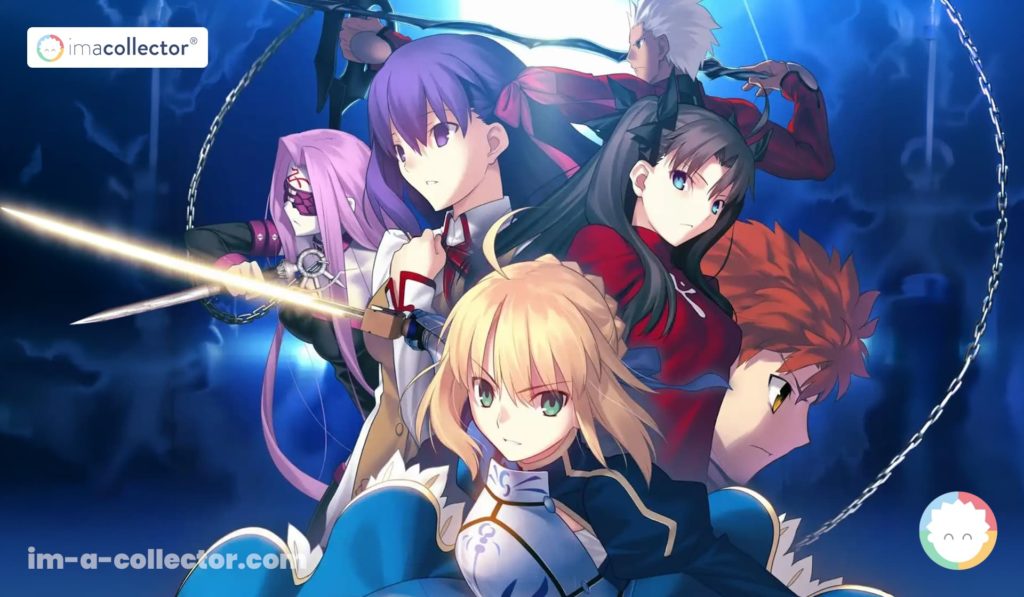
Originally, Fate/stay night is a dense, lengthy, demanding visual novel. It requires immediate engagement from the reader, acceptance of its pacing, and a willingness to push through a challenging entry into its universe. I personally came to it relatively late, through a French translation of the original visual novel, and spent countless hours immersed in it.
It is important to understand that Realta Nua does not alter this narrative structure. What it changes is access. The removal of erotic scenes, the addition of full voice acting, presentation adjustments, and adaptation for console platforms do not transform the substance of the game. They shift the threshold of entry.
Realta Nua does not seek to simplify Fate/stay night: it seeks to make it readable for a broader audience, one accustomed to narratives where image and sound actively guide perception.
It is within this precise context that the animated openings appear.
Not as cosmetic additions, but as a formal response to a work that had become increasingly difficult to approach without mediation.
Why multiple openings exist
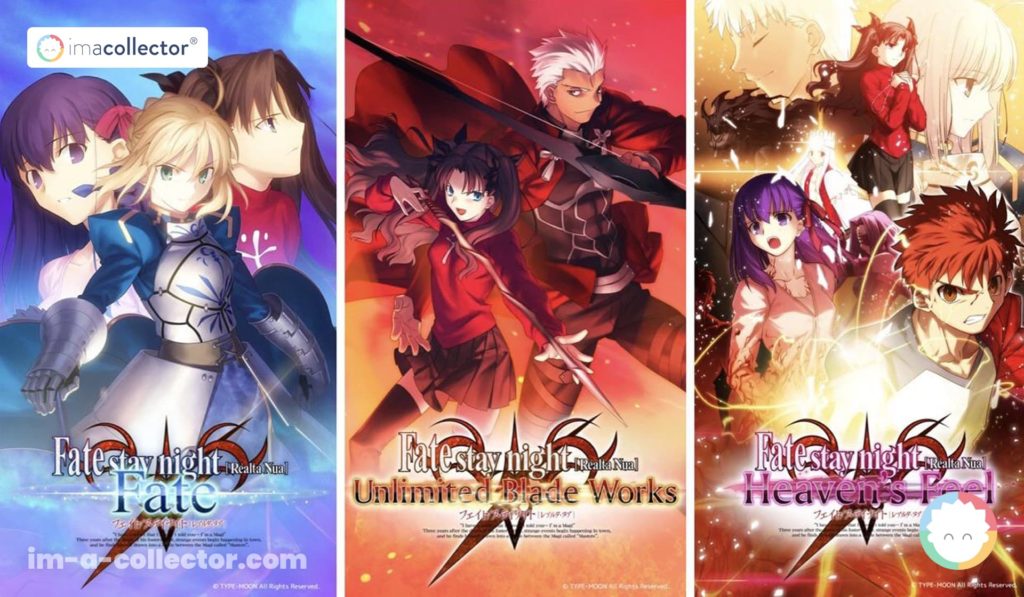
The core point of Realta Nua is not the presence of an animated opening, but the fact that there are three. This choice is directly tied to the game’s structure. The Fate, Unlimited Blade Works, and Heaven’s Feel routes are not variations of the same story.
They are three complete trajectories, three distinct ways of asking the same questions, three readings that become incompatible if one attempts to reduce them into a single synthesis. I know this firsthand: I completed the Fate route without even being aware that these alternative narratives existed, and finished Heaven’s Feel without realizing that this route itself had two different endings.
As a result, a single opening would have imposed a dominant perspective at the expense of the others. Multiplying the openings makes this plurality immediately visible.
From the outset, the game signals that the experience will not be linear, that it cannot be summarized through a single axis, a single promise, or a single emotional register.
Routes and emotional orientation
The openings of Realta Nua do not tell the story. They explain nothing about stakes, do not introduce characters, and do not reveal future events.
Their function lies elsewhere. They operate as emotional thresholds. Before reading a single line of text, the player is placed into a specific state of mind.
Each opening prepares a way of reading the route it introduces, without explicitly commenting on it. This shift is crucial.
Where the original Fate/stay night required readers to gradually construct their relationship with the work, Realta Nuaoffers an initial orientation. It does not guide: it positions.
That is why the openings do not say what will happen; they suggest how it will be experienced.
PS2 and PS Vita: two visual readings
The logic of the openings differs depending on the platform.
On PS2, Realta Nua introduces the first animated openings of Fate/stay night, produced by Studio Deen / Tatsunoko. Their staging is relatively restrained, sometimes illustrative. Their primary role is to provide a first visual form to a work that was previously almost entirely textual.
On PS Vita, the approach changes significantly. The openings are fully reworked by ufotable. The connection to the animated adaptations becomes explicit. Direction gains in dynamism, visual density, symbolism, and production quality.
This imbues entry into the work with a new sense of prestige without altering the game’s structure itself.
This is not a strict qualitative progression, but rather two visual readings anchored in their respective eras and platforms.
Each sheds light on Realta Nua from a different angle.
And the PC versions?
PC versions of Realta Nua reuse these openings depending on editions and available updates. They do not introduce a new logic, but they contribute to the current fragmentation of sources.
This fragmentation explains many recurring confusions, particularly regarding differences between platforms or the difficulty of locating certain openings depending on the version.
Summary overview
On PS2
All three routes are available
Each opening is produced by Studio Deen / Tatsunoko. Their role is straightforward: visual gateways into the visual novel
Scénario Fate : article disponible ici
Scénario Unlimited Blade Works (UBW) : article disponible ici
Scénario Heaven’s Feel : article disponible ici
On PS Vita
All three routes are again available
Each opening is produced by ufotable. Their function is more complex: a modern reinterpretation and continuity with the animated series, featuring more fluid and dynamic animation
Scénario Fate : article disponible ici
Scénario Unlimited Blade Works (UBW) : article disponible ici
Scénario Heaven’s Feel : article disponible ici
On PC
Still three routes. Openings vary depending on edition and updates. A full article on PC variations may follow in the future, depending on available time.
What these openings truly reveal
Wikis catalog versions and list differences. What they rarely address is what this multiplication reveals about the work itself.
The openings of Realta Nua do not aim to summarize Fate/stay night. They signal that the work cannot be approached from a single point of view. They materialize a plurality of readings that was already present, but previously implicit.
Documenting Realta Nua is not about stacking data or comparing editions.
It is about understanding how a work reformulates itself to continue existing, how it is transmitted through changing forms, and how those transformations themselves become meaningful.
Conclusion
Fate/stay night Realta Nua does not change the story of Fate/stay night. It changes access to it.
The multiplication of openings is not meant to impress, but to make visible a fundamentally varied and plural structure.
Three routes, three openings, not to multiply effects, but to respect the diversity of perspectives the work offers.
This is precisely where Realta Nua finds its singularity: in how it transforms the transmission of a narrative without altering its nature.
Article produced by imacollector® — an editorial archive dedicated to the memory and heritage of Japanese pop culture.
Content published for informational and documentary purposes. All rights reserved to the respective rights holders.