

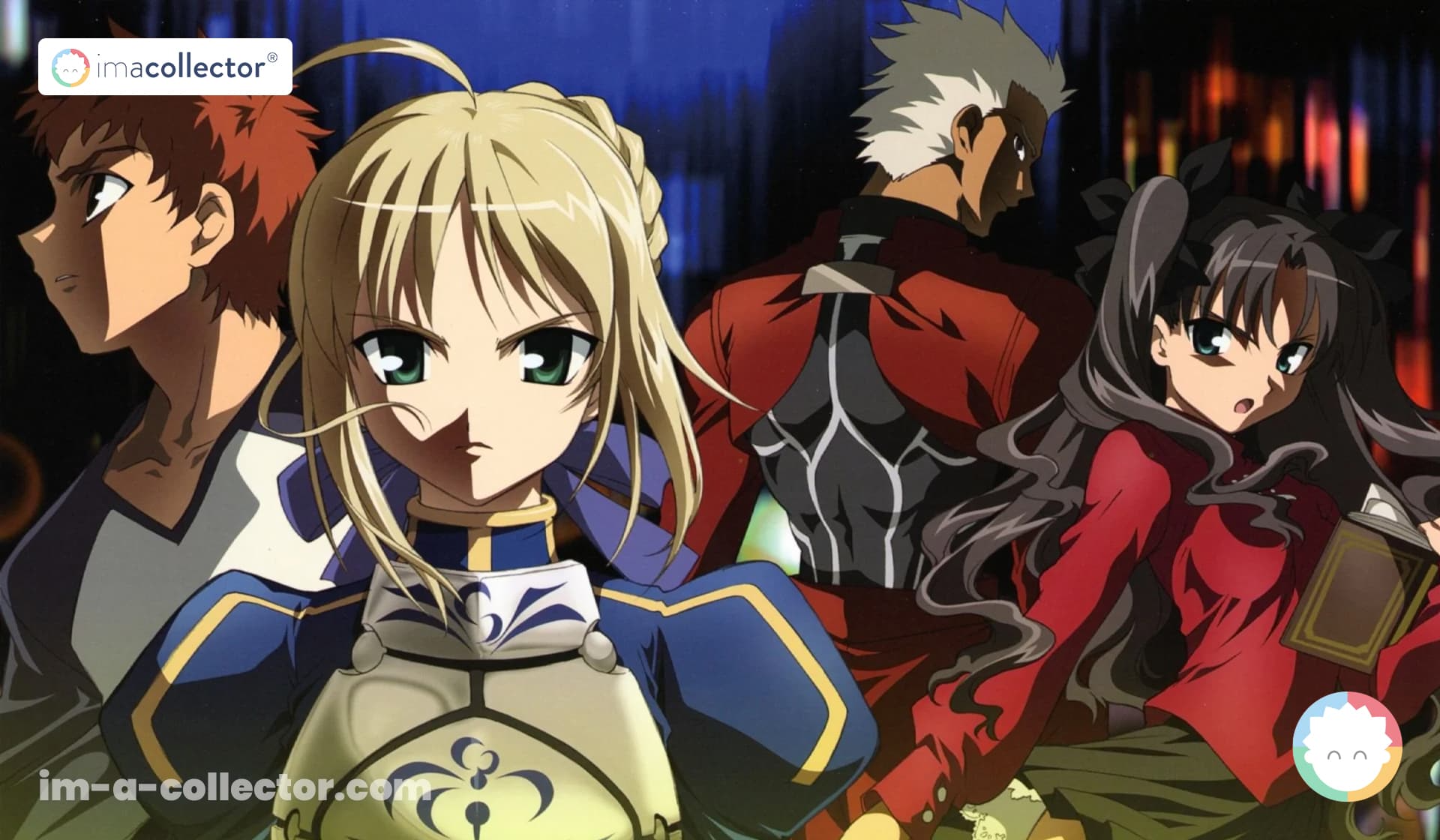
[analysis] Fate/stay night: the universe that chose me before I understood it – series (1/12)

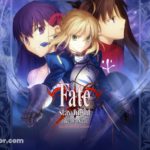
Fate/stay night is a universe you do not understand immediately, yet one that imposes itself even before you truly grasp it. Behind its many versions, routes, and adaptations lies a work of remarkable coherence, depth, and lasting impact. This article is a personal essay that attempts to understand why Fate/stay night remains, even today, one of the most powerful and formative universes I have ever experienced.
Sommaire
- Discovering Fate/stay night: encountering the anime before the universe
- Rider: the character who made me love the Fate universe
- From origins to visual novel: understanding Fate/stay night and its three routes
- The shock of the original 2004 version
- What fans say in retrospect
- Fate, Unlimited Blade Works, Heaven’s Feel: three scenarios, three readings
- Shirou Emiya: altruism as a breaking point
- Sakura Matō and Heaven’s Feel: understanding too late
- Gilgamesh, Kirei, Zōken: why Fate’s monsters remain unforgettable
- Fate/stay night Realta Nua: changing access without betraying the work
- Why Fate/stay night marked me for life
- After Fate/stay night: when Fate truly begins with Fate/Zero
Discovering Fate/stay night: encountering the anime before the universe
I discovered the 2006 anime adaptation produced by Studio Deen almost by accident. At the time, I watched it twice in a row. It was not obsession but it was more than simple fascination.
To understand that moment, some context is necessary. The franchise that had shaped my childhood, Saint Seiya, was no longer at its peak. I had grown up with it, but it no longer offered renewal.
I needed something new. An universe capable of surprising me differently. A modern mythology, less linear, more ambiguous, and above all, less binary in its moral structure.
Fate/stay night arrived at precisely that moment. The Holy Grail War. Mythological heroes summoned into a contemporary setting. Complex rules never fully explained. Constant gray areas. It felt denser than it appeared at first glance.
The characters were charismatic: sometimes immediately compelling, sometimes deeply unsettling. It was not a comfortable world, but it was a new one.
Most importantly, it was unlike anything I had known before. I did not yet understand that this anime was only an imperfect gateway to something far larger. But I could already sense that it contained a depth the adaptation only hinted at.
Rider: the character who made me love the Fate universe
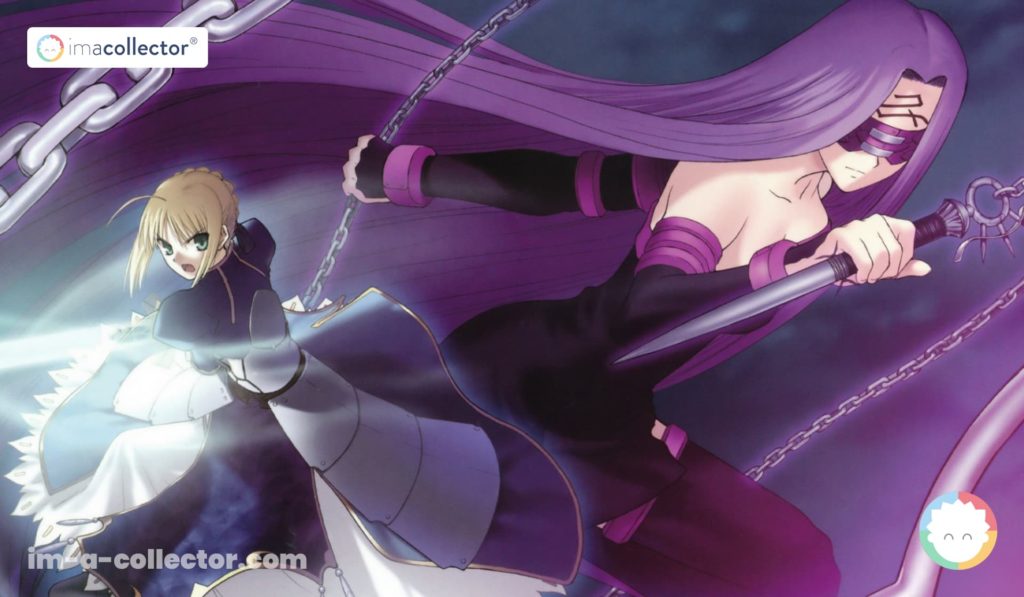
Before I truly understood Fate, one character imposed herself: Rider.
From her first appearance, without exposition, without dramatic emphasis, she left an impression.
First visually. Her chains, her slender silhouette, her obvious beauty that never feels ostentatious. Then through her presence. There was an almost melancholic grace to her, and above all a restrained, silent strength, as if something immense were deliberately being held back.
Rider never tries to exist. She simply is. And that is enough.
Looking back, I understand why she moved me so early. Rider is perceived before she is understood. And Fate often works this way.
She was the trigger. Without her, I might never have explored the universe further — and certainly not tried to understand it.
From origins to visual novel: understanding Fate/stay night and its three routes
After finishing the anime, my curiosity naturally deepened. I learned that Fate/stay night originally began as a visual novel released in 2004: the first commercial game from Type-Moon.
At the time, Type-Moon was not yet the giant it would become. The studio was emerging from the success of Tsukihime, initially released as a doujin game.
Fate/stay night marked a turning point: more ambitious, longer (between fifty and seventy hours depending on the route), and conceived from the start as a foundation for an entire universe.
Released on PC, it reflected early-2000s Japanese visual novel conventions: heavy text, minimal animation, demanding narration, and total reader involvement.
I found an English translation, then a French one, which I managed to install on my Nintendo DS at the time.
From there, I plunged into the game without a guide, without a roadmap, without fully understanding what I was entering.
I did not even know the game contained three distinct scenarios: Fate, Unlimited Blade Works, and Heaven’s Feel. Nor did I know they were locked in a specific order designed by Kinoko Nasu.
The shock of the original 2004 version
When I launched the 2004 visual novel, I did not expect something so harsh. I did not even know it was originally an eroge. Naively, I assumed the explicit versions I had seen were fan art.
I had not anticipated the role certain scenes would play, nor their tone.
Some sequences were crude. At times awkwardly written. And deeply disturbing in what they revealed about the violence of the Fate universe.
These scenes did not exist merely to provoke. They contributed to a harsher vision of the world where bodies, domination, and suffering were never fully aestheticized. At the time, it unsettled me. I did not expect Fate to go that far, that directly.
With hindsight, I understand what the original version revealed: a rougher universe. Imperfect. Sometimes excessive. But always coherent with what it was already suggesting beneath the surface.
Fate/stay night was not designed to reassure. It was already testing its limits and those of its audience. Later, the Réalta Nua version would smooth that access, without completely erasing the original discomfort.
What fans say in retrospect
Over time, I also became aware of how long-time fans view the 2004 version. One point often returns: even among dedicated fans, the erotic scenes are widely considered the weakest aspect of the work.
Indeed, they are often described as awkward, poorly written, occasionally embarrassing — and rarely defended for narrative quality.
Yet very few fans call them pointless.
Many acknowledge that they contribute to the universe’s rawness, reinforcing the impression of a cruel, unidealized world where physical and psychological violence are never entirely softened.
This discourse becomes especially visible when discussing Heaven’s Feel, where these scenes amplify the sense of unease, loss of control, and psychological deterioration (coincidentally the route I had unknowingly entered first).
That may be why Realta Nua is now overwhelmingly recommended for newcomers.
It is not seen as censorship, but as editorial reframing: full voice acting, script refinements, new music, an added epilogue, and the removal of scenes considered more awkward than essential.
In retrospect, many believe Fate became what it is despite those early excesses and that this evolution is part of its trajectory.
Fate, Unlimited Blade Works, Heaven’s Feel: three scenarios, three readings
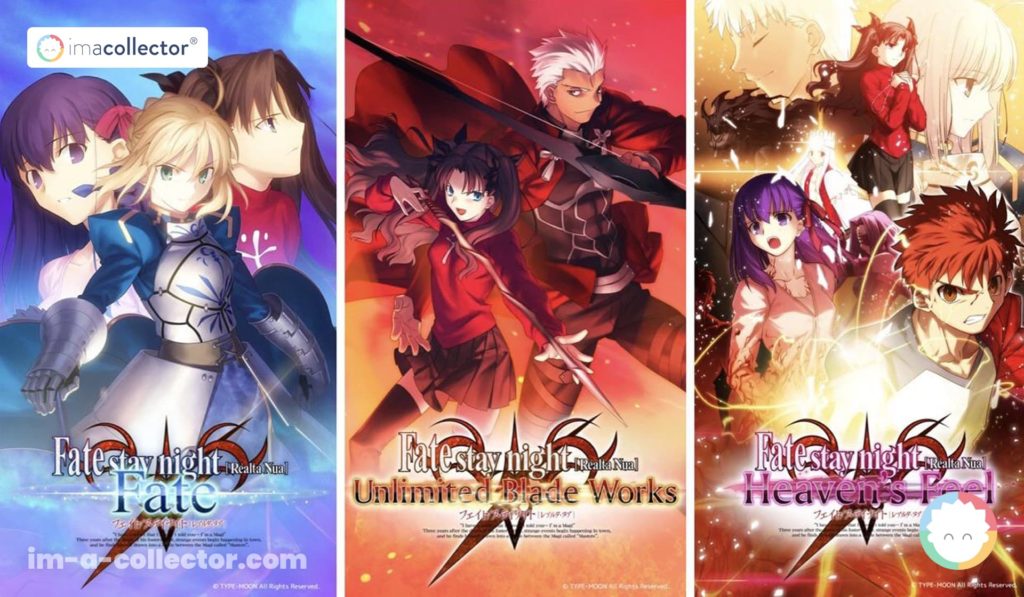
The Fate route serves as an introduction to the world, its rules, and Shirou’s ideals. Unlimited Blade Works gradually deconstructs what once seemed established, while Heaven’s Feel functions as a radical conclusion—darker, more intimate, and at times unsettling.
The game does not allow free route selection. It forces perspective shifts. It insists that Fate’s truth is always partial.
I progressed through my choices, avoiding bad endings as best I could, punished by the infamous Tiger Dojo sequences, absurd interludes reminding the player that Fate is fully aware of its structure. Dojos that drive you mad, because you never truly know when you made the “wrong” choice.
I eventually completed Heaven’s Feel; unaware that it contained two distinct endings. I first obtained the so-called “normal” ending, deeply tragic, before returning years later to unlock the true ending.
This dual conclusion is not anecdotal. It perfectly reflects Heaven’s Feel’s core.
Depending on Shirou’s choices, the story shifts either toward a desperate compromise or toward a more luminous resolution, yet one that is always costly.
The game never tells you which path is correct. It leaves you with your choices.
Shirou Emiya: altruism as a breaking point
Shirou Emiya is a character who has often made me uncomfortable. His constant empathy, his obsessive need to help others, and his inability to protect himself have sometimes irritated me. His kindness toward Shinji, in particular, has always unsettled me.
I disagreed with him. I would not have acted the same.
And yet, when he devotes himself entirely to saving Saber, Rin, or Sakura (when he chooses to break himself rather than betray his ideals), it becomes impossible to remain indifferent.
Shirou is consistent to the point of excess, and Fate never tries to make that comfortable.
It asks a simple, brutal question: how far are you willing to go to remain faithful to your ideals?
Sakura Matō and Heaven’s Feel: understanding too late
Sakura Matō was a character I did not immediately understand. The visual novel forced me to reconsider her silences and to look into her eyes differently.
Heaven’s Feel revealed the depth of sadness and despair tied to the abuse she endured under Zōken Matō.
Zōken is not a simple antagonist. He embodies an intimate, repeated horror. Fate never looks away from what he represents.
Gilgamesh, Kirei, Zōken: why Fate’s monsters remain unforgettable
If one character is widely praised, it is Gilgamesh: imposing himself early through arrogance, contempt, and overwhelming charisma.
Only later, through Fate/Zero, did I understand his near-symbiotic relationship with Kirei Kotomine.
Kirei is disturbing because he is coherent from the start, without compromise.
Zōken, for his part, is beyond redemption, and Fate/Zero only reinforces the horror he embodies.
Fate taught me something essential: a character can be fascinating without being excusable. It is an uncomfortable lesson — but a valuable one.
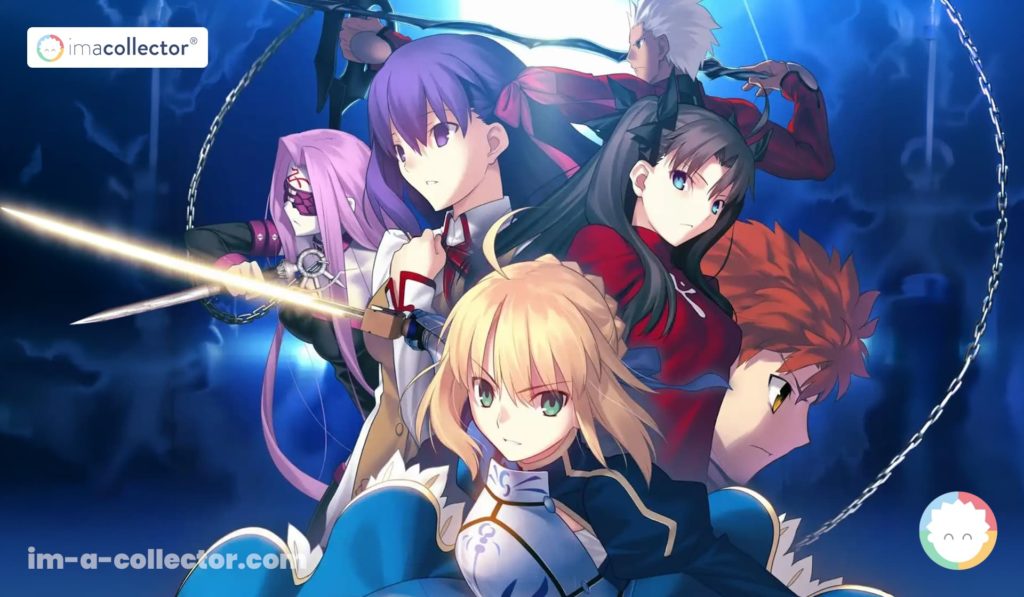
Fate/stay night Realta Nua: changing access without betraying the work
My journey did not end with the original visual novel. I discovered Fate/stay night Réalta Nua upon its 2007 PlayStation 2 release, though I never played it directly due to the language barrier.
It is worth noting that Realta Nua is not a simple re-release. It is a genuine editorial reformulation of Fate. The removal of the erotic scenes, the addition of full voice acting, and the visual and musical revisions all point to a clear intention: to open the work up to a broader audience.
I later experienced it through ufotable’s opening sequences on YouTube. These are not mere openings. They function as emotional thresholds, setting the tone for each route. They make visible what the visual novel left implicit: each route is an emotional reading. Each path is valid. None is total.
(see my article on the Realta Nua openings)
Why Fate/stay night marked me for life
Fate/stay night marked me because it accomplished something rare: creating strong, coherent, deeply human characters defined by their contradictions.
We encounter them differently depending on the route. Their ideals remain constant. Their trajectories diverge.
And ultimately, that mirrors real life. Our choices alter our paths but rarely what we fundamentally are.
Fate/stay night is not simply a work I loved. It is a universe that has accompanied me for over twenty years and continues to do so.
After Fate/stay night: when Fate truly begins with Fate/Zero
Fate/stay night is the foundation. A first path.
In 2010, Fate/stay night: Unlimited Blade Works offered another arc. If this article resonated with you, you might also appreciate my reflection on that film Fate/stay night: Unlimited Blade Works (2010) – What everyone missed in this film… even me
And what I did not know at the time was that before Shirou, there was Kiritsugu. Before the Fifth War, there had been another.
Fate/Zero asks a far more brutal question: what happens when ideals no longer save anyone?
That is where the continuation truly begins.
Article produced by imacollector® — an editorial archive dedicated to the memory and heritage of Japanese pop culture.
Content published for informational and documentary purposes. All rights reserved to the respective rights holders.