

Over time, I lost much of my attraction to ecchi and hentai figures. Some now strike me as too vulgar, many as not well made enough, and others simply matter less to me than they once did. G-Taste, though, stayed with me. It is not some embarrassing old memory to hide away, but a work that fixed something lasting in my imagination, in my collection, and in my memory. That may be exactly why it deserves a closer look today.
Table of contents
Why G-Taste was never just another series in my journey
G-Taste is an erotic manga by Hiroki Yagami, published in Japan from 1996 to 2004, then adapted into several OVAs between 1999 and 2003, with an additional episode released in 2010. The series is built around a succession of short scenes centered on different female characters, conceived less as long-form heroines than as figures of fantasy and fascination.
Put that way, the series could easily be filed away under the broad production zones of ecchi or hentai. The kind of work that often ages badly, or gets reduced to nothing but its erotic or fetish appeal. But for me, G-Taste was never a passing curiosity. It holds a distinct place in my life as a collector.
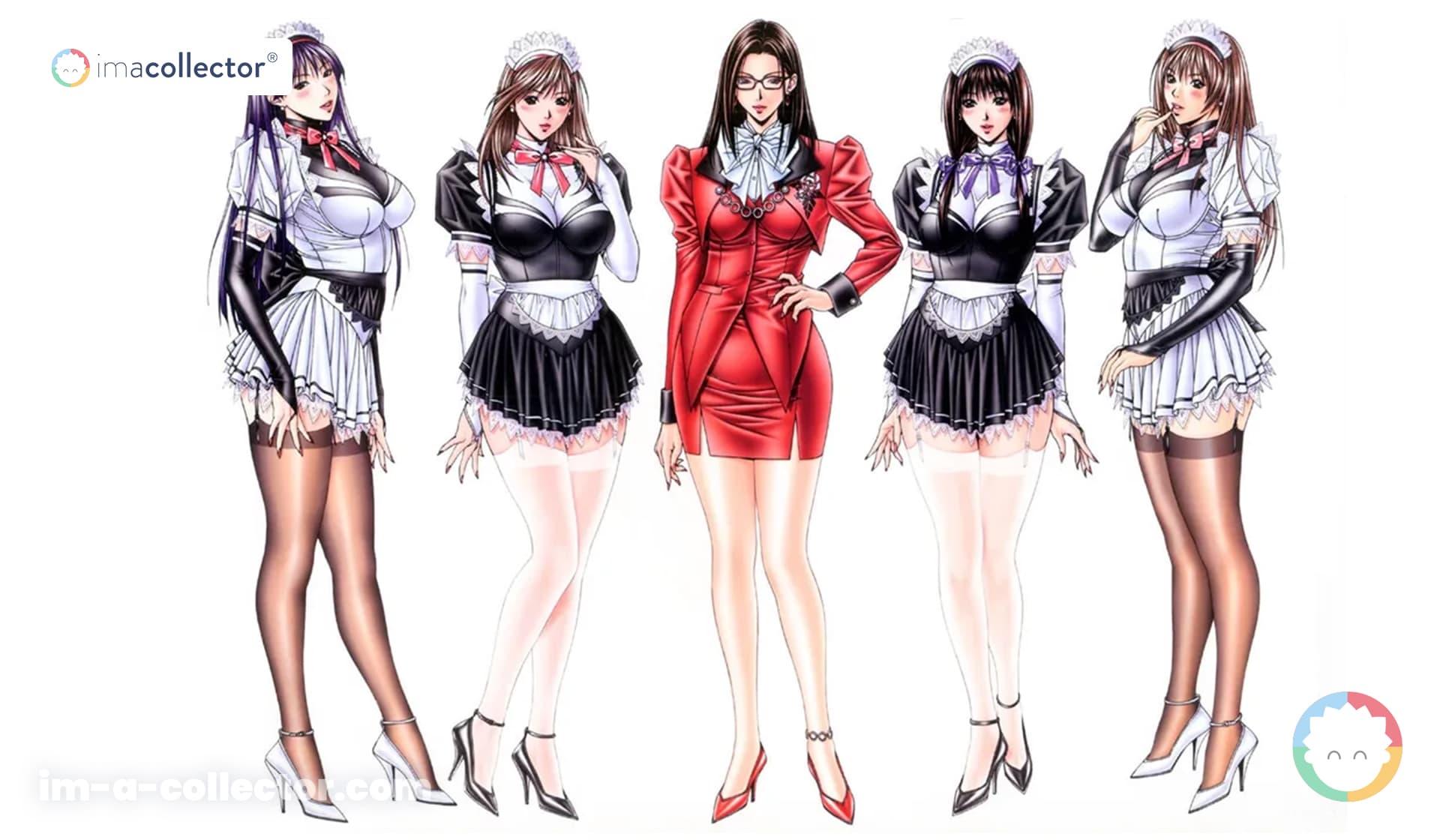
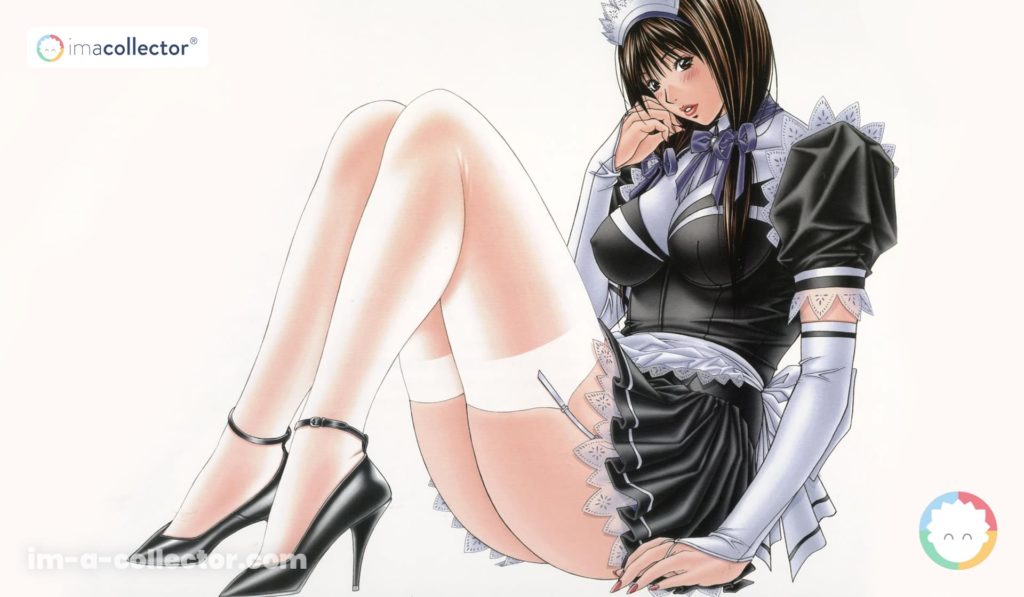
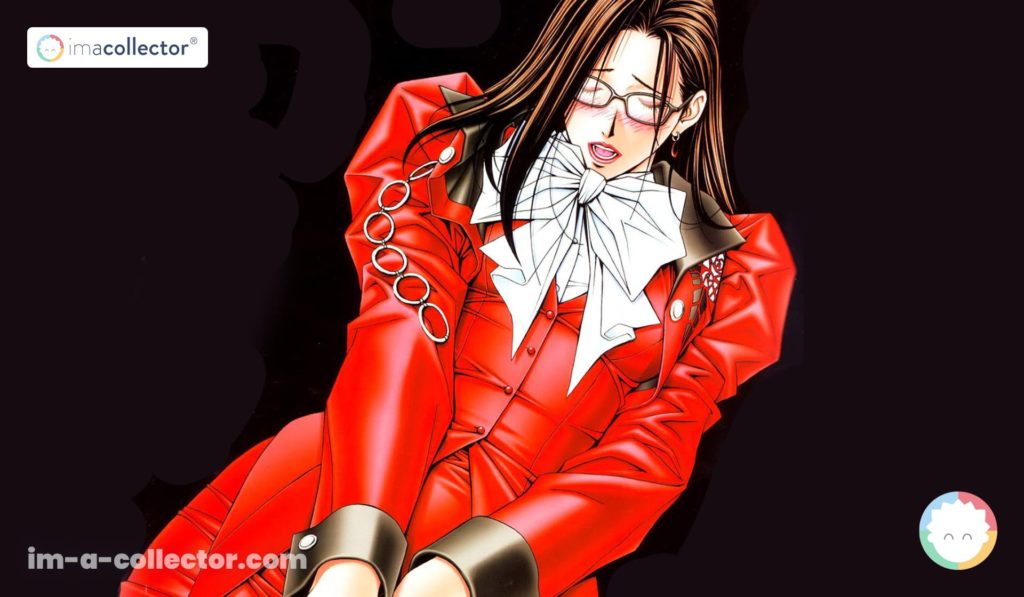
That remains true even though I never read the manga. I did watch the OVAs, but they left far less of an impression on me than the illustrations or the figures. What I loved most in G-Taste was the visual world itself: the artist’s style, the way certain characters were framed in the image, and a kind of eroticism carried as much by the linework as by imagery that could still be fully explicit.
What G-Taste fixed early on in my imagination
My attachment to two very specific characters, Moe Yagisawa and Mai Kannazuki, is what gave G-Taste a place of its own in my collection.
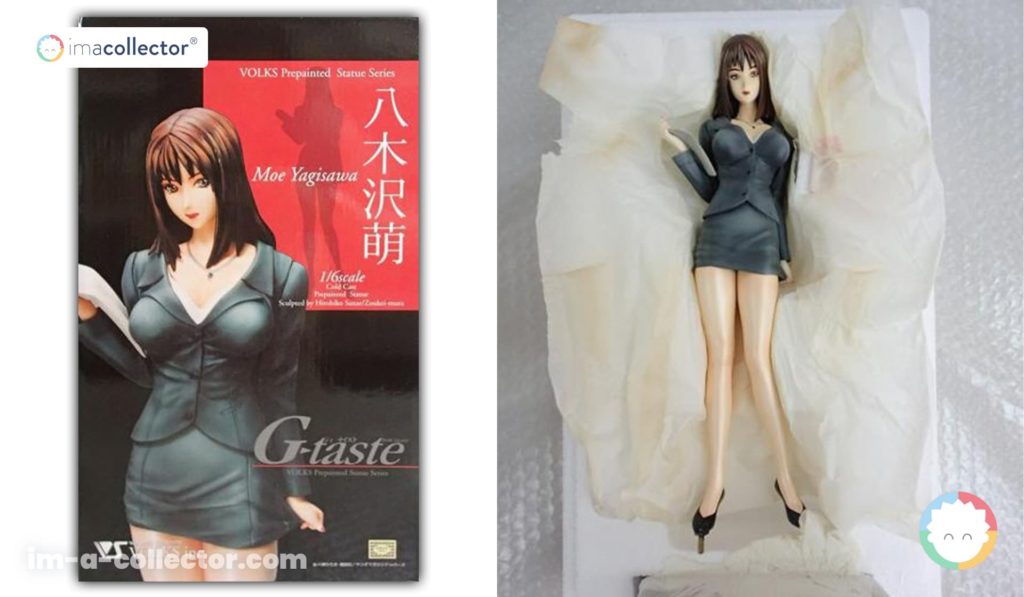
Moe Yagisawa came first, for what she represented to me: pure fantasy, an instantly memorable silhouette, an outfit that on its own captured part of what drew me to the series. Her importance does not come down only to male desire or to a passing taste for eroticism. It also lies in the way Hiroki Yagami could turn a character into a powerful presence, almost an icon of feminine sensuality.
Mai Kannazuki embodied something else. Less fantasy than commanding femininity, presence, and poise. Again, it is no accident that she remained important to me. In my memory, G-Taste was never built on a blur of interchangeable characters. On the contrary, some figures stood apart with unusual sharpness, to the point that I still remember their names and designs years later.
This work caught me because, for me, it could create not just scenes, but presences. Characters I could never quite forget, even when I started questioning certain pieces in my collection.
When memory becomes a collection
What also sets G-Taste apart from a mere memory is that it eventually entered my collection in a literal, physical way.
J’ai tous les gashapons, toutes les PVC, quasiment toutes les résines de la série, sans oublier de nombreux cellulos. À partir d’un certain point, je pense qu’on ne plus seulement parler d’une œuvre que j’ai aimée, on peut largement confirmer qu’il s’agit d’une mémoire que j’ai réussi à matérialiser.
Some pieces capture that attachment especially well. One example is the prepainted VOLKS 1/6 Yagisawa Moe resin figure released in 2001, which also exists as a resin kit version.
Then there are all the pieces tied to Mai Kannazuki, which are much harder to find. Exactly the kind of objects that end up mattering more because of the time, effort, and commitment they demanded.
That is probably where G-Taste finally separated itself from other series: it did not remain at the stage of fantasy or viewing. It became part of my collection. And a collection does not carry the same weight as a simple memory. It reveals attachment. It gives that attachment weight, and a form of proof over time.
Putting G-Taste back into context
G-Taste is not extraordinary in every respect either. It belongs to a specific moment in my own history, and in a broader cultural one: that of late-1990s and early-2000s erotic manga shaped by female archetypes, short scenes, and a visual setup centered on observation and fantasy. The series has often been described as a chain of vignettes in which male involvement is almost nonexistent, reinforcing that sense of voyeurism. And to be clear, narrative was never the work’s strong point.
That is worth stating clearly. G-Taste is not a profound work. Nor is it a series one must revisit at all costs in the name of some forgotten intrinsic greatness. Its interest lies elsewhere.
It lies in the quality of the artwork, and in the precision with which Hiroki Yagami could create a desirable image without always slipping into blunt vulgarity. It also lies in the place the series occupies within a period when this kind of world held a more visible place in the otaku imagination. A time when it was difficult to find something that felt neither too restrained nor too crude.
From that perspective, the OVAs feel well below the mark. They exist, and they are part of the license’s history, but they never managed to bring to the screen what made G-Taste truly distinctive. What stayed with me was not the animation. It was the drawing, the visual finish, and the author’s distinctly singular style.

When tastes change, but memory remains
Over time, my relationship with what I would call more provocative figures changed. I do not know whether that comes from maturity, from a broader shift in my collection, or simply from a kind of visual fatigue. But little by little, many pieces that once would have drawn me in stopped doing so.
Some now felt too vulgar. Others, on the contrary, no longer seemed well made enough. The attraction receded gradually. An emotional withdrawal I cannot fully explain.
G-Taste, however, did not undergo that same emotional erosion.
Perhaps because it was the first series of that kind I truly watched. Perhaps also because it set, very early on, a threshold of quality, drawing, and presence that many others never reached for me. Where much of that universe gradually dissolved, G-Taste kept that little extra something. A way of remaining on the right side of my memories.
That, in the end, is probably what I am trying to say in this article: you can lose your taste for something without losing every work that once passed through it. Some remain because they mattered more, and with greater accuracy, than others. Not necessarily because they were better, but because they left a deeper mark.
To close
I simply note that within one area of Japanese pop culture that many people would rather caricature, or ignore altogether, some works still left traces behind. Traces of taste, of fantasy, but also of collecting.
G-Taste belongs to that category.
Because yes, tastes change. Collections evolve. Memories shape us. But sometimes a series remains, along with a few characters and a few objects that survive the sorting process of time. And that persistence often says more about a work than the words we try to place on it years later.



![Key visual for the official B4 reproduction from the 1st anniversary of Fate/Zero [Next Encounter], featuring Saber, Lancer, Archer, Rider, Berserker, Assassin, and a Master.](https://im-a-collector.com/wp-content/uploads/2026/04/collection-imacollector-fate-zero-reproduction-next-encounter-cover-OK-440x440.jpg "[wanted] Fate/Zero – Fate/stay night: official B4 reproduction for the 1st anniversary of Next Encounter")