Attack on Titan: how do we come to believe the other must disappear?

Attack on Titan depicts a world that learns to hate. A look at propaganda, fear, memory and the mechanisms that gradually make the disappearance of the other seem conceivable.
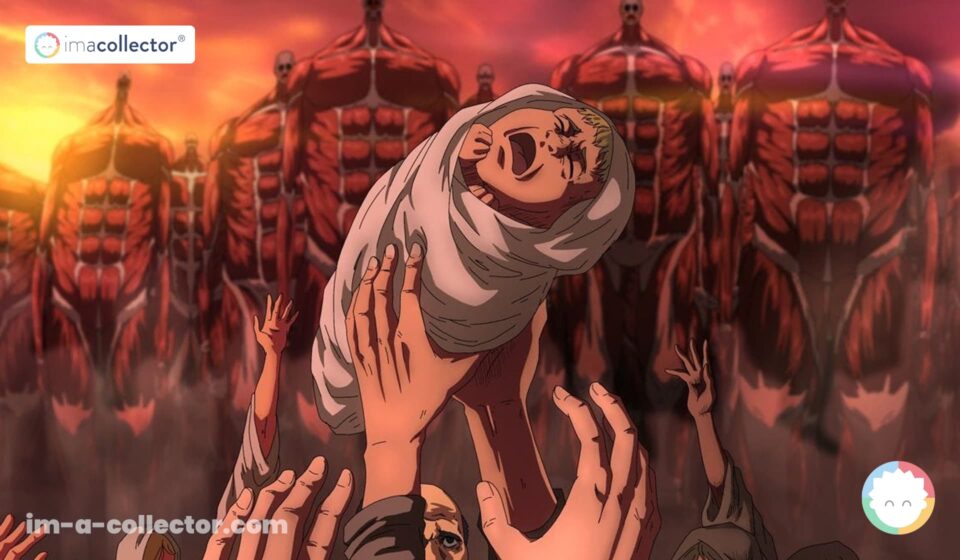
When the Rumbling begins, Attack on Titan – Shingeki no Kyojin seems to have reached a true point of no return in its violence. Eren is prepared to crush almost all of humanity beyond Paradis to protect his home island. And this horrifying decision is the result of a long process of reflection and of weighing every choice he believes he has been given.

Long before that, Hajime Isayama shows us children taught to call other human beings “devils”, populations separated by walls or fences, horrific crimes passed down like an inheritance, conflicting accounts of the past, and characters who gradually become convinced that their own survival depends on the disappearance of others.

This in-deapth feature series analyzes Attack on Titan – Shingeki no Kyojin through one simple question: how do we come to believe the other must disappear?

To try to answer it, I retrace the path leading up to the Rumbling to understand how a society can gradually reach that point: classifying people, separating them, constructing an image of the enemy, passing down fear, making certain forms of violence acceptable and, ultimately, treating the disappearance of a group as a solution.

My aim is not to find an exact real-world equivalent for Marley, the Eldians or Paradis. Instead, I want to understand the mechanisms the series portrays by comparing them with research in history, social psychology and sociology, as well as with several well-documented historical events.

Attack on Titan in a few key dates

2009 — Hajime Isayama begins serializing Shingeki no Kyojin in Bessatsu Shōnen Magazine.

2013 — The anime adaptation begins. At this point, the world of Attack on Titan still appears to be limited to the Walls and humanity’s struggle against the Titans.

2017–2019 — Seasons 2 and 3 change the picture completely: the origins of the Titans, the history of the Walls and the existence of the outside world place the conflict within a much larger history.

2020 — The Final Season opens in Marley. Through Gabi, Falco and the Warrior candidates, we discover the conflict from the other side of the sea.

2021 — The manga ends with chapter 139, after nearly twelve years of serialization.

2023 — The anime adaptation also comes to an end, concluding both the Rumbling and Eren’s journey.

Across those years, our understanding of the conflict changes profoundly. Behind the struggle against the Titans, Marley, the Eldians and Paradis gradually emerge, along with questions of discrimination, propaganda, memory, revenge and genocide. This feature series returns to these different themes to understand how the story builds, step by step, the cycle of violence that leads to the Rumbling.

The ten chapters in this series

Rather than looking for a single explanation or even one common explanation for the violence depicted in Attack on Titan – Shingeki no Kyojin, this feature series follows the different stages of the process. Each chapter begins with a question raised by the work itself, before confronting it with what history and the social sciences can teach us.

Is the Rumbling really a genocide?

Eren wants to crush almost all of humanity outside Paradis. Yet the scale of the massacre alone is not enough to legally define it as genocide. This first chapter looks at Marley, Zeke’s plan and the Rumbling to understand what distinguishes genocide from massacre, extermination or a crime against humanity — and, above all, why the intent to destroy a group lies at the heart of that definition.

(coming soon) Why does Gabi hate people she has never met?

When Gabi Braun first appears, she has never met a single person from Paradis. Yet she already sees them as “devils” and wants to take part in their extermination. This second chapter examines how a category can come to overshadow the individuals within it, and why actually meeting people we thought we knew can sometimes change that perception.

(coming soon) Why does Reiner want to become a “good Eldian”?

Reiner grows up in a society that teaches him that being born Eldian is already a problem. Becoming a Warrior then offers him a way to prove that he and his family belong among the “good” Eldians. Through his story, this chapter examines how someone can internalize the discrimination directed against them, to the point of trying to distance themselves from people like them in the hope of finally being accepted.

(coming soon) Why should we pay for crimes committed before we were born?

Gabi, Reiner and Grisha never took part in the crimes of the former Eldian Empire. Yet they grow up in a world where that past continues to determine how Eldians are perceived and treated. This chapter examines how guilt can be passed from one generation to the next, how conflicting memories can sustain a conflict, and how far descendants can be held responsible for the actions of their ancestors.

(coming soon) How can Willy Tybur convince a crowd that an attack has become necessary?

At Liberio, Willy Tybur reveals part of the true history of the former Eldian Empire before presenting Eren Yeager and Paradis as a threat to the world. His speech allows us to examine how real facts can be selected, arranged and narrated to give the present a particular meaning, but above all how fear of a threat can gradually make violence against an entire group seem acceptable.

(coming soon) How does the Rumbling eventually become acceptable on Paradis?

For generations, the people of Paradis know almost nothing about the outside world. When they finally discover it, they also learn that part of that world wants them gone. This chapter examines how the fear of annihilation can gradually narrow the range of solutions people consider possible, until extreme violence begins to appear legitimate as a way of protecting their own group.

(coming soon) Why does Eren keep going when he knows what he is doing is atrocious?

Eren crosses the sea, meets people he once considered his enemies and realizes that they are not fundamentally different from the people of Paradis. He also knows what the Rumbling will do. This chapter examines how someone can recognize the humanity of their victims, know that what they are about to do is horrific, and still continue to see their destruction as the only possible solution.

(coming soon) How can Zeke believe that making the Eldians disappear is a form of compassion?

Zeke does not seek to massacre the Subjects of Ymir directly. His plan is to prevent any further births so that their people gradually disappear along with the power of the Titans. This chapter looks at another way of making the disappearance of a group acceptable: no longer presenting it as revenge or victory, but as a supposedly rational, even compassionate solution to suffering considered impossible to resolve in any other way.

(coming soon) Why doesn’t Levi turn his desire for revenge into hatred of an entire group?

Levi watches his comrades die, loses Erwin and pursues Zeke after the massacres for which he is responsible. Yet his hatred remains directed at one individual rather than the people to whom that individual belongs. His story therefore raises an essential question: why do some people who suffer extreme violence continue to distinguish those responsible from others who resemble them, while others eventually extend guilt to an entire group?

(coming soon) Can the cycle of hatred really be broken?

Gabi changes, Reiner discovers the humanity of those he was supposed to fight, and Levi refuses to extend his revenge to an entire people. Eren, however, shows that knowing the other is not always enough to prevent their destruction. This final chapter therefore examines what can stop inherited hatred from being passed on, but also why meeting, understanding and even recognizing the humanity of others is not always enough to break the cycle of violence for good.

Five characters for understanding how the enemy is constructed in Attack on Titan

Through its characters, Attack on Titan – Shingeki no Kyojin allows us to observe different stages of the same process. They do not all think alike and their paths are not the same, but each of them helps illuminate one part of the journey from fear of the other to the possibility of their disappearance.

Gabi Braun How a society can teach someone to hate a group they have never met, until that representation comes to feel self-evident. Reiner Braun How someone can internalize the discrimination directed against them and try to prove they deserve acceptance by distancing themselves from their own group. Willy Tybur How a political narrative can organize facts, memory and fear to construct a common threat. Zeke Yeager How the disappearance of a people can be presented not as revenge, but as a way of ending suffering. Eren Yeager How the destruction of others can become acceptable in the name of protecting one’s own, even when their humanity is fully recognized.
Character What their story allows us to examine

Why analyze Attack on Titan through our own history?

Attack on Titan – Shingeki no Kyojin can never replace a history book, academic research or the testimony of people who lived through the events referenced in this feature series.

Fiction, however, has another remarkable strength: it can make us observe a mechanism before we even know what to call it.

By the time we meet Gabi, we already know that the people of Paradis are nothing like the “devils” she imagines. When Reiner discovers the people he was sent to fight, we have already spent several chapters — or seasons — alongside them. And when the Rumbling begins, we have spent hours watching or reading the events that gradually led to that final decision.

I do not want the series to explain history. When I began this feature series, the idea was simple: start with the questions raised by fiction and use them to understand mechanisms that historians, psychologists, sociologists and legal scholars study and try to explain in our own world.

Understanding and analyzing Attack on Titan

What are the main themes of Attack on Titan?

Attack on Titan – Shingeki no Kyojin explores freedom, war, the transmission of memory, revenge, discrimination, propaganda, collective responsibility and the cycle of violence, among other themes. The series is particularly interested in how different groups construct their image of the enemy and gradually justify their own violence.

The Rumbling seeks to destroy almost all of humanity outside Paradis. The question, however, is more complex than simply comparing the number of victims: the concept of genocide notably requires the intent to destroy, in whole or in part, a protected group as such. The first article in this feature series is devoted entirely to this question.

The cycle of hatred is one of the central themes of the final part of Attack on Titan – Shingeki no Kyojin. Violence committed by previous generations feeds the fears and violence of those that follow, until each side has reasons to see its own actions as a response to the other’s. Several characters nevertheless try to break out of this logic.

Attack on Titan – Shingeki no Kyojin uses images, situations and mechanisms that can evoke different periods of history, but its world remains entirely fictional. It is therefore possible to study certain mechanisms through historical research without looking for an exact correspondence between Marley, the Eldians, Paradis and real peoples or states.

Directly equating the Eldians with Jewish people creates several problems. Although some visual or political elements in Attack on Titan – Shingeki no Kyojin may evoke the history of antisemitism and the Holocaust, the Eldians also have their own history and supernatural characteristics specific to Isayama’s fictional world. This feature series therefore compares mechanisms of discrimination or persecution rather than peoples themselves.

How this series was researched

For each article, the starting point remains Attack on Titan – Shingeki no Kyojin itself.

I return first and foremost to Hajime Isayama’s manga, the official French edition and the anime adaptation. Chapters and dialogue are checked whenever an interpretation depends specifically on what a character says, believes or understands at a particular point in the story.

These elements are then compared with different types of sources: academic research in social psychology, sociology and history; publications on genocide and mass violence; United Nations documents; decisions by international courts; and resources produced by memorial institutions.

There are therefore three levels of reading:

  • what Attack on Titan explicitly shows,
  • what the research allows us to establish,
  • and the interpretation I propose when I bring these elements together.

The aim is never to look for historical equivalents between real states, peoples or individuals and those in the story. It is to understand what fiction can lead us to question in the real world, and what we can learn from a work as important to Japanese pop culture as Attack on Titan.

Scroll