

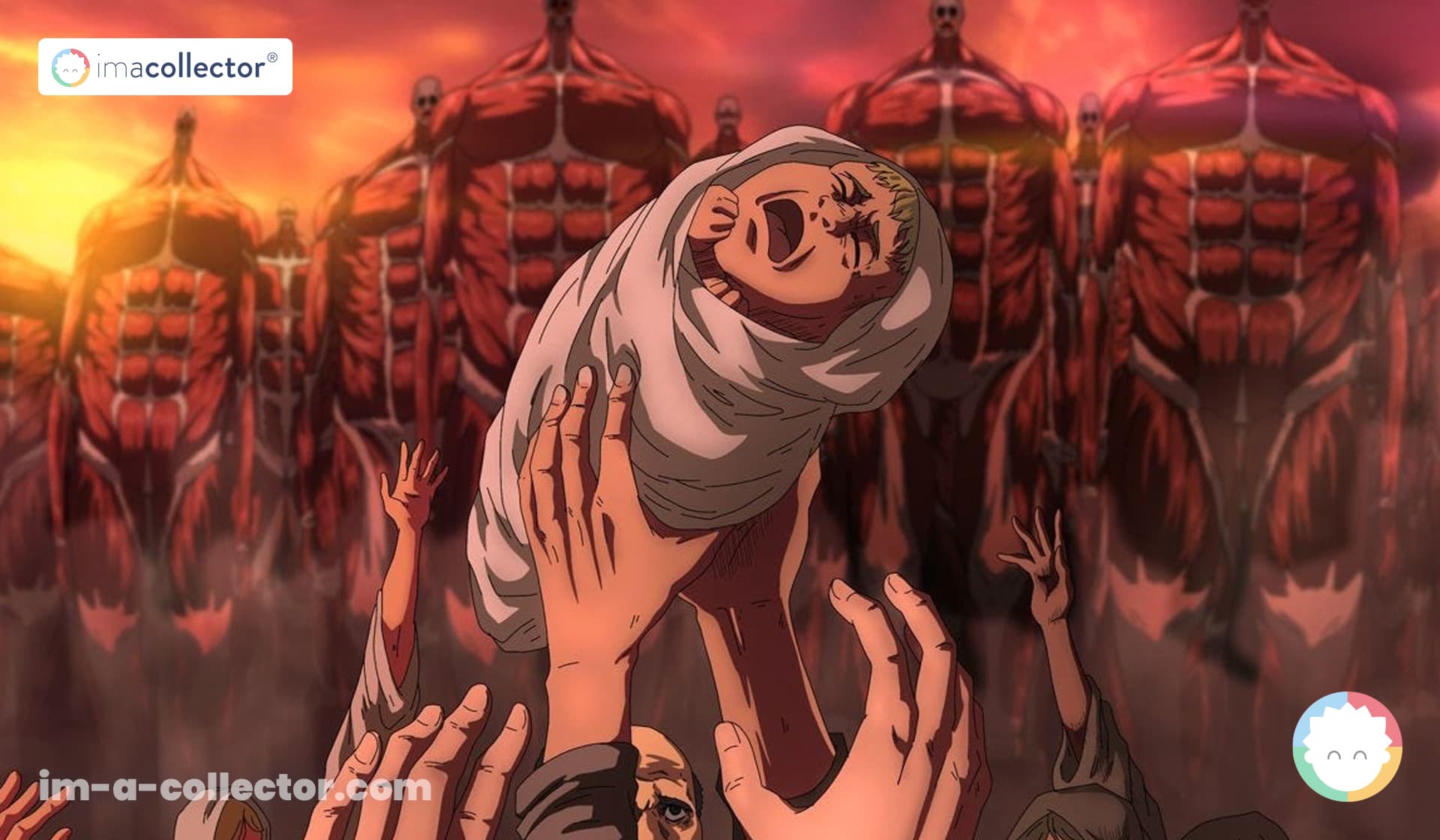

After finishing Attack on Titan (Shingeki no Kyojin), one word immediately came to mind: “genocide.” Not only because of the Rumbling, but because of everything the story builds around the disappearance of peoples, hatred passed down from one generation to the next, and populations confined, displaced, or simply condemned to vanish. There are also the images themselves: entire cities crushed, lives shattered, adults and children dying regardless of their origins or their past. I could easily have used the term without questioning it. It seemed obvious… until I started looking into what it actually means and asked myself: can we really call what Attack on Titan depicts a genocide?
Table of contents
- Genocide is not defined by the death toll alone
- Genocide, massacre, extermination, crimes against humanity: why the words matter
- Srebrenica and Cambodia: two cases that complicate the picture
- Srebrenica (1995): a recognized genocide
- Cambodia (1975–1979): a complex case
- Before Eren and Zeke, there was already Marley
- What is Eren actually trying to do?
- Is the Rumbling a genocide?
- Zeke’s plan: a textbook case of genocide
- Eren and Zeke: two visions of a world without the other
- Genocide begins long before the massacres
- Sources
Genocide is not defined by the death toll alone
The word “genocide” did not exist before the Second World War. It was coined in 1944 by Raphael Lemkin, a Polish Jewish lawyer. In Axis Rule in Occupied Europe, he was trying to name something the vocabulary of the time failed to describe properly: not the massacre of individuals, but the organized destruction of a human group. Lemkin built the term from the Greek genos (group, people) and the Latin suffix -cide (to kill). In his conception, this destruction could target the political, social, cultural, economic, biological, and physical foundations of a group.
Only four years later, on December 9, 1948, did the United Nations adopt the Convention on the Prevention and Punishment of the Crime of Genocide. The legal definition that followed was narrower than Lemkin’s, but it retained his central idea: the immediate victim is an individual, while the real target is the group to which that person belongs.
For an act to qualify as genocide in legal terms, a specific intent must therefore be established: the intent to destroy, in whole or in part, a national, ethnic, racial, or religious group as such.
It may seem strange, but two massacres can produce the same number of deaths while following radically different logics. In one case, people may be killed in a campaign of terror, in war, because of their political views, or simply because they were in the wrong place at the wrong time. In the other, they are attacked because belonging to a particular group is enough to mark them as people whose disappearance is desired.
The death toll may therefore be identical, and the horror just as great, while the project behind those deaths is fundamentally different.
Genocide does not necessarily mean killing
The 1948 Convention identifies five types of acts that may constitute genocide when committed with the intent to destroy a protected group:
1. Killing members of the group;
2. Causing serious bodily or mental harm to members of the group;
3. Deliberately inflicting conditions of life calculated to bring about the group’s physical destruction;
4. Imposing measures intended to prevent births within the group;
5. Forcibly transferring children of the group to another group.
That fourth form will become particularly important when we turn to Zeke.
Genocide, massacre, extermination, crimes against humanity: why the words matter
Why do these distinctions matter? Because each term corresponds to a different legal and historical reality:
- Massacre: a descriptive term. It refers to the large-scale killing of people, but says nothing about why the victims were killed.
- Extermination: under international law, it can constitute a crime against humanity when it involves deliberately imposed living conditions intended to bring about the destruction of part of a population.
- Crime against humanity: covers serious acts such as murder, extermination, deportation, torture, persecution, or forcible transfer when they are committed as part of a widespread or systematic attack directed against a civilian population.
- Genocide: adds one crucial dimension: the intent to destroy the group itself.
These distinctions can seem abstract, but two historical examples make them concrete: Srebrenica and Cambodia.
Srebrenica and Cambodia: two cases that complicate the picture
Srebrenica (1995): a recognized genocide
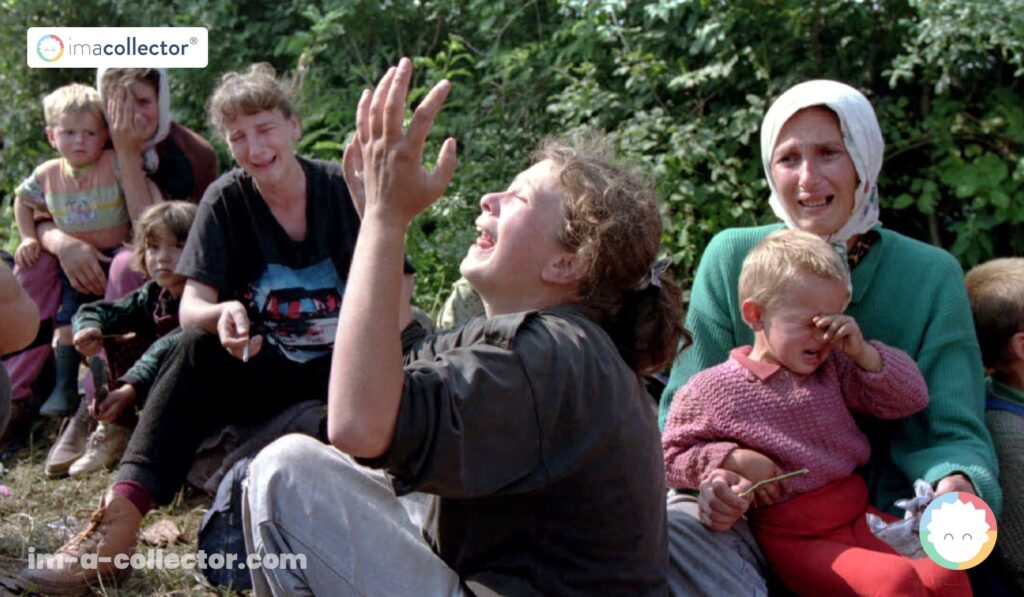
In July 1995, Bosnian Serb forces captured Srebrenica, which had been declared a United Nations “safe area.” More than 8,000 Bosniak Muslim men and boys were killed or went missing. During the same period, tens of thousands of women, children, and elderly people were expelled from the enclave.
Here, the number of deaths is not the decisive point. What matters is the purpose behind the killings. International courts recognized Bosnian Muslims as a protected group, with the Muslims of Srebrenica constituting a significant part of that group. Men and boys were systematically separated, detained, and then executed, while the rest of the population was expelled.
The destruction of the men of this community was not simply a consequence of war: it formed part of a deliberate effort to make the Srebrenica community disappear. That is why the massacre was legally recognized as genocide (International Court of Justice, judgment of February 26, 2007).
Ce que nous devons en retenir ici est qu’il n’est pas nécessaire de vouloir tuer chaque membre d’un peuple dans le monde entier. Détruire une partie conséquente du groupe peut suffire.
Cambodia (1975–1979): a complex case
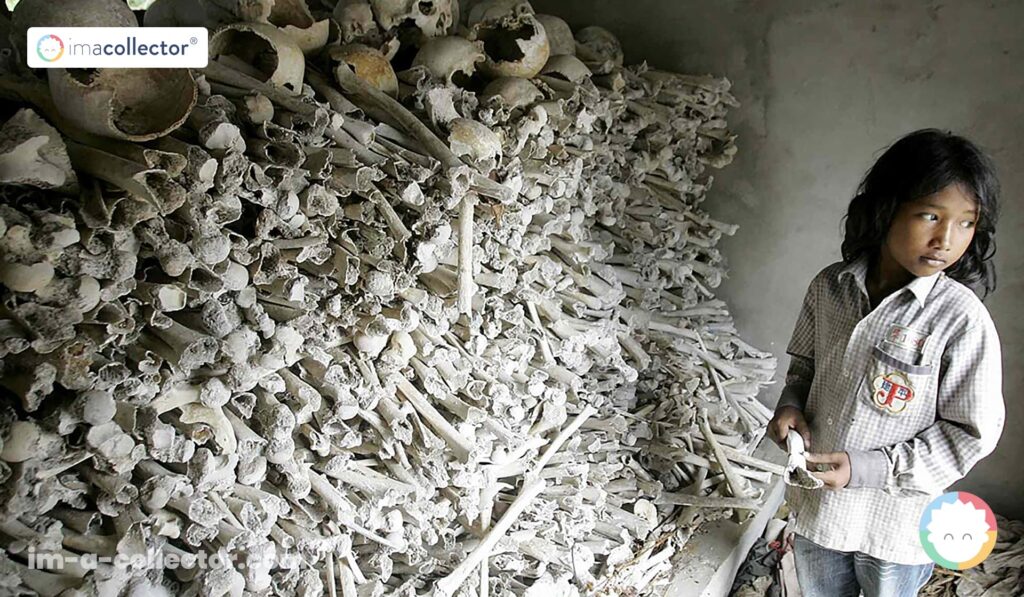
Between April 1975 and January 1979, the Khmer Rouge regime imposed forced evacuations, exhausting labor, famine, detention, persecution, and executions. Widely cited estimates put the death toll at close to two million. Yet not all of these victims are legally considered victims of genocide. Much of the population was persecuted according to political, social, or ideological criteria that do not correspond to the four groups protected by the 1948 Convention (national, ethnic, racial, or religious).
However, the Extraordinary Chambers in the Courts of Cambodia did classify certain acts of violence directed at specific groups as genocide, notably those targeting Vietnamese people and Cham Muslims.
This example shows that the same criminal system can produce genocide, crimes against humanity, and extermination without every victim falling under the same legal classification.
Both cases point to the same lesson: the intent behind the violence is crucial. And it is precisely this question of intent that makes Attack on Titan (Shingeki no Kyojin) so difficult to classify.
Genocides recognized since 1948
Since the adoption of the Genocide Convention, there has been no single official count listing every genocide.
1975–1979 — Cambodia: genocide recognized, notably against Vietnamese people and the Cham.
1994 — Rwanda: around 800,000 people killed, mainly Tutsi.
1995 — Bosnia and Herzegovina (Srebrenica): more than 8,000 Bosniak Muslim men and boys murdered.
Since 2017 — Myanmar: allegations of genocide against the Rohingya, as part of ongoing international proceedings.
Since 2017 — China: several states have characterized the treatment of Uyghurs as genocide, including the United States in 2021.
Since 2022 — Ukraine: several institutions have referred to genocidal acts against Ukrainians, amid ongoing investigations.
Since 2023 — Gaza: several organizations have characterized acts against Palestinians as genocide, including the UN Independent International Commission of Inquiry in 2025.
As the United States Holocaust Memorial Museum emphasizes, genocide is not defined by a death toll, but by the intent to destroy a group.
Before Eren and Zeke, there was already Marley
By the time Attack on Titan (Shingeki no Kyojin) introduces Marley, the idea of treating an entire population as a problem has existed for a long time.
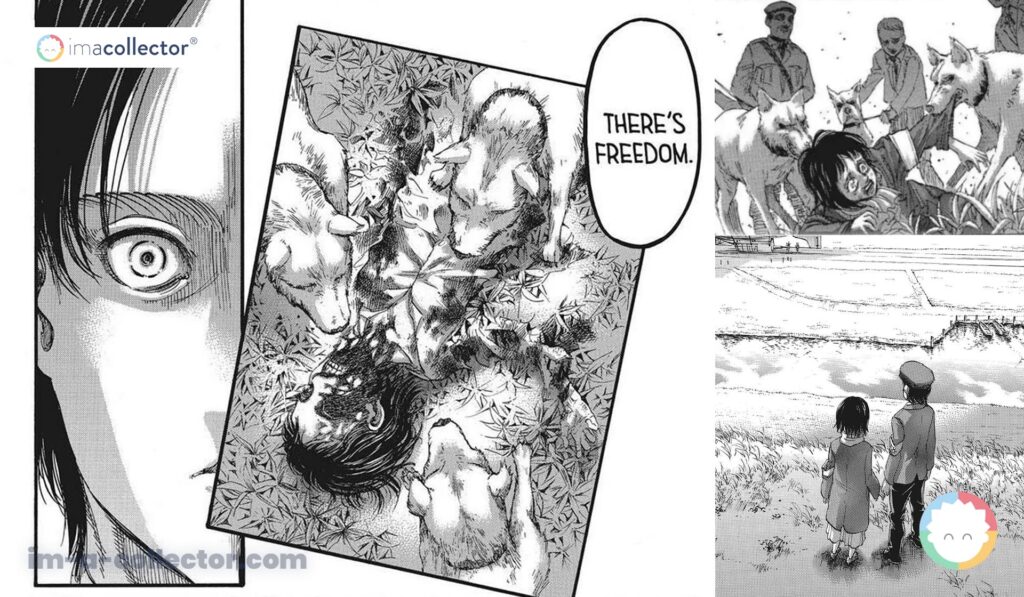
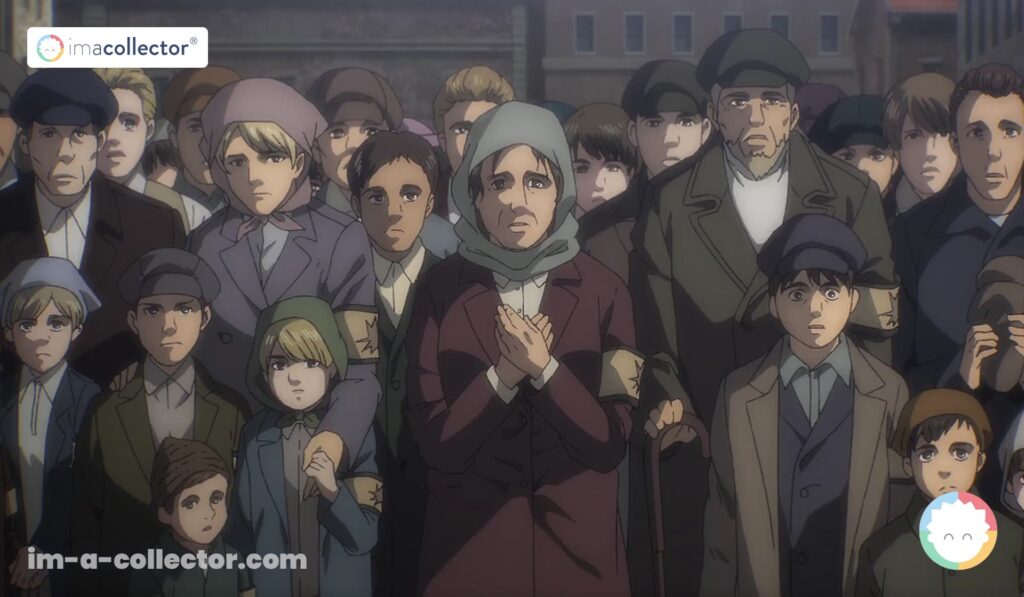
Eldians living on the continent are confined to internment zones such as Liberio. They wear armbands that identify them, carry the burden of crimes attributed to their ancestors, and are constantly expected to prove that they are not like the “devils” of Paradis Island.
Marley’s relationship with them is deeply contradictory. On the one hand, Eldians are presented as dangerous because they can become Titans. On the other, that very ability makes them indispensable to Marley’s military power.
This is the paradox faced by Warrior candidates such as Gabi and Falco, and by Warriors such as Reiner and Zeke: becoming a “good Eldian” means serving a system that still treats their people as guilty for a past they themselves never knew.
It is important to stress that Marley is not trying to make every Eldian disappear. On the contrary, the system needs them, their Titans, and their military strength. But Attack on Titan (Shingeki no Kyojin) already makes one essential point clear: a population can begin to be treated as a collective problem long before any project of extermination emerges.
Individuals are no longer judged only by what they have done. Birth alone is enough to assign them a place, a guilt, and sometimes even the status of a threat. This logic becomes even more visible when Willy Tybur presents Paradis as a global danger: the entire island becomes the threat around which Marley seeks to unite the rest of the world.
And it is within that environment that Eren ultimately unleashes the Rumbling.
What is Eren actually trying to do?
For much of Attack on Titan (Shingeki no Kyojin), the threat appears to come from Marley. Marley uses Titans as weapons, keeps Eldians in internment zones, and takes a direct part in the war against Paradis. It would therefore be natural to assume that Eren’s primary aim is to destroy this specific enemy. Yet that is not what he announces.
When he addresses the Subjects of Ymir in Chapter 123, his objective goes far beyond Marley: “The Titans of the Walls will advance beyond this island and crush the lands outside it until all life there is gone.”
Kodansha, the series’ Japanese publisher, summarizes this part of the story with striking clarity:
- Volume 31: “destroy the world through the Rumbling.”
- Volume 32: “exterminate humanity outside the island.”
- Volume 33: “trample every land except Paradis.”
Eren’s target is no longer just an army, or even a nation. It becomes almost everything on the other side of the sea: Marleyans, of course, but also Eldians, refugees, children, people from nations hostile to Marley—and probably peoples about whom Eren knows almost nothing.
Ramzi embodies the absurdity of this in the most brutal way. Eren meets him during his stay in Marley. He sees him being assaulted, steps in to protect him, understands his poverty, and even spends time with his family while already knowing what is going to happen.
Eren knows perfectly well that Ramzi will be killed by the Rumbling. He is ashamed, cries in front of him, and even asks for his forgiveness. Yet he continues with the plan anyway. Ramzi poses no threat to Paradis. He bears no responsibility for the conflict between the Eldians and the rest of the world. He will die simply because he lives on the wrong side of the sea. Collateral damage…
And it is this part of Eren’s plan that makes the Rumbling so difficult to characterize.
Is the Rumbling a genocide?
Eren wants almost all of humanity outside Paradis to disappear. In doing so, he crushes Marleyans, Eldians, refugees, and peoples whose names he probably does not even know, without distinction.
Yet, as explained above, for an act to qualify as genocide it must target a protected group (national, ethnic, racial, or religious) as a group. As Abhijeet Shrivastava and Anujay Shrivastava (2022) point out, the Rumbling poses a challenge to the Genocide Convention because its target is primarily geographic (“everyone living outside Paradis”) rather than a specific group.
The Rumbling, then, despite its unimaginable violence, does not fit the definition of genocide exactly. It is closer to a crime against humanity involving mass extermination, or to a project of mass destruction, but without the targeted intent required by the 1948 Convention.

Zeke’s plan: a textbook case of genocide
Zeke’s project is far more precise and personal: he does not want to massacre the Eldians. In his own logic, he is instead trying to spare them a violent extermination. His plan is simple: use the power of the Founding Titan to make every Subject of Ymir unable to have children. Eldians already alive could continue living. They would grow old and eventually die naturally. No new Eldians would be born after them. The disappearance of the people would be slow, but final.
Zeke even imagines a temporary military deterrent to prevent the rest of the world from exterminating the generations still alive. His goal is therefore not to kill every Eldian, but to ensure that one day none remain.
This distinction also explains why Zeke sees his plan as a form of salvation. To him, being Eldian means carrying the burden of the Titans, Marley’s hatred, historical guilt, and an endless conflict. From his perspective, the question becomes almost logical: “Why keep bringing children into the world only to condemn them to the same suffering?” His answer is radical: better to prevent those lives from existing at all.
This is where the 1948 Convention becomes crucial again. One of the five acts explicitly listed as genocide is “imposing measures intended to prevent births within the group.”
As the International Criminal Tribunal for Rwanda established in the Akayesu case (1998), such measures can constitute genocide when the intent is to destroy the group. In Zeke’s case, that intent is difficult to dispute, or even deny: he is not simply trying to reduce the birth rate among the Subjects of Ymir. He wants the last of them to die without descendants so that their people will cease to exist permanently.
Aussi dingue que cela puisse paraître, le projet de Zeke remplit les critères du génocide et, assez ironiquement, c’est donc lui, dont le plan ne produit aucun massacre immédiat, qui se rapproche le plus de la définition juridique du génocide.
Eren and Zeke: two visions of a world without the other
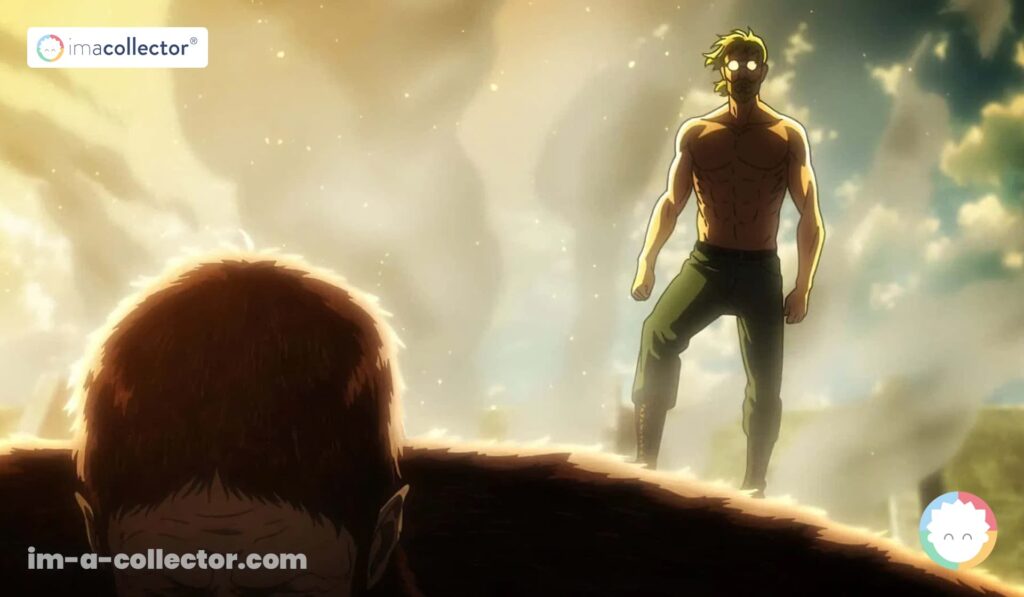
Eren and Zeke do not want the same thing, but their personal projects lead to a similarly brutal dead end: coexistence is no longer an option.
Zeke believes the existence of the Subjects of Ymir creates too much suffering, both for them and for the rest of the world. His solution? Gradually eliminate the possibility of their being born at all.
Eren begins from the opposite principle: being born is enough to establish a right to exist. He rejects Zeke’s idea because he believes no Eldian should have to disappear simply because the world rejects them. But when he applies that conviction to Paradis, a problem emerges: to guarantee his own people’s right to exist, Eren ultimately removes that right from almost everyone else.
The two brothers therefore reach the same point by opposite routes: they stop seeing coexistence as a possible solution.
Zeke imagines a world with no future Eldians, while Eren imagines a world in which almost all humanity outside Paradis has disappeared. The first turns extinction into an act of compassion; the second turns annihilation into a condition of freedom.
Worse still, neither of them needs to believe that the people they condemn are completely inhuman in order to carry out the plan.
Other works of fiction confronting genocide
Attack on Titan (Shingeki no Kyojin) is not the only work to examine the mechanisms of dehumanization, propaganda, and mass violence.
Death Note: Light Yagami follows a logic similar to Eren’s—mass elimination as the solution to a problem he sees as impossible to overcome. The difference? Light targets criminals, by his own definition, while Eren targets an entire population without distinction.
Fullmetal Alchemist: Brotherhood: the series explores dehumanization and state propaganda through the genocide of the Ishvalans, who are presented as a threat to be eliminated.
Vinland Saga: the story explores the cycle of revenge and the dehumanization of the enemy through Thorfinn’s journey.
Berserk can also be mentioned for its depiction of mass sacrifice in the service of an individual goal, while Monster explores manipulation and dehumanization on a large scale.
Genocide begins long before the massacres
The purpose of this article was never to reduce the projects of annihilation in Attack on Titan (Shingeki no Kyojin) to a simple legal label. Above all, I wanted to understand how this universe makes us grasp and feel things that resonate with us even when we struggle to explain them. Details may evoke memories from our own history (the yellow star, camps, and so on) but we do not always have the right words to describe what we are seeing.
What Attack on Titan (Shingeki no Kyojin) does above all is build an entire ecosystem:
- children grow up believing they carry the sins of their ancestors
- Eldians live in internment zones
- entire populations are taught to see the people of Paradis as devils
- on the island, discovering the outside world gradually destroys the idea that anything beyond the Walls can be simple
Added to this are wars, reprisals, conflicting historical narratives, fear, humiliation, and memories passed down from generation to generation.
Marley is essential to this mechanism. The story shows that before a people is targeted for disappearance, it can first be separated, identified, assigned collective guilt, and taught to be seen as a threat by definition.
Yes, at times it resembles our own world. And yet it remains profoundly different.
The Rumbling and Zeke’s plan are the spectacular culmination of this process. But neither is its beginning. And this is probably where the word “genocide” becomes genuinely useful for reading and understanding Attack on Titan (Shingeki no Kyojin).
Before a group can be massacred, sterilized, or condemned to disappear, a deeper idea must already have taken hold: that perhaps the world would be better without it. That is the transformation we now need to understand. How does a population gradually become an enemy? How do propaganda, fear, memory, and education make acceptable what would have seemed unthinkable only a few years earlier?
Autrement dit : comment en arrive-t-on à penser que l’autre doit disparaître ? C’est bien cette question que la suite de ce dossier va tenter d’explorer.
Sources
Hajime Isayama — Attack on Titan – Shingeki no Kyojin, Kodansha, volumes 22 à 34 : source primaire pour Mahr, Revelio, le Grand Terrassement, les intentions d’Eren, le projet de Zeke et Ramzi.
Nations unies —Definitions of Genocide and Related Crimes : Définition du génocide et distinctions avec les autres crimes internationaux.
Raphaël Lemkin —Axis Rule in Occupied Europe (1944) : Origine du mot « génocide » et première conceptualisation de la destruction d’un groupe. La page des Nations unies consacrée à la définition du génocide présente également l’origine du terme.
Cour internationale de Justice —Bosnie-Herzégovine c. Serbie-et-Monténégro, arrêt du 26 février 2007 : Reconnaissance du génocide de Srebrenica et analyse de l’intention génocidaire.
TPIY / Mécanisme international résiduel —Affaire Radislav Krstić : Notion de « partie substantielle » d’un groupe dans le cas de Srebrenica.
Chambres extraordinaires au sein des tribunaux cambodgiens —Dossier 002/02 : Crimes commis sous les Khmers rouges et qualification de génocide concernant les groupes vietnamien et cham.
United States Holocaust Memorial Museum —Cambodia 1975–1979 : Contexte et ampleur des violences commises sous les Khmers rouges.
Abhijeet Shrivastava & Anujay Shrivastava —« How ‘Attack on Titan’ Complicates the Genocide Convention » (2022) : Analyse de la difficulté à appliquer strictement la définition juridique du génocide au Grand Terrassement.
Tribunal pénal international pour le Rwanda —Procureur c. Jean-Paul Akayesu, jugement du 2 septembre 1998 : Jurisprudence fondamentale sur le génocide et les mesures visant à empêcher les naissances au sein d’un groupe, utilisée dans l’analyse du projet de Zeke.
Cour internationale de Justice —Gambie c. Myanmar : Procédure concernant l’application de la Convention sur le génocide aux Rohingyas.
U.S. Department of State —Atrocities in Xinjiang : Qualification de génocide concernant les Ouïghours.
Nations unies —Commission internationale d’enquête sur le territoire palestinien occupé, y compris Jérusalem-Est, et Israël : Travaux de la Commission concernant Gaza.
Nations unies —Commission d’enquête internationale indépendante sur l’Ukraine : Travaux concernant les violations et crimes commis en Ukraine.