

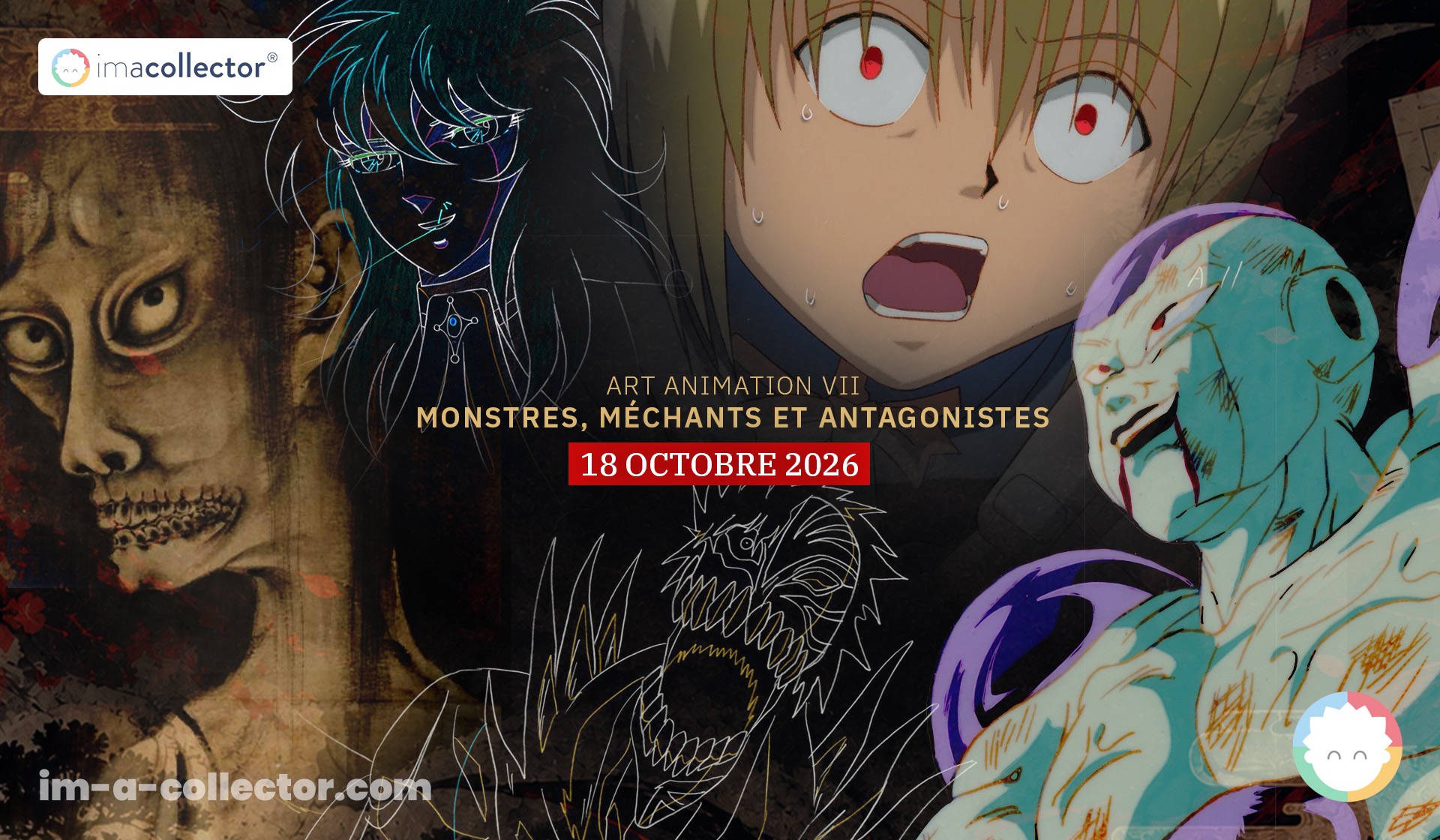
A collection often begins with a simple choice: the heroes. Yet their enemies, their counterparts and their darker sides are just as essential to the stories we love. The Art Animation VII: Monsters, Villains and Antagonists auction offers a chance to explore, through original drawings and animation cels, why antagonists deserve a place in an anime art collection.
Table of contents
- A collection tells a fuller story when it preserves both sides of a conflict
- Antagonists often allow for greater freedom in character design
- The most interesting antagonists are not always villains
- An antagonist’s artwork can preserve a pivotal moment rather than a portrait
- The most revealing document is often not the finished image
- Cel, douga, background: the accompanying material can matter as much as the character
- Why collect antagonists too?
- A few lots worth exploring
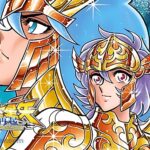
When we start collecting artwork from a series, most of us follow the same instinct: we choose our favourite hero. Son Gohan from Dragon Ball, Shun from Saint Seiya or Tsubasa from Captain Tsubasa. It makes perfect sense. We spend dozens of episodes with these characters and develop a particular affection for them.
But a collection made up entirely of heroes tells only part of the story of the works we love.
No character develops in isolation. Part of who they are is shaped by what stands against them: a rival, a tyrant, a creature, an opposing ideology or even a side of themselves they struggle to control. In shōnen series, antagonists drive the plot, shape the heroes’ development and help define a work’s visual and narrative identity.
That is what makes the theme of Art Animation VII: Monsters, Villains and Antagonists so appealing to collectors. Across its 185 lots, some characters embody evil with little ambiguity, such as Frieza and Raoh. Others, like Piccolo, undergo a profound transformation. Some become enemies through circumstances beyond their control, as Julian Solo does, while Ichigo must fight against his own Hollow nature.
A collection tells a fuller story when it preserves both sides of a conflict
A cel of Goku can be beautiful on its own. Put it alongside an image of Frieza from a defining moment in their battle, and it also evokes a relationship that shaped a major part of Dragon Ball Z.
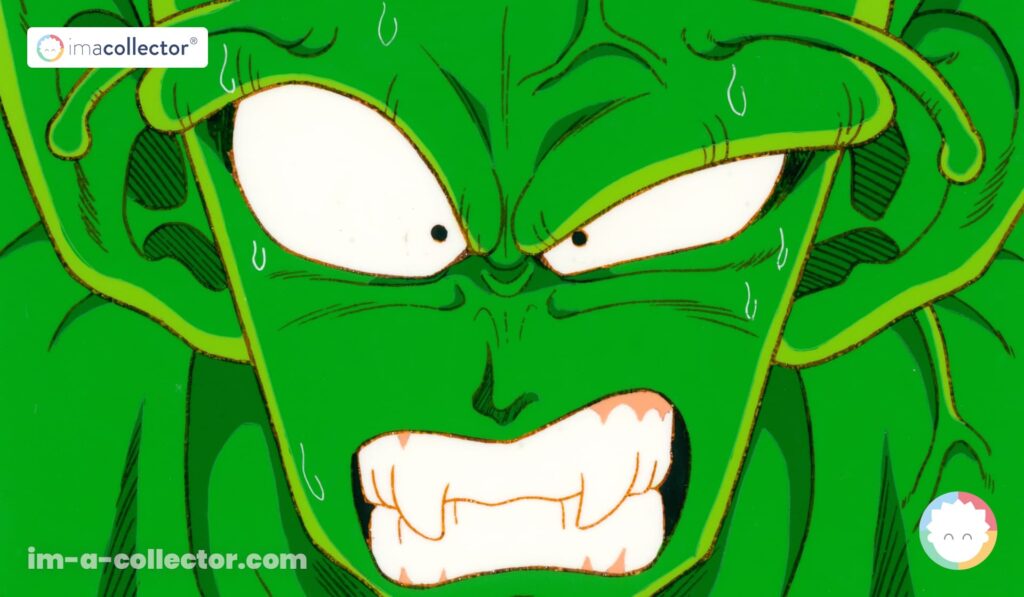
Lot 164 offers a particularly compelling example, showing Piccolo facing Nappa in episode 25 of Dragon Ball Z. The cel comes with its original dōga and frames Piccolo in an exceptionally tight close-up. His face fills almost the entire image: his teeth are clenched, his eyes strikingly asymmetrical, and beads of sweat become an integral part of his expression.
What makes this piece distinctive is not simply Piccolo’s presence, but the moment in his story it preserves. Once Goku’s enemy, he now faces a threat that places him in the role of protector.
For a new collector, the character may be the main attraction, especially in such a powerful image. For someone building a more developed collection, the context and the shot’s precise place in Piccolo’s evolution may prove decisive.
Antagonists often allow for greater freedom in character design
The heroes of major series need to leave a strong visual impression, and their character designs must remain recognisable from episode to episode. Even as they change, their silhouettes usually retain elements of their original appearance.
Antagonists are often far more radical.
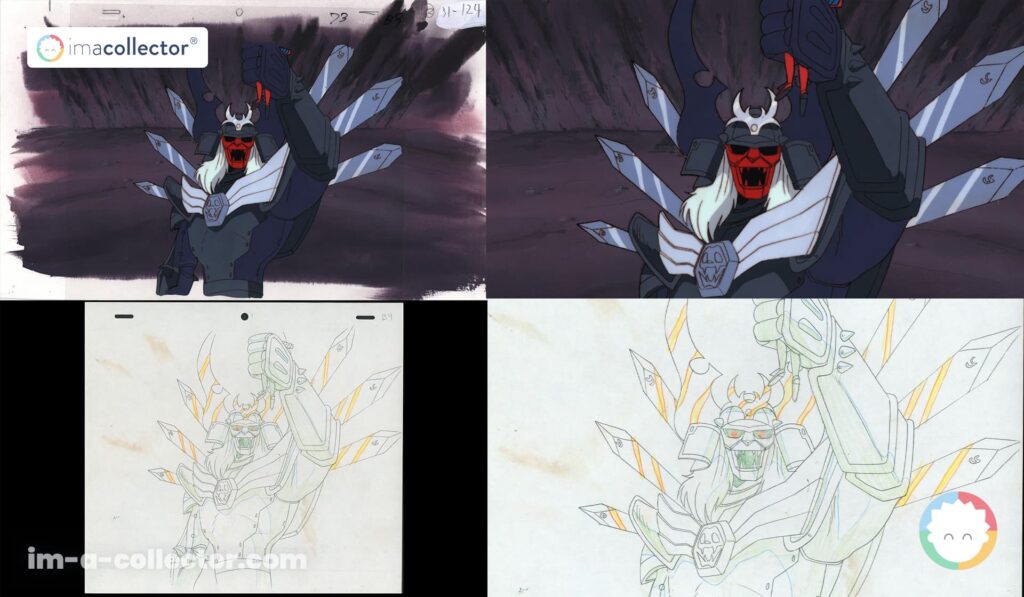
Arkatator (Arago in the Japanese version), the main antagonist of Yoroiden Samurai Troopers (Les Samouraïs de l’éternel), is a good example. Sunrise officially describes him as the ruler of the demon world who takes control of Tokyo and confronts the five Samurai Troopers.
Lot 70 brings together a cel, its original dōga and a period gouache background. Almost nothing about the character’s silhouette is neutral: horns, spikes, oversized armour, long white locks and a red face sharply framed by dark armour. Even the chest is built around an aggressive central motif that immediately draws the eye. The design signals danger before the character speaks or moves.
The Grand Pope from Saint Seiya, in lot 85, works differently. He has no need for a monstrous body. A helmet, spikes, broad shoulders, a mask and the stark contrast of red, black and purple are enough to establish his authority. The shot faces him almost head-on, lending him the presence of an idol or ceremonial statue.
Shingo Araki and Michi Himeno played an essential role in shaping the series’ visual identity and are officially credited for character design by Toei Animation. Although this cel cannot be directly attributed to their personal touch, as neither directed the episode it comes from, it belongs to the aesthetic they developed for the animated adaptation.
The most interesting antagonists are not always villains
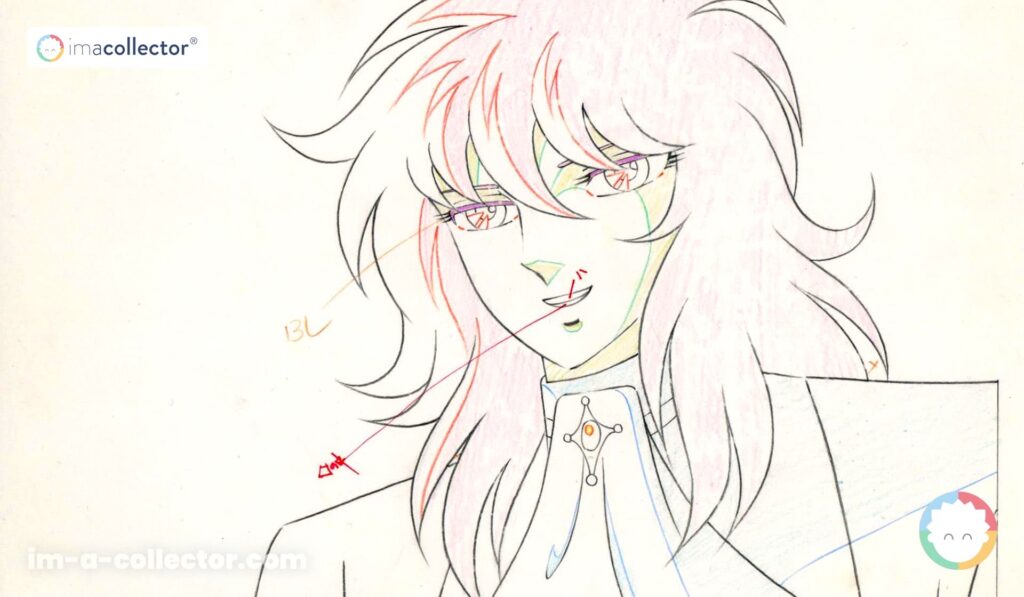
Lot 172, featuring Julian Solo, may be one of the clearest examples. Julian is more than an opponent: his body serves as Poseidon’s vessel.
Unlike Arago or the Grand Pope, his appearance is not immediately monstrous. His features are delicate, his hair carefully drawn and his expression almost serene. The threat comes not from a distorted body, but from what the viewer knows lies beneath the surface. The catalogue identifies the shot precisely: episode 100, at 6 minutes 28 seconds.
This contrast fits the visual language of Saint Seiya particularly well. Araki and Himeno bring the same elegance to enemies as they do to heroes, allowing characters such as Poseidon to retain an almost ideal beauty while representing a serious threat. Shingo Araki is credited as animation director for this particular piece.
Lot 175 from Bleach takes the opposite approach. It shows Ichigo as his Hollow nature takes over. The antagonist is no longer someone else, but part of the hero himself.
The drawing abandons much of the familiar human silhouette. The mouth becomes an enormous jaw lined with sharp teeth, the torso is distorted, spikes jut out from the body and the overall shape grows distinctly animalistic. Yet it is still Ichigo.
For a Bleach collector, a piece like this may be more compelling than a conventional portrait of the hero. It captures one of his central struggles: learning to control a power that also threatens to erase who he is.
Lot 26 from InuYasha explores a similar idea. InuYasha is not an antagonist in the traditional sense, but as a hanyō, half human and half demon, he can also become a danger to himself and others. The catalogue highlights this aspect of his character: when his demonic nature takes over, his eyes turn red, markings appear on his face and he loses control.
The aim is no longer simply to find ‘an Ichigo cel’ or ‘an InuYasha cel’. It can be to collect different states of the same character, capturing several stages of their development.
An antagonist’s artwork can preserve a pivotal moment rather than a portrait
As a collection grows, the particular shot often matters more than the character’s name.
Two drawings of Raoh can mean very different things depending on the moment they depict.
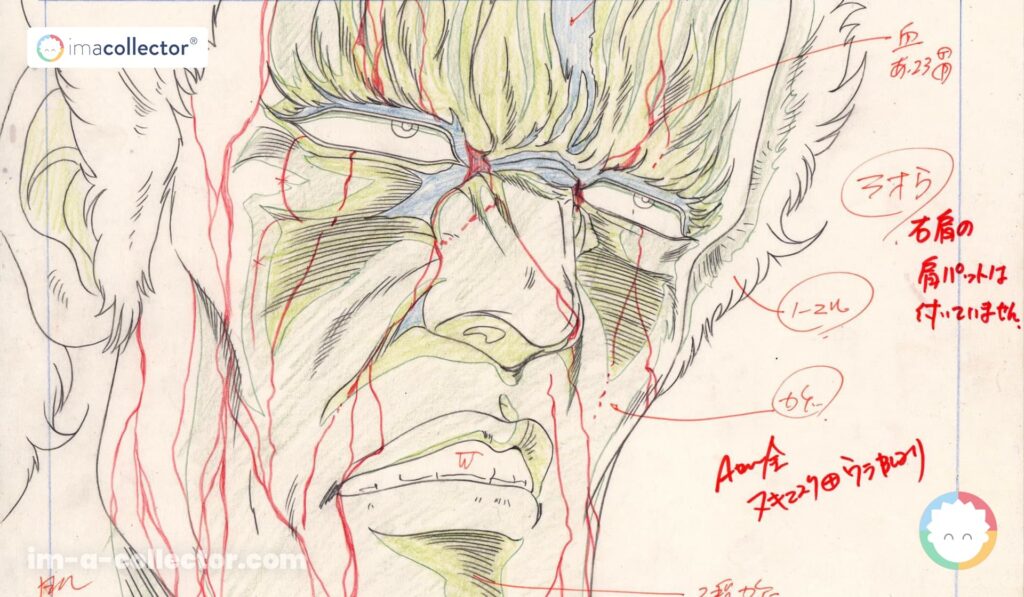
Lot 93, from the 1986 film Hokuto no Ken, makes this especially clear. It is a genga identified at 1 hour 35 minutes 10 seconds, during the final confrontation with Kenshiro. Raoh appears in an extreme close-up, his face covered in blood.
Choosing a genga rather than a finished cel also changes how we experience the piece. The shapes of the face, colour annotations and construction of the expression remain visible before the drawing is translated into paint. For a character defined through much of the story by physical strength and domination, preserving the exact moment when his aura of invincibility breaks gives the drawing an added narrative significance.
The same principle applies to lot 57 from Tokyo Ghoul √A. This dōga shows Ken Kaneki facing Matasaka Kamishiro in episode 4, at 15 minutes 39 seconds. Its oversized format suits the character’s stance: legs spread wide, centre of gravity lowered and fists drawn in front of his body. Coloured-pencil annotations make its role as a production drawing immediately apparent.
The piece captures an identifiable confrontation and a particular stage in the creation of the shot. Its size is another genuine strength, giving it a substantial presence in a collection.
The most revealing document is often not the finished image
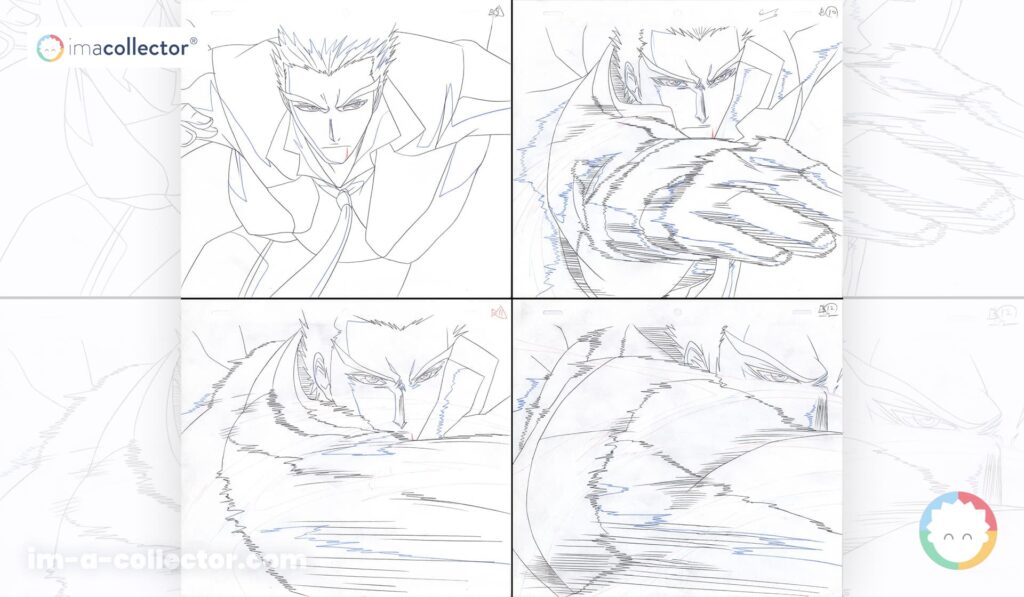
Lot 142 from Bleach, showing Jin Kariya facing Ichigo in episode 91, is not a cel. It is a set of dōga drawings that lets us examine and understand the movement.
Looking at the sheets, the value of such a set becomes immediately clear. The framing tightens around Kariya’s face as his moving hand gradually takes up more of the screen. Blue, red and black lines distinguish the different instructions needed for production. Viewers ultimately see only a rapid succession of images; the drawings reveal how that movement was built.
For someone discovering anime art, this offers a very direct explanation of why a dōga, genga or storyboard that appears less ‘finished’ can sometimes teach us far more than a cel.
These characters are often involved in battles, transformations and tense scenes, opening up a wide range of production materials: storyboards, layouts, genga, dōga, cels and backgrounds.
Cel, douga, background: the accompanying material can matter as much as the character
Lot 70 from Yoroiden Samurai Troopers pairs Arago with his dōga and an original gouache background. The catalogue does not state that the background is matching. Even so, bringing several original production elements together in one set remains valuable.
Lot 85 featuring the Grand Pope is slightly different. The background is explicitly described as non-matching: it is an original production background, but not the one seen behind this cel in the corresponding scene. The lot also includes two cel layers, and the catalogue notes that the cel is stuck to a plastic film, with areas of loss along the upper edge.
For beginners, learning how to read these descriptions is essential. For experienced collectors, such details may determine whether a piece is worth pursuing.
Why collect antagonists too?
Think of Dragon Ball Z and it is hard not to picture Frieza, Cell or Buu. It is just as difficult to imagine Saint Seiya without the Grand Pope or Poseidon, or Hokuto no Ken without Raoh.
These characters have sometimes left as lasting an impression on viewers as the heroes themselves. Some stand out for their personalities, others for their appearance, their battles or simply the memories they have left us.
Owning an original drawing of Frieza means more than owning a piece of Dragon Ball Z. It brings back a character who was part of our experience of discovering the series.
When I first started collecting animation drawings, the Grand Pope and Poseidon were among my earliest purchases. Not because I was determined to own Seiya’s enemies, but because these characters and their designs had made such an impression on me.
That is ultimately what I love about anime art. These pieces preserve something tangible of characters, scenes and emotions we may still remember decades after first encountering them.
Whether it depicts a hero, an antagonist or a supporting character, a piece’s value is not defined solely by that character’s place in the story. It also lies in the place they hold in our memories and our hearts.
A few lots worth exploring
Lot 26 — InuYasha, production dōga
An opportunity to explore the character’s inner conflict and dual nature.
Lot 57 — Tokyo Ghoul √A, Kaneki vs Matasaka Kamishiro
An oversized dōga from an identified confrontation in season two.
Lot 70 — Yoroiden Samurai Troopers, Arago / Arkatator
A cel, dōga and original background featuring the series’ main antagonist.
Lot 77 — Dragon Ball Z, Garlic Jr.
An interesting antagonist partly because he belongs to a storyline created for the anime.
Lot 85 — Saint Seiya, Grand Pope
Two cel layers accompanied by an original non-matching background
Lot 93 — Hokuto no Ken, Raoh vs Kenshiro
A genga from the final confrontation in the 1986 feature film
Lot 142 — Bleach, Jin Kariya vs Ichigo
A set of dōga drawings revealing how the movement was constructed
Lot 164 — Dragon Ball Z, Piccolo vs Nappa
A full-frame cel accompanied by its original dōga
Lot 172 — Saint Seiya, Julian Solo / Poseidon
A compelling example of an antagonist whose appearance is not overtly monstrous
Lot 175 — Bleach, Ichigo Hollow
The hero confronting his own monstrous nature
This article was produced as part of a commercial collaboration with Art Animation Auction for the Art Animation VII: Monsters, Villains and Antagonists sale on 18 October 2026.
The selection of works and editorial analysis remain entirely those of imacollector®.