

“The shady business behind anime ‘original drawings’?” by Nicolas Delage — why this video bothers me

Nicolas Delage set out to tell a story about what he calls the “shady business” of anime original drawings. In twenty minutes, what he mostly reveals is something else: how little he knows about this subject, how deeply this world is still misunderstood and misnamed, and above all how stripped it remains of what gives it its real value.
Sommaire
- Problem N°1: talking about “original drawings” as if the phrase still meant anything precise
- Problem N°2: a clickbait title for a world that first needs to be decoded and understood
- Problem N°3: a video about anime that spends much of its time at Disney
- Problem N°4: the prices
- What the market actually shows
- The Ghibli case: where the video gets something right, then stops too early
- Problem N°5: the word “expertise”
- What this video should have done
- Conclusion
The problem is not that Nicolas Delage is lying or intentionally misleading people. On the contrary, the problem is much simpler than that: he approaches a complex world with vague words, poorly defined categories, and shortcuts that leave viewers with the impression that they have understood something.
But this world cannot be reduced to a few cels, a few spectacular auction results, and certainly not to four price ranges thrown onto the screen for effect. It involves a production chain, objects of fundamentally different kinds, a precise vocabulary, a material memory, and a hierarchy of pieces that amateurs and generalists almost always confuse.
And that is exactly where this video fails. It takes a difficult subject, simplifies it too quickly, and then calls that an explanation. With this kind of content, the public learns almost nothing. They leave with fuzzy terminology, a vague impression of the market, and the false feeling of having approached a world they have in fact only brushed against.
Meanwhile, the true value of these objects disappears: their value as traces and as products of a creative process. Not to mention their value in the concrete history of animation.
And that is what I want to put back in its proper place here.
Problem N°1: talking about “original drawings” as if the phrase still meant anything precise
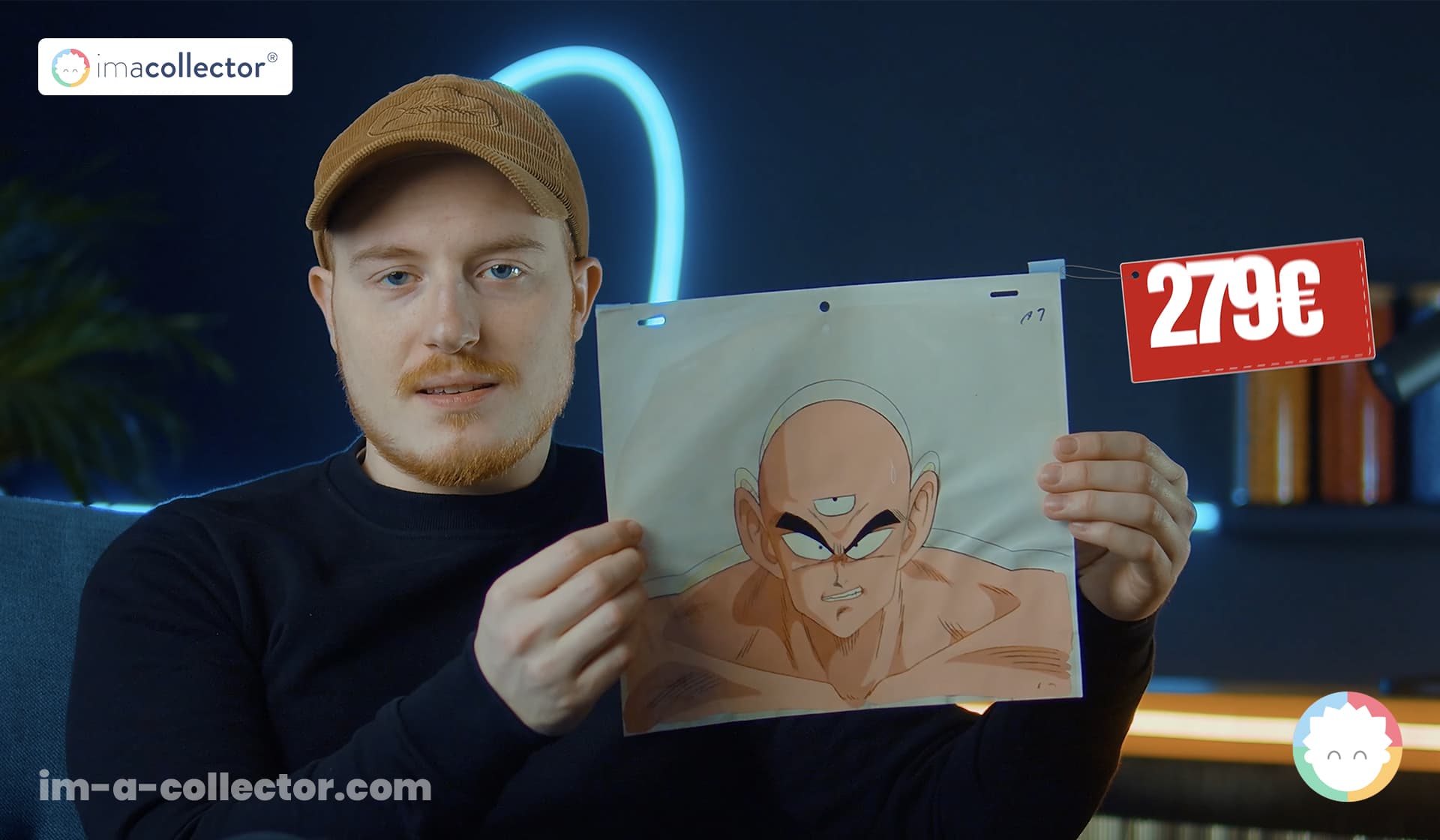
The video opens with an “original hand-drawn artwork used in the production of a Dragon Ball episode,” before clarifying that it is “more precisely” a cel. It only takes a few seconds, but the slippage has already happened. I was already ready to stop the video.
Why? Because in reality, an “original anime drawing” is not a precise category. In the traditional production of anime, you first have to distinguish between several families of objects:
- genga, which establish the key poses
- douga, which refine, clean up, and complete that work
- cels, which belong to the painted stage on transparent support
- layouts
- settei / character sheets
- storyboards
- backgrounds
- and finally, all the derived editions produced later for the market
Even the most basic educational resources on Japanese animation remind us that genga and douga are not the same type of drawing. In other words, reducing the subject of “original drawings” to cels alone already means telling the story with an impoverished vocabulary.
And that impoverishment is not trivial, because it shapes everything that follows:
- what the public believes to be rare
- what they believe to be “noble”
- what they believe to be expensive
- and what they believe to be authentic
Yet a cel is not automatically more important than a douga or a genga, at least not in my eyes. That is one of the things the video never explains, even though it should have been central to the subject.
A cel is attractive because it looks more like the final image. It is often the object the general public understands most quickly. But that immediate legibility does not automatically grant it greater artistic, documentary, or historical importance.
A genga may contain an essential movement decision.
A douga, on the other hand, can reveal a precision of line and construction that the final image will unfortunately erase. A layout can shed light on the very construction of a shot.
A background may preserve the atmosphere of a scene that the video no longer sees as anything more than “decor.”
So the market’s spontaneous hierarchy is not always the hierarchy of meaning. That is where a serious collector begins to differ from a casual buyer.
A serious collector does not simply ask: is it a cel? They ask: what exactly is this piece’s function? What does it say about the animator’s work? About the studio? What does it preserve that the screen has already absorbed, or will eventually erase?
The video never goes that far. It stays at the level of visual recognition. That may be comfortable, but it is nowhere near enough.
Problem N°2: a clickbait title for a world that first needs to be decoded and understood
“The shady business.” The title is designed for clicks. It is aimed at that gray zone of the YouTube audience that wants information and wants to know why it is supposedly shady. It sets up suspicion, curiosity, and intrigue.
But the video itself mostly shows something else: an introduction to cels, a long historical detour through Disney, a few spectacular auction results, some remarks about fakes, and finally a handful of very broad, overly general price ranges by the time it finally gets to the real subject, Japanese anime.
This video is not an investigation. It is a narrative. And it is a narrative that very quickly chooses what works best on YouTube: surprise, scandal, and the “look how ridiculous this is” effect.
The problem is that a subject like this does not need to be dramatized. It needs to be explained properly and understood.
Because this market is less shady than it is badly read. What makes it opaque is not only the presence of reproductions or counterfeits. It is the inability of so much content to understand the right categories and then clearly establish them.
At the very least, the video should have explained the difference between:
- material actually used in production
- an object derived from production material
- a limited edition made for collectors
- a decorative or commercial reproduction
- terminology that simply exploits the word “original”
Without that clarification, you are not educating anyone. You are just talking. This video is nothing more and nothing less than 23 minutes of talking.
Problem N°3: a video about anime that spends much of its time at Disney
This is probably the most visible editorial contradiction in the video.
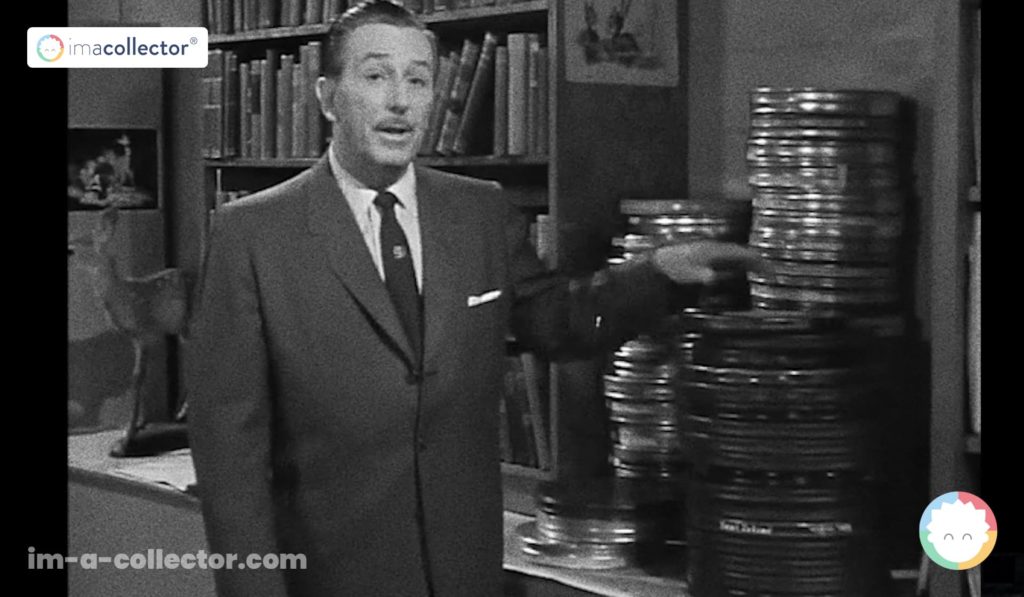
Its supposed aim is to explain why the resale of “original anime drawings” is shady. And yet Nicolas Delage devotes a large part of his argument to Disney, Christie’s, Sotheby’s, Roger Rabbit, The Little Mermaid, Beauty and the Beast, and then the CAPS system.
I do not dispute Disney’s importance in the history of the medium. No one can.
The CAPS system did indeed play a major role in the transition toward digital production. Disney’s official D23 site defines it as a system used to combine animation, backgrounds, special effects, and computer-assisted elements into the final film print.
Disney also notes that this technology received a Scientific and Technical Academy Award in 1992.
But this much-too-long Disney section produces a very simple effect: it fills a lot of space while leaving aside the very heart of the subject.
Because a video that genuinely wanted to explain original anime artwork should have spent more time on Japanese practices themselves:
- the concrete separation between production stages
- the different value of objects depending on their function
- the workings of the secondary market
- the way collectors identify a piece beyond its visual appearance alone
Instead, what we mostly get is a story about the symbolic inflation of cels in the post-Disney era, followed by a quick jump to Japan.
That may be narratively effective for YouTube. Intellectually, it is not very solid.
Problem N°4: the prices
This is where the video really loses its footing. I nearly stopped watching again.
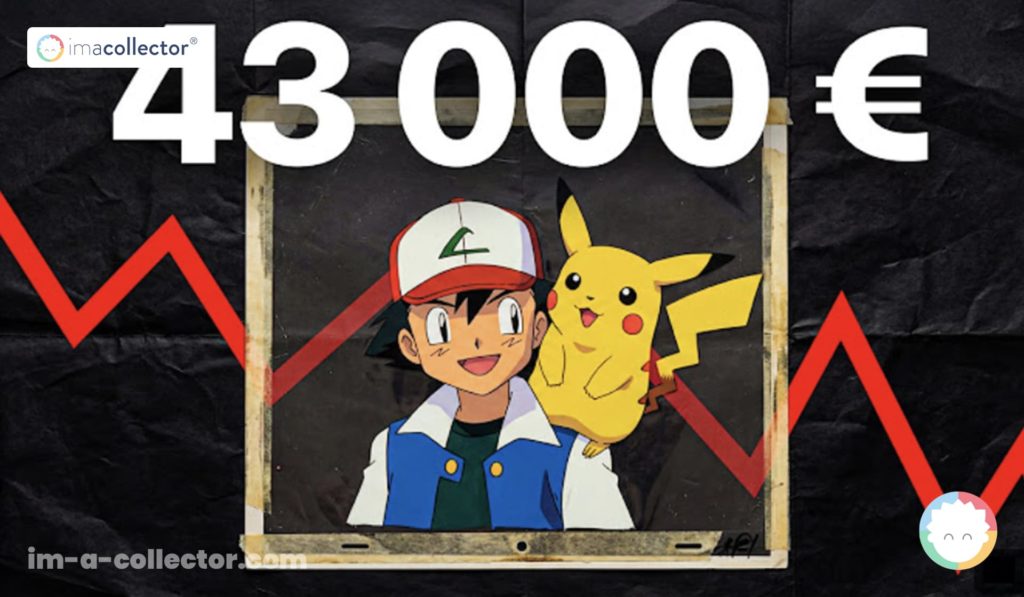
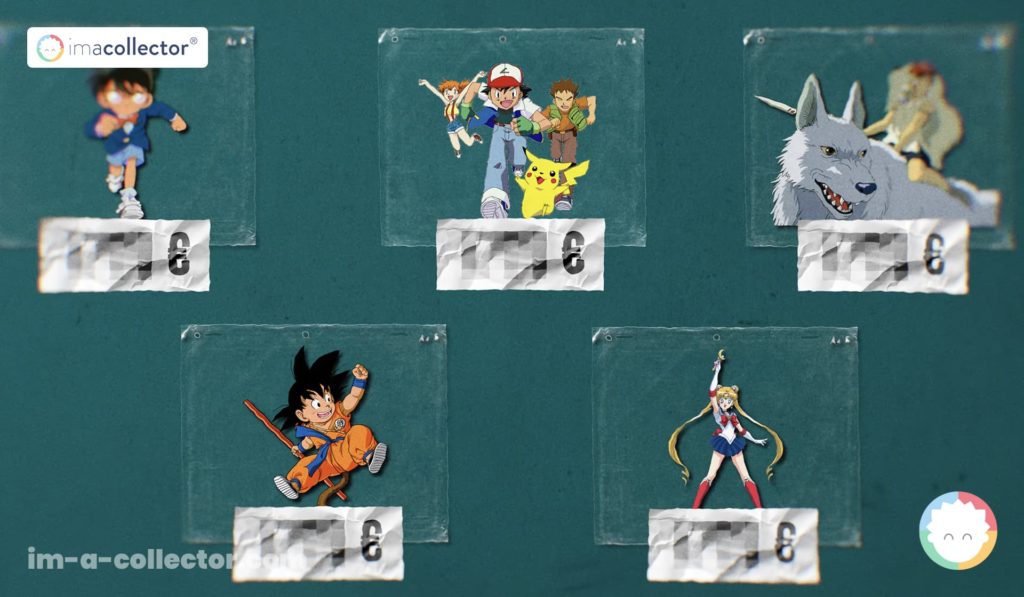
It claims that a Dragon Ball cel can be worth between 200 and 1,000 euros, that Detective Conan or Sailor Moon are around 100 to 400 euros, that Pokémon starts at 1,500 euros minimum, and that for a Miyazaki film prices can range “from a few hundred to several tens of thousands of euros.”
Presented like that, it sounds like a useful framework. In reality, it is not. Because the price of animation art does not primarily depend on the name of the license. It depends on a wide range of factors: the scene, the character, the composition, the number of visible characters, the presence of a background, the material condition, the provenance, and sometimes the emotional or iconic charge of a very specific shot.
Recent public sales are enough to show just how reductive these “average prices” really are.
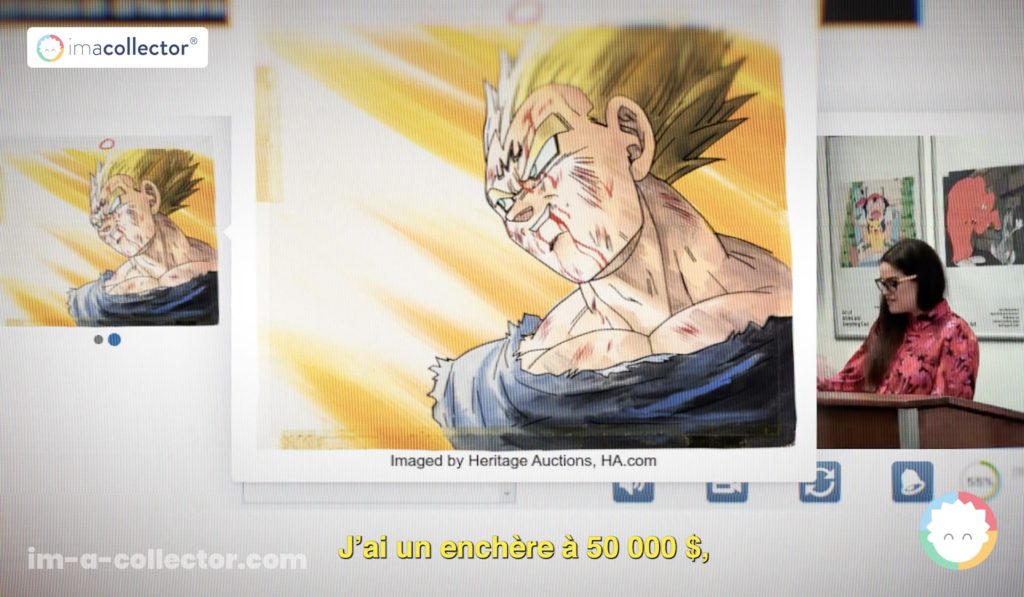
In March 2025, Heritage sold a Pokémon setup featuring Ash, Pikachu, Misty, Brock, and Togepi for $8,100. That same month, Heritage also recorded a Dragon Ball Z cel of Goku at $5,520, while other Dragon Ball Z lots in the same sale sold for around $750 to $840.
For Sailor Moon, an opening cel featuring Sailor Moon, Mercury, and Mars sold for $4,200, while other public results for the franchise have been far lower depending on the year, the characters, and the quality of the lot.
So no, saying “Pokémon starts at 1,500” or “Dragon Ball is 200 to 1,000” does not help anyone understand the market. On the contrary, it only creates an impression of the market. Not an actual reading of it.
And that is precisely the kind of mistake people make when they popularize a subject they have not worked on or understood deeply enough: they replace object-based analysis with a memorable price bracket.
What the market actually shows
The market does not say, “this franchise is worth this much.” The market says: describe exactly the object you are looking at, and only then can we begin to talk seriously about value.
That is what I have seen every day for the past 25 years.
Since Covid, platforms like Yahoo! Japan Auctions, Mercari, and now auction houses have shown both absurd price spikes for pieces of very low quality and weak interest, and at the same time insulting offers made to collectors who have owned far stronger, more meaningful, and objectively better pieces for years.
That gap is not an anomaly. It simply reveals that many buyers are still buying names, characters, or illusions of rarity, not objects they actually understand.
You also see buyers who cannot read Japanese paying far too much for copies because the mere appearance of a cel, or the word “original,” is still enough to trigger a buying reflex. Baka!
Beyond a certain point, this is no longer a specialist market. It becomes a market saturated with visual recognition. And that is exactly why a video like this is bad, and even dangerous.
Because it adds noise to a field that already suffers from being badly named.
The Ghibli case: where the video gets something right, then stops too early
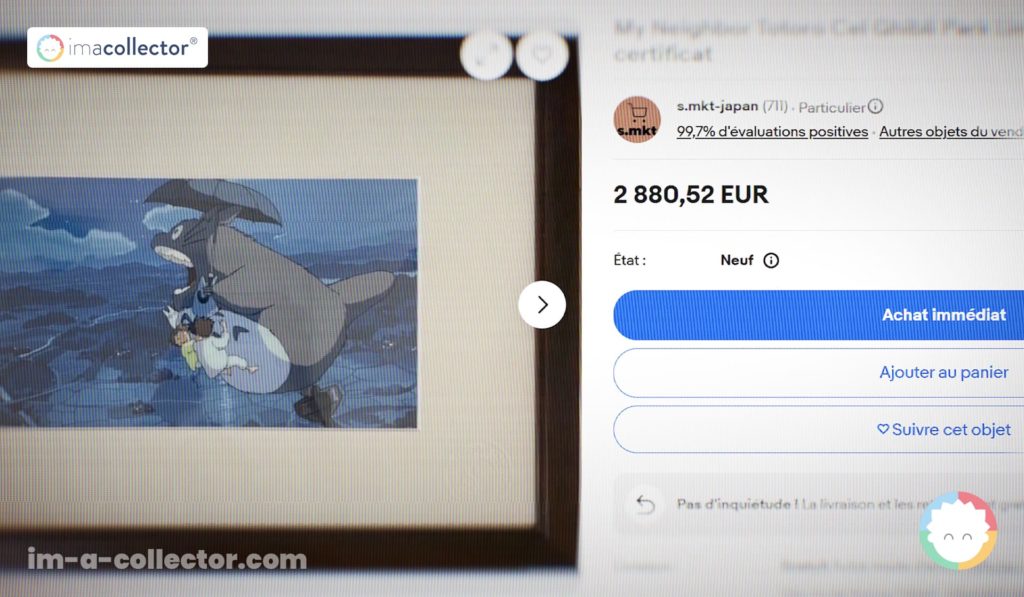
To be fair, the video is right on one important point. It reminds viewers that Spirited Away was not animated on cels, and that what is often found on the market under that label usually belongs to limited editions or collector reproductions, not actual production material.
That is correct. But it is only the beginning. Because the real lesson is not simply: be careful, this is not a real production cel. The real lesson is that an object can be:
- officiel
- rare
- expensive
- beautifulbeau
- legitimate for a collector
without belonging to the production process in the strict sense.
In March 2025, Heritage sold a Spirited Away Haku and Chihiro Limited Edition Cel for $4,800. The lot was described as a limited edition cel, not a production cel.
I have personally bought Fate/stay night rilezu pieces for more than €600 because they held emotional and qualitative value for me.
That is exactly the kind of distinction the video should have explained much more forcefully, because it completely changes how one looks at the object.
If you do not make that distinction, you do not clarify anything. You just add confusion to a video whose script is already badly weakened.
Problem N°5: the word “expertise”
The subject is complex. More complex than it looks. That is precisely why you cannot popularize it properly in twenty minutes with a few anecdotes, a long detour through Disney, four casually tossed-out price ranges, and a title aimed purely at attracting clicks.
The world of animation is much richer than that. Above all, it cannot be simplified without loss. When people try to popularize it without enough thought, they almost always end up erasing what is most precious about it: the depth of its making.
That is exactly what this video suffers from. It skims over a world made of traces, gestures, invisible hierarchies, and badly read secondary markets, then repackages the whole thing as a “shady business.”
The result is that viewers believe they understand the situation, when in fact they have only been given a simplified, spectacular, and ultimately hollow version of it.
And that hollow core is, in the end, the most troubling thing about it.
Twenty minutes for so little.
Twenty minutes that say almost nothing about douga, genga, layouts, settei, storyboards, backgrounds, edition cels, sericels, rilezu, or the real hierarchy between these objects.
Twenty minutes spent talking about “originals” without teaching the audience how to recognize what is actually in front of them.
Twenty minutes of life wasted.
At this point, the problem is no longer just the weakness of the information. I have made that clear enough.
Let us talk about an angle that is far too often forgotten: the material itself. Because you cannot seriously speak about these pieces without also speaking about their support. They are not just images. They are also old, fragile, and sometimes unstable objects.
Animation originals are made on materials that age, deteriorate, and demand proper conservation. That matters because an original animation piece is not simply a resale product or a souvenir to frame in a living room or hallway. It is first and foremost a material fragment of visual history.
Why does that matter? Because an animation original is not just something to resell, or a souvenir to frame in your living room (or your hallway…). It is first and foremost a material fragment of visual history.
And that is where the true value of these objects reappears. Not only in the price. In the trace. The trace of a process, of a gesture. The trace of an intermediate state of the image, before it was absorbed by the film, and then by the viewer’s memory.
I should add that I found the images used throughout this video more interesting than its creator’s rant. Most of them were well chosen and, at last, brought some actual value to the whole thing.
The moment a video reduces this world to an economy of resale, it diminishes the very thing it claims to reveal.
What this video should have done
First, it should have been more modest and therefore more useful.
In my view, it should have:
- clearly named the categories of objects
- explained why a cel does not exhaust the subject
- shown that not all “expensive” pieces are production pieces
- broken down prices through real case studies rather than franchise names
- reminded viewers that authenticity is never reducible to appearance alone
- placed these objects within a logic of heritage, not just the market
Instead, it chooses the title. Then it chooses the pacing. Then it piles on the shock. But with a subject like this, shock is rarely what is missing.
What is missing is not only knowledge, but precision.
Conclusion
Nicolas Delage’s video is not disturbing because it is entirely false. It is disturbing for something worse than that.
It takes a complex world, simplifies it, dresses itself up in pseudo-expertise, and delivers it to the public under a sensational title that promises revelation while offering neither a real taxonomy, nor a real method, nor anything close to real depth.
The subject deserved better. It deserved an explanation that finally made clear that not all “original drawings” are equal, do not look alike, and do not tell the same story.
I wanted someone to remind viewers that a cel is not automatically nobler than a genga or a douga. I wanted someone to show that prices are not the most interesting part of any of this.
This should have been about explaining, not selling.
So before making an “explanatory” video on a subject like this, you really need to work on the field, the objects, the words, and avoid lazy shortcuts.
And above all, avoid clickbait titles when you are barely brushing with your fingertips the thing you claim to reveal.
Because in the end, the real issue is not whether the market is “shady.” It is whether we actually know what we are looking at.
And on that point, I do not need to make a video. I only need to put things back where they belong.
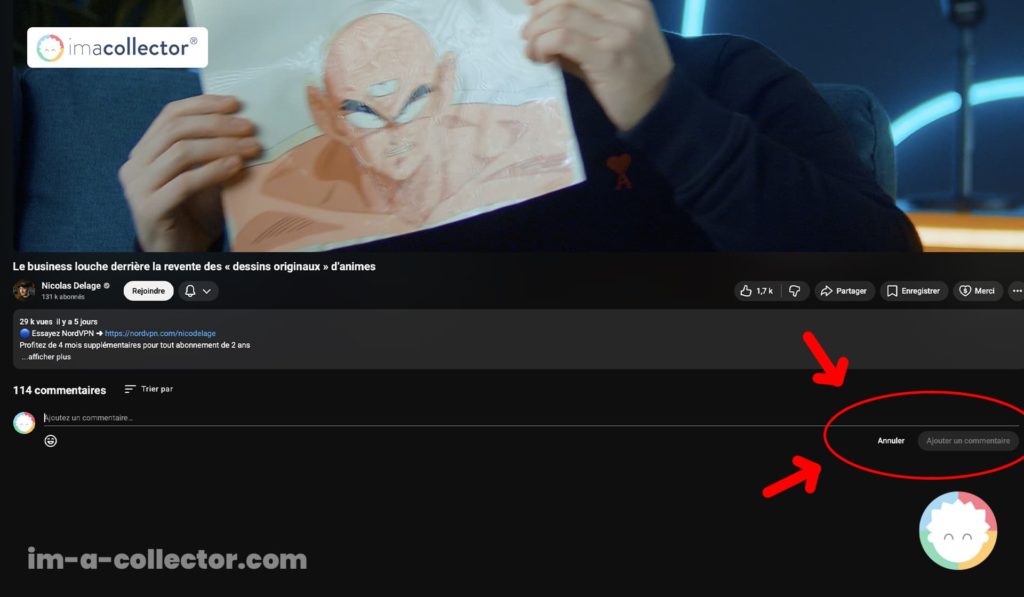
A final anecdote: I shared my article with Nicolas Delage on YouTube and left two or three comments to explain my point of view after some off-topic replies. The result? I am now blocked from commenting on Nicolas’s videos. Blocking someone after a reasoned critique does a very good job of confirming how superficial the whole treatment really was.
Article produced by imacollector® — an editorial archive dedicated to the memory and heritage of Japanese pop culture.
Content published for informational and documentary purposes. All rights reserved to the respective rights holders.