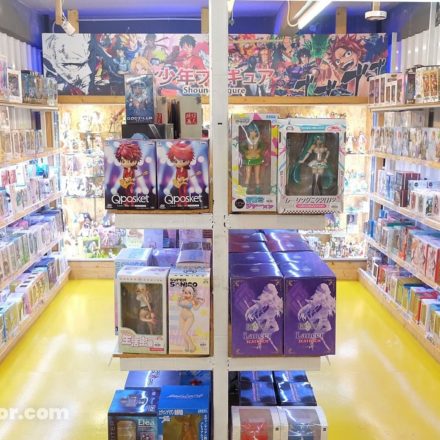


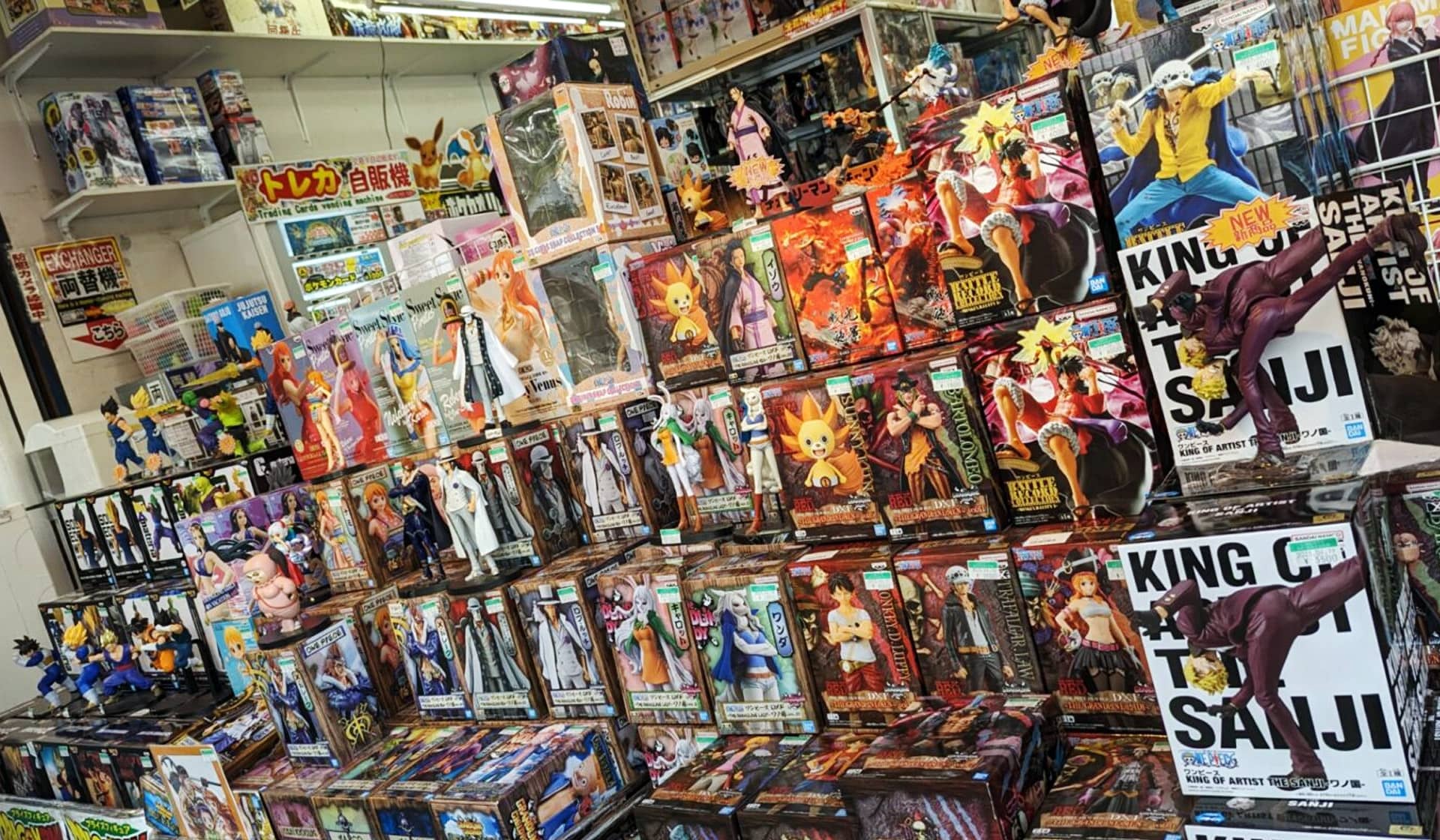
How to start an anime figure collection: the beginner’s guide that actually helps

Starting an anime figure collection gets expensive fast if you buy without a plan. This guide helps you choose the right figure lines, set a realistic budget, and avoid the beginner mistakes that ruin a collection early.
Sommaire
- What you will find in this guide
- define your collecting focus before you buy
- Understanding the main figure categories
- Prize figures (Banpresto, SEGA, FuRyu…)
- Scale figures (Good Smile Company, Kotobukiya, Alter)
- Nendoroid (Good Smile Company)
- Figma
- Garage kits et résines
- Setting a realistic budget
- Buying from the right places
- Avoiding beginner mistakes
- Protecting and displaying your collection
- Going further and collecting with more discernment
- Conclusion
You want to start collecting anime figures, but you are not quite sure where to begin. A series, a character or a whole universe speaks to you, and you keep coming across pieces you genuinely like. You know the prices, but they vary wildly, the formats are all over the place, the sellers are countless, not to mention pre-orders, limited editions and everything else that comes with it. Before long, it can feel like simply buying things here and there is enough to build a collection.
Unfortunately, it is rarely that simple. When you are just starting out, the real problem is not a lack of interest. Quite the opposite. What you are really missing is a clear set of reference points. That is exactly why I created this guide.
Between prize figures, scale figures, Nendoroids, Figmas, counterfeits, surprise customs fees and the pressure created by rarity, it is very easy to buy too fast, buy poorly, or buy without building anything coherent.
At first, you do not really notice it. But believe me, over time, you can easily end up with a collection that feels confused, frustrating, sometimes expensive, and far removed from what you actually wanted to build.
This guide was written to help you avoid that. The goal is not to push you to buy more. The goal is to help you start better.
You will see how to define a clear collecting focus, understand the main figure categories, set a realistic budget, buy from the right places and avoid the mistakes that can ruin a collection before it has even truly begun.
Because a collection does not need to be huge to be strong. What matters most is that it is clear, coherent and fully owned.
What you will find in this guide
- how to define a clear collecting focus
- which figures to choose based on your budget and collecting profile
- how much to set aside to get started without draining your budget
- where to buy without getting burned
- which mistakes to avoid so you do not build a shaky collection
define your collecting focus before you buy
One of the first mistakes people make when starting out is believing that their collection begins the moment they buy their very first figure. The reality is very different, because your collection starts much earlier than that.
It begins the moment you make a choice.
You can love many universes, many characters and many designs. That does not mean everything deserves a place in your home. Just because a figure is well made does not mean it automatically belongs in your collection. I know that from experience, because there was a time when I bought anything connected to my favorite series, whether it was Saint Seiya, Hunter X Hunter, Tenjo Tenge or others.
So before you start looking at prices, shops or pre-orders, ask yourself a much more important question: what do you actually want to collect?
You can build your collection around several different approaches:
- a single license you care deeply about, as I did with Fate
- one character you want to follow over time
- a specific product line
- a particular aesthetic
- a tightly focused collection built around a few strong and rare pieces
- a more archival approach, where you keep fewer objects, but choose them more carefully and more specifically
Honestly, there is no single right focus. On the other hand, there are plenty of collections that end up scattered over time, sometimes from the very beginning, simply because they were built without a clear direction.
If you buy on impulse alone, you may feel like you are treating yourself at first. But very quickly, you can run into the same problems I did: too many licenses mixed together, too many small purchases, not enough coherence, not enough space, not enough distance, and above all a vague frustration in front of a collection that does not really say anything precise.
Choosing a focus does not mean frustrating yourself.
Choosing a focus means giving yourself a guiding line. And that line will shape everything else in your collection: your budget, your space, your trade-offs and your long-term satisfaction. Your collection is not built only through what you decide to buy. It is also built through what you decide to leave aside.
Understanding the main figure categories
When you are new to this, it is easy to feel that all figures are more or less the same. In reality, they do not answer the same expectations at all.
Some are designed to stay accessible. Others aim for a higher level of finish. Others focus on modularity, articulation or display possibilities.
If you do not understand those differences from the start, you may end up paying too much for a line that fits neither your budget, nor your tastes, nor the way you want to collect.
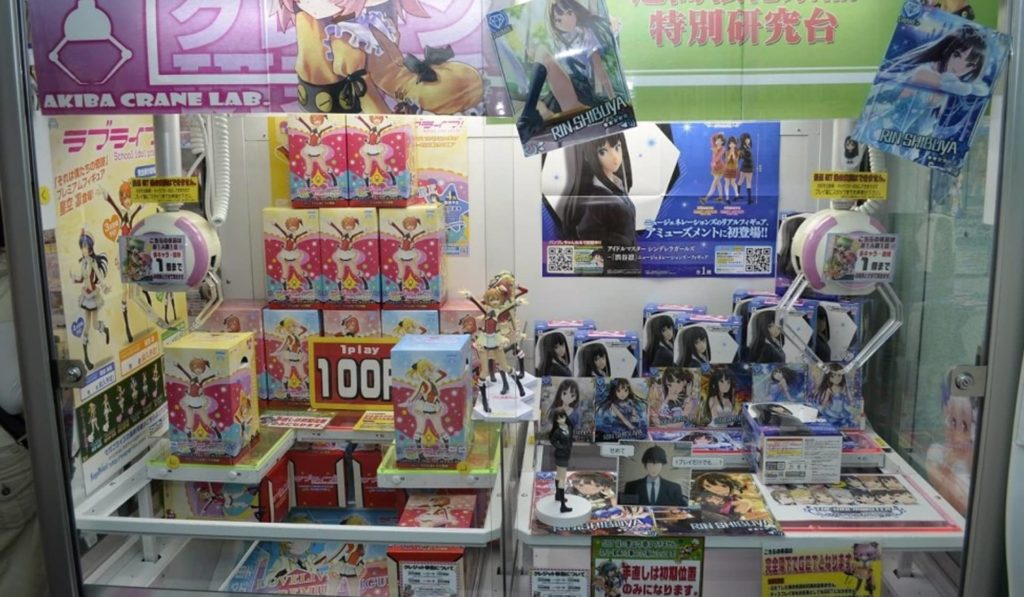
Prize figures (Banpresto, SEGA, FuRyu…)
Prize figures are often the first real gateway into anime figure collecting.
Their main strength is accessibility. They are usually not very expensive, easier to find, and make it possible to discover a license or a character without a heavy financial commitment. If you want to test out a universe, get started without taking too big a risk, or avoid putting a large budget into a single piece right away, they can be a very good option.
But you need to stay clear-eyed. Not all prize figures are equal. Some are very successful for their range, while others are far less convincing. Faces, proportions, paintwork, stability and overall presence can vary a great deal.
You need to choose them carefully.
A good prize figure can be an excellent first purchase. A string of small prize figures bought without any guiding line can quickly turn into a pile with little real value.
Prize figures are ideal for starting a collection without overspending, because they offer a solid balance between accessibility and collecting enjoyment.
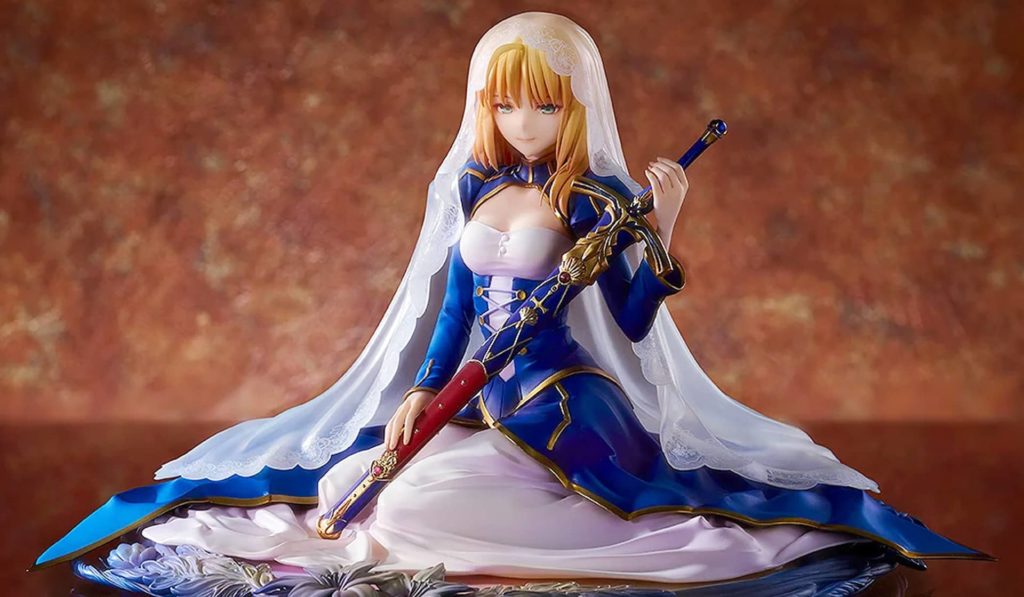
Scale figures (Good Smile Company, Kotobukiya, Alter)
Scale figures usually belong to a much more ambitious segment than prize figures. In most cases, they offer better sculpt quality, better paintwork, stronger visual presence and a far more refined overall finish.
If you want a piece with more impact, something more memorable and more central within your collection, a scale figure can answer that expectation very well. One well-chosen scale can sometimes be enough to establish a universe or give real structure to the beginning of a collection.
But they also require more distance and more thought, because their price is higher, their impact on your display space is often greater, and buying one commits you more strongly.
If you start straight away with a scale figure without knowing where you are heading, you can end up with a beautiful piece that still lacks any real logic.
So starting with a scale is not necessarily a mistake. Starting with a scale without thinking about what comes next can become one.
Scale figures are often seen as the premium pieces in a collection, and they frequently become the centerpiece of a display case.

Nendoroid (Good Smile Company)
Nendoroids occupy a place of their own. Personally, I love them, and I own hundreds of them.
Their chibi format, interchangeable faces, accessories and modular nature make them especially popular with fans and collectors. If you like compact, expressive pieces that are easy to display and visually flexible, they can suit you very well.
They also have an obvious advantage if you do not have much space. You can bring together several characters without filling up your display area too quickly.
But this format does not speak to everyone. If you are looking for something more faithful in scale, more sculptural or more serious in its overall rendering, you may find yourself less attached to them over time.
So the real question is not, are Nendoroids good? The real question is, does this format fit the way you want to collect?
Fun and highly customizable thanks to interchangeable faces and accessories, Nendoroids are perfect for collectors who enjoy staging their figures in a humorous or decorative way.
Figma
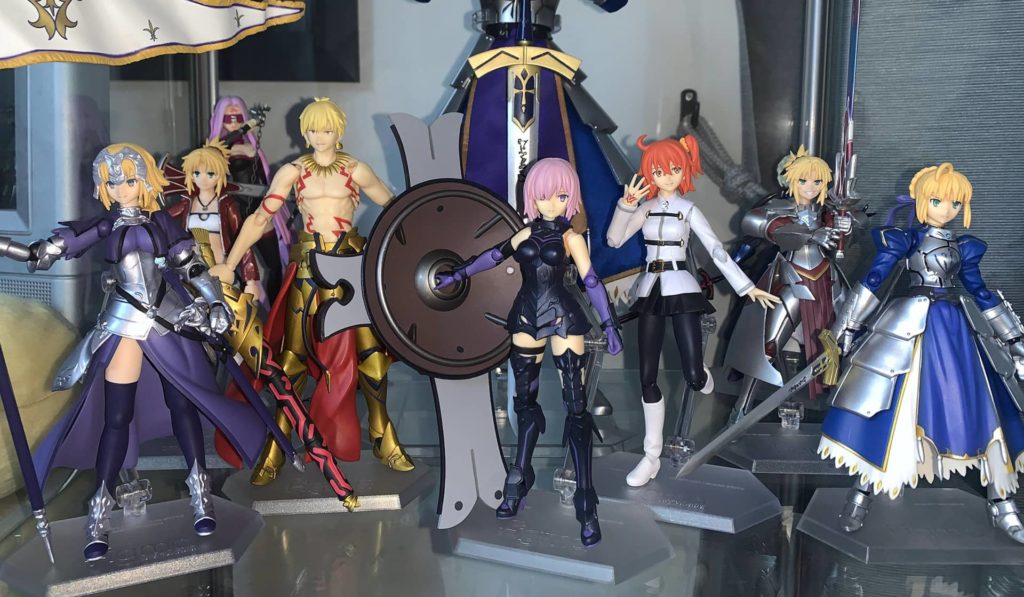
Figma figures tend to appeal more to people who enjoy posing, movement, handling and often photography as well. Their articulation can be a real advantage if you want to vary how they look in a display case or simply bring more life into your setups.
But again, that approach is not for everyone. If what you want above all is a display collection that feels stable, visually strong and closer to a museum presence than to something playful, Figma may not be your ideal entry point.
They can even create an aesthetic break if you mix several object types too quickly without a clear direction.
They are perfect for staging battles or a wide range of situations. They are also very popular among collectors who photograph their figures.
Garage kits et résines
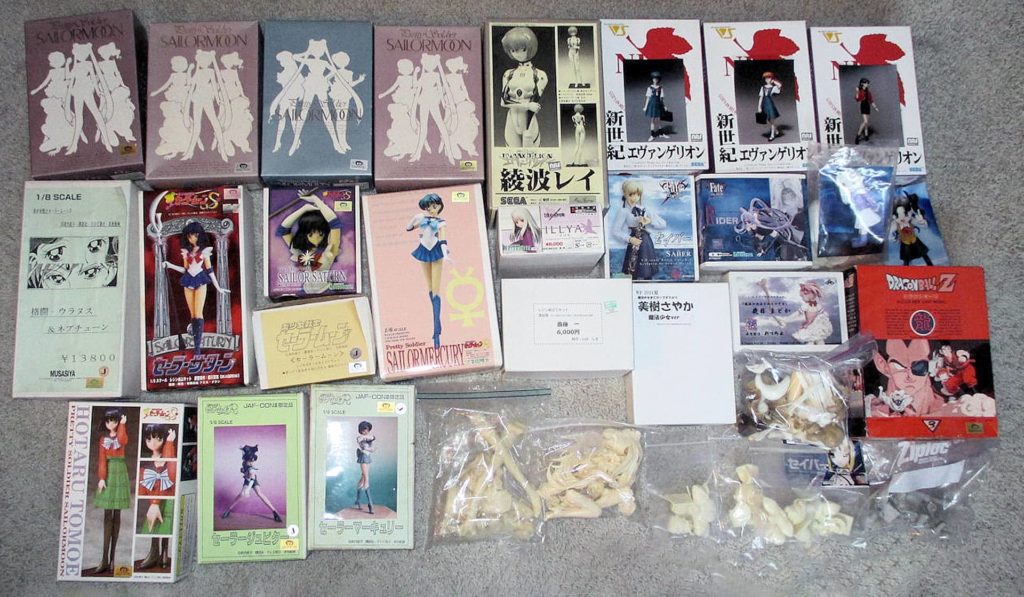
I have a real passion for this type of product and a genuine soft spot for it. Garage kits and resin pieces make a strong impression from the start. Some are spectacular, highly detailed, visually powerful, sometimes rarer and sometimes much more imposing.
But if you are just starting out, they are generally not the best entry point. These pieces often require a bigger budget, sometimes a very big one, more space, more vigilance, and sometimes more maturity in your choices, especially when finish quality can be tricky and assembly or painting may also come into play.
They can be magnificent, but they are not there to compensate for a lack of direction. Never forget that you do not need to start with what looks most impressive. You need to start with what truly makes sense for you.
For me, this represents the pinnacle of collecting, reserved for passionate and experienced collectors.
Each piece is a true work of art.
Setting a realistic budget
At the beginning, it is easy to think that you will only overspend on one or two major exceptional pieces. The reality is very different, because many collections become expensive through a chain of small, poorly considered purchases.
That is exactly why a clear budget changes everything.
Your budget is not there to frustrate you. Quite the opposite. It is there to stop you from building an unstable collection. When you look at a figure, do not stop at the listed price.
You need to look at the bigger picture:
- the price of the piece
- shipping costs
- possible import fees or customs charges
- display-related costs
- impulse purchases that add themselves on the side
If you only look at the purchase price, you are ultimately seeing just one part of the real cost of your collection.
Another common trap is believing that a cheaper piece is automatically the more reasonable purchase. Unfortunately, that is far from always true. A more expensive figure, if it is genuinely well chosen, can sometimes make far more sense than a series of smaller pieces bought without any logic.
So the right question is not only: how much does this figure cost?
The more important question is: why does it deserve a place in my collection?
If you want to make things easier for yourself, start with a few simple rules:
- set yourself a monthly or quarterly budget
- always keep some room for the unexpected
- avoid buying across several licenses at the same time if your focus is not yet clear
- do not let fear of missing a piece dictate your choices
A beginner collector rarely runs into trouble because of one single figure. More often, the damage comes from a chain of poorly thought-out decisions.
Get the beginner collector kit
Do you want to move forward without burning yourself out?
Sign up and get the beginner collector kit: it will help you avoid the 20 most common mistakes
- a pre-purchase checklist
- a short glossary of what is out there
- a simple method for choosing your collecting focus
- a budget sheet to better structure your purchases
No spam. Just useful resources to help you collect with more discernment.
Buying from the right places
Knowing what to buy is one thing. Knowing where to buy is another.
Like anyone else, your first instinct may be to look for the best price above all else. That is understandable and natural. But it is not the best way to think.
Buying for less means nothing if you are buying badly.
You can find a piece at a price that looks attractive and still end up with a questionable seller, a counterfeit, poor condition, a damaged box, hidden fees or a buying experience that leaves a bitter taste.
There are several places where you can buy:
- specialized stores
- Japanese platforms
- second-hand channels
- specific pre-orders
- broader marketplaces
Each of these channels can be useful, provided you understand what you are doing. Specialized stores are often more reassuring at the beginning, especially for new items and pre-orders.
Second-hand buying, on the other hand, can be excellent if you know how to read condition, descriptions, boxes and listings properly. I will admit that this is where I have found my best deals and where I spend most of my time.
Japanese platforms can offer very good opportunities, but they require more attention when it comes to costs, delivery times and shipping methods. And in recent years, it has become even worse: shipping prices, the number of damaged parcels and customs charges have all surged.
Here again, the real danger is not only technical. It is psychological above all. You are most likely to make a bad purchase when you are in a rush, excited, or convinced that you have to act immediately or miss a good opportunity.
And that sense of urgency leads to a great many mistakes.
A good purchase is one that makes sense, that you understand clearly, that fits your budget, and that is genuinely aligned with your collecting focus.
Avoiding beginner mistakes
When you are starting out, you may imagine that your biggest mistakes will mostly be outside your control, like buying an expensive counterfeit, dealing with a dishonest seller or pre-ordering just anything.
Of course, those mistakes do exist. But the most common ones are often more discreet.
The first is wanting to collect everything at once. In that area, I was a champion back then. Several licenses, several lines, several formats, several logics. Very quickly, that leads to a scattered collection with no coherence.
The second is buying too quickly. Again, something I did far too often. You see a rare piece or one that really appeals to you, and you react instantly, telling yourself that this is the right moment. Most of the time, you need to do the exact opposite: take your time, think, and weigh the pros and cons.
The third is copying other people’s collections. Seeing beautiful display cases can be inspiring. But if you reproduce a logic that is not your own, you may end up buying pieces you will look at with far less attachment a few months later. That is exactly what happened to me with my Myth Cloth collection, which I eventually sold a few years ago.
The fourth is neglecting your space. A figure is not just an object you buy. It is an object you need to place, display, protect and integrate into a whole. It is a rule I ignored for a long time, and one that causes me major logistical problems today.
The fifth is giving in to FOMO. Pre-orders, announcements, rarity, the last available units and the fear of missing a piece are powerful forces. But a collection guided by urgency rarely becomes a solid one.
The sixth is confusing popularity with relevance. Just because a figure is shown everywhere, sought after by others or valued by the market does not mean it automatically deserves a place in your home.
What damages your collection is not only a lack of money. Above all, it is a lack of direction.
Protecting and displaying your collection
Always remember that your collection does not end at the moment of purchase.
A figure that is poorly displayed or poorly stored can lose quality much faster than you imagine. Dust, direct light, excessive heat, humidity and repeated handling can all leave their marks over time.
When you are starting out, it is easy to push that issue into the background. And yet the way you display your figures already says something about the way you collect.
Whenever you put a piece on display, you are always choosing what to bring forward. Whether you mean to or not. You are also choosing what to protect. You also shape how your collection will be read, perceived, and understood.
Here are a few simple principles that already make a big difference:
- avoid direct sunlight
- limit exposure to dust
- check the stability of your pieces
- do not overcrowd your figures
- keep the boxes if they are genuinely useful for storage or transport
- think through your space before filling it up
Tu n’as pas besoin d’une installation haut de gamme pour bien faire. Tu as surtout besoin d’un peu plus d’attention que la moyenne.
A well-preserved collection is not necessarily an impressive one. More often, it is a collection that has simply been thought through more seriously.
Going further and collecting with more discernment
If you have made it this far, you have already understood something important: starting an anime figure collection is not just about buying your first pieces.
Above all, it is about learning to look at what you are doing and how you are doing it.
There are countless ways to collect. You can collect for pleasure, for memory, for the beauty of a design, for a character who has stayed with you over the years or one you suddenly fell for, for a work that marked you deeply, or simply because certain pieces make you want to build a world that feels like your own.
All of those reasons are valid, without any doubt.
But the further you go, and the more time passes, the more one question starts to matter:
What does my collection really say?
A strong collection does not need to be huge. It does not need to be spectacular either, and even less does it need to follow every market trend.
Above all, it needs to be coherent.
Because it should show that behind it there is something more than a sequence of purchases. Collecting well is not about owning everything. And that took me a long time to understand.
It is above all about knowing what you truly want to keep in your home.
Collecting well is not about piling things up to impress others. It is about building a coherent whole that reflects you and, above all, speaks to you.
That is when a collection becomes more interesting. No longer as a series of compulsive consumer purchases, but as the extension of a gaze, a memory and a standard.
Conclusion
Starting an anime figure collection can feel intimidating at first. You see countless offers, many different figure lines, wide price gaps, plenty of conflicting opinions and, more and more, a constant pressure to buy quickly before you miss something.
The good news is that you do not need to move fast to start well. You do not need a large number of pieces to build a good collection. And you do not need to aim straight away for the most expensive or most impressive figures either.
What you need is:
- a clear focus
- a realistic budget
- and a little patience, because yes, you will need it
The rest will come with time. A collection is built as much through your choices as through what you decide not to pursue, and believe me, I know exactly what I am talking about.
That is often where the difference is made between a mere accumulation of objects and a whole that genuinely means something.
Si tu veux commencer de la meilleure des manières, souviens toi de ceci : le vrai cap n’est pas de posséder plus, c’est de collectionner mieux.
So, are you ready to get started?
Want to avoid the mistakes most beginners make? Get the kit
Nothing could be simpler. Sign up and get the beginner collector’s kit.
It will help you avoid the 20 most common mistakes.
- a pre-purchase checklist
- a short glossary of what is out there
- a simple method for choosing your collecting focus
- a budget sheet to better structure your purchases
No spam. Just useful resources to help you collect with more discernment.
Article produced by imacollector® — an editorial archive dedicated to the memory and heritage of Japanese pop culture.
Content published for informational and documentary purposes. All rights reserved to the respective rights holders.