

Thierry Fourcassier: when the myth of a collector begins to crack; a personal reflection on passion and its illusions

After twenty-five years of collecting, I find myself looking back—not to glorify a journey, but to question the myth I unknowingly built along the way.
This is not a story about trophies or record prices. It is a reflection on silent frustration, on the distortions created by money and comparison, and on the maturity required to collect differently—more consciously, and with meaning.
Sommaire
Twenty-five years of collecting
I’ve been collecting for twenty-five years. It’s a sentence I almost never use as an argument from authority. Simply because it says nothing about the quality of a collection, nor the accuracy of one’s perspective.
It only speaks of time. Time spent searching, learning, desiring, and renouncing. Time spent understanding that some images stay with us for a lifetime, even when they never belong to us.
When I started, I had very little: no money, no network, no strategy.
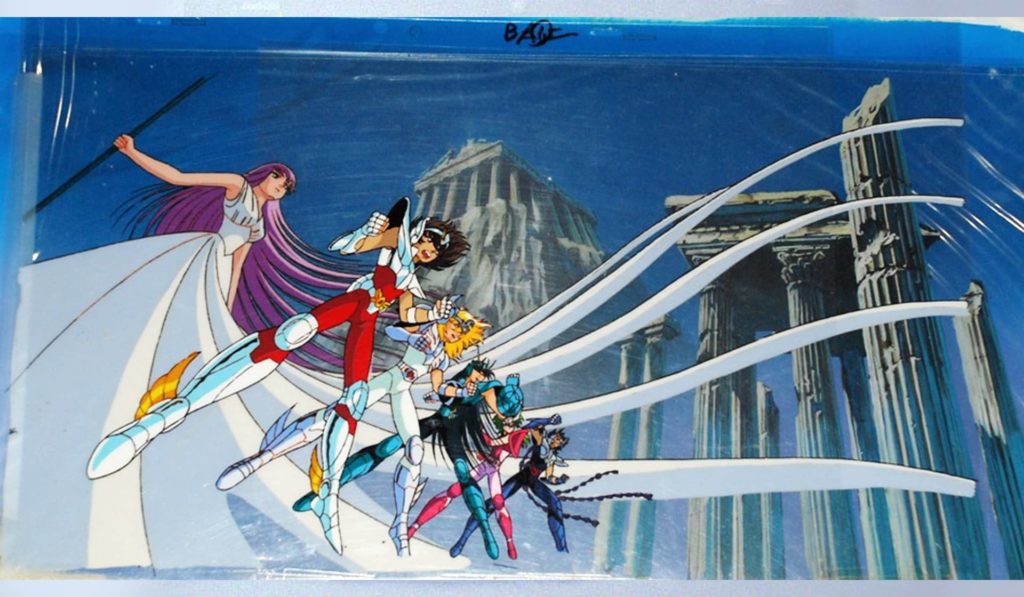
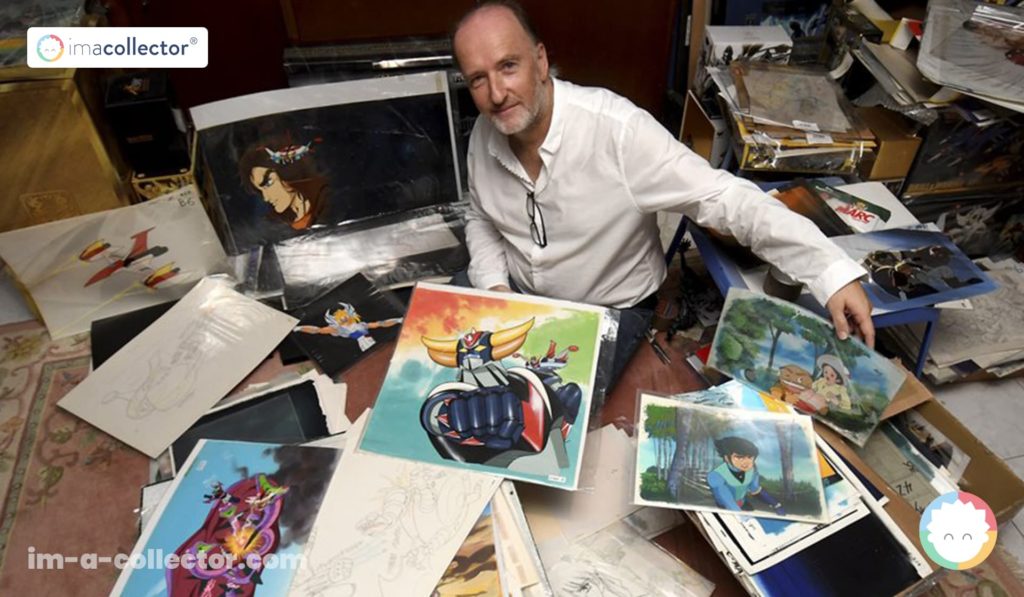
I was passionate. A fan. Someone for whom a cel or a douga was not just an “object,” but a tangible trace of a world that had mattered in youth or adolescence. A material proof that those works had existed somewhere beyond my memories.
Very quickly, however, the auction world imposed itself: platforms, timed sales, lots disappearing in seconds.
And with them, names. Often the same ones. Names you do not really know, yet keep coming back at the decisive moment, when the price suddenly shifts. When the object slips out of reach.
For years, Thierry Fourcassier was one of those names to me. I didn’t really know him, and I only exchanged with him very rarely. I knew almost nothing about his life, his path, or his motivations.
But I saw him win. Again and again. Cels, dougas, major pieces… at prices I couldn’t even consider paying.
The birth of a myth
In fact, the birth of a myth is never entirely conscious. I think all collectors end up creating myths. Never deliberately. It’s almost mechanical.
When the same people consistently access what escapes us, we begin to attribute special qualities to them:
- a superior understanding of the market
- a decisive head start
- a kind of natural legitimacy
For a long time, I told myself he had been there earlier. Older. Better established. That he had known a time when prices were still accessible. When buying didn’t require sacrificing something else.
And above all, he seemed to have money. That idea served as an explanation. Almost as comfort.
Almost a form of consolation. If I could not get there, it was not for lack of passion, but because I had not been born at the right time, because I simply did not have the right means. Because I wasn’t “in the right world.”
As the years went by, that feeling changed. The fascination remained, but it became tinged with frustration, sometimes even with a sense of injustice, or shame. The shame of not being able to keep up financially. The shame of feeling excluded from a world I loved deeply, simply because I could not spend thousands, or even tens of thousands of euros, on a piece I longed for.
For a while, I hoped. I believed that one day, I too might compete.
Then something broke. That world, where everything was negotiated at absurd sums, began to repel me. I distanced myself. I wondered if it was still for me at all.
Fascination with excess
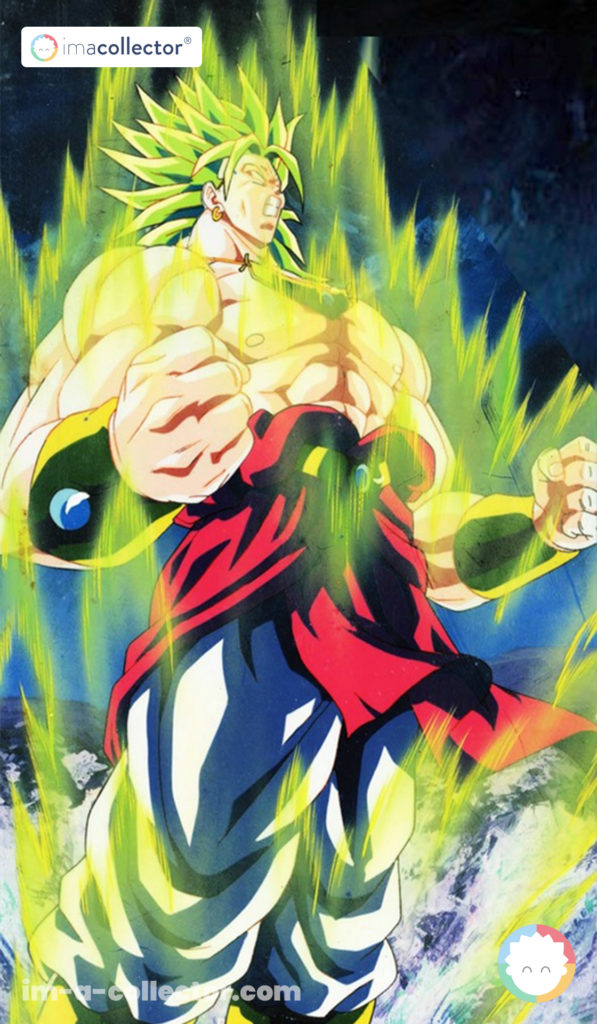
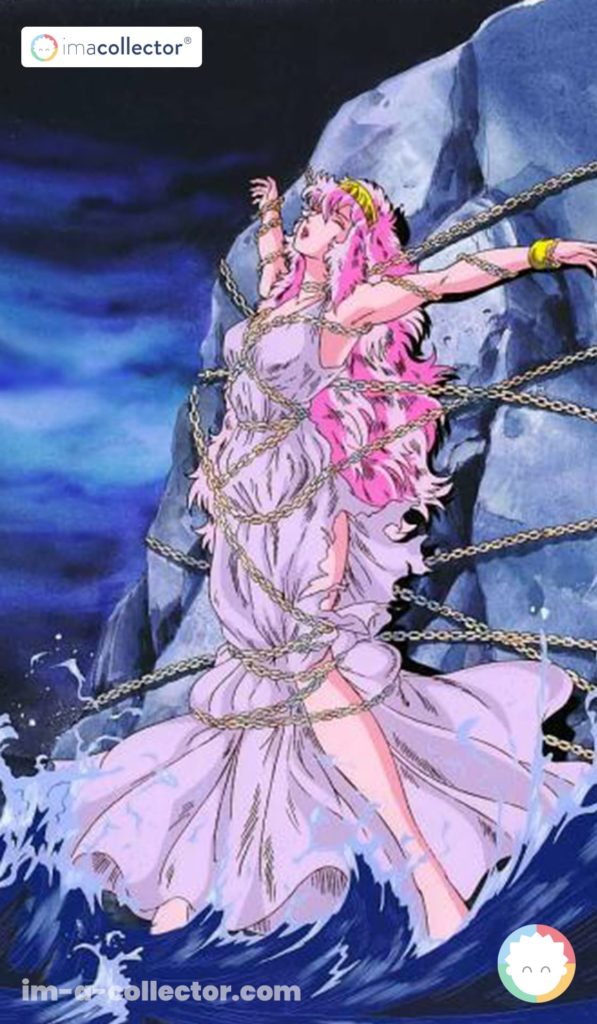
With hindsight, though, I can admit it plainly: what fascinated me back then was not only the beauty of the pieces. It was also the excess. Rarity pushed to an extreme. The idea that a collection could become a kind of private museum, inaccessible, almost unreal.
I looked at these accumulations the way one looks at the Louvre: impressed, overwhelmed, and yes, a little envious.
Like many others, I sometimes idealized the object at the expense of its context. At first, price erased almost everything else. It became proof in itself.
That was my blind spot: a lack of distance. A confusion between emotional value and market value.
Between late 2022 and 2025, I stepped away. Properly. I needed distance. I needed to remember why I had started in the first place.
I needed to escape a logic where every lost auction felt like a personal failure.
A delayed shock
Then, in early 2026, almost by chance, I came across an old Facebook post from 2024.
I read it. Then read it again. I tried to understand, and little by little, I did. And then, all at once, I realized that while I had stepped away, things had happened.
Public information. Press articles. Investigations. Documented, accessible, sourced facts.
I was stunned. Not because these facts existed, but because they collided head-on with the image I had constructed for years.
Everything I thought I understood about that world cracked at once.
And gradually, without realizing it, my perspective shifted.
What truly collapsed
Contrary to what one might expect, my first reaction was not anger. Nor sadness.
It was something more unsettling: relief.
As if an invisible weight had lifted. As if I could finally accept that this wasn’t purely a personal failure. That my frustration wasn’t just the sign of a lack or a delay.
In truth, what collapsed was not a man. It was a myth. A myth I had built, fed, and sustained without even realizing it.
I understood something essential: we never envy a real person. We envy a story we tell ourselves. A narrative that helps explain what we cannot reach.
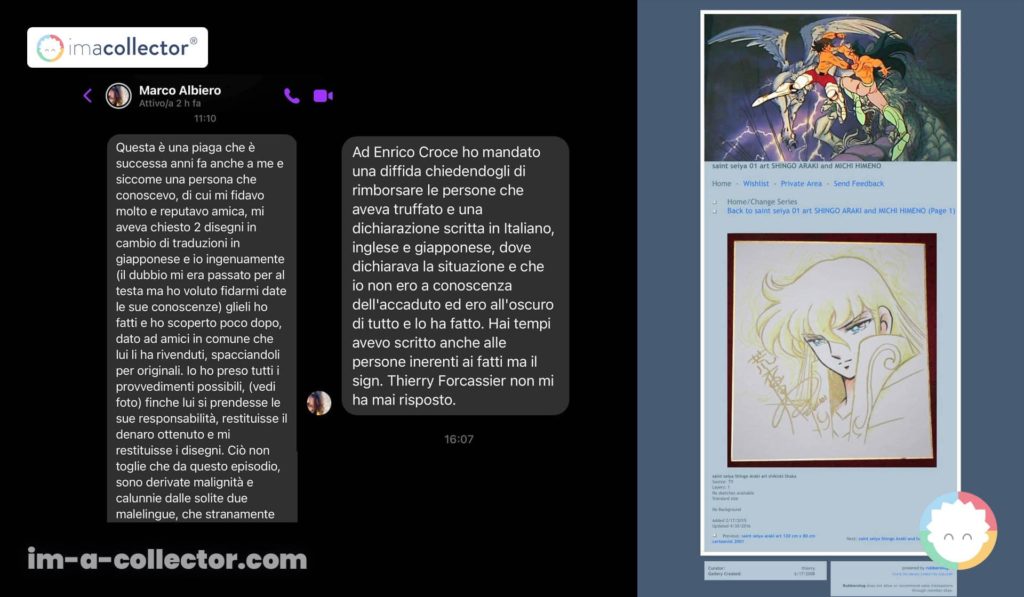
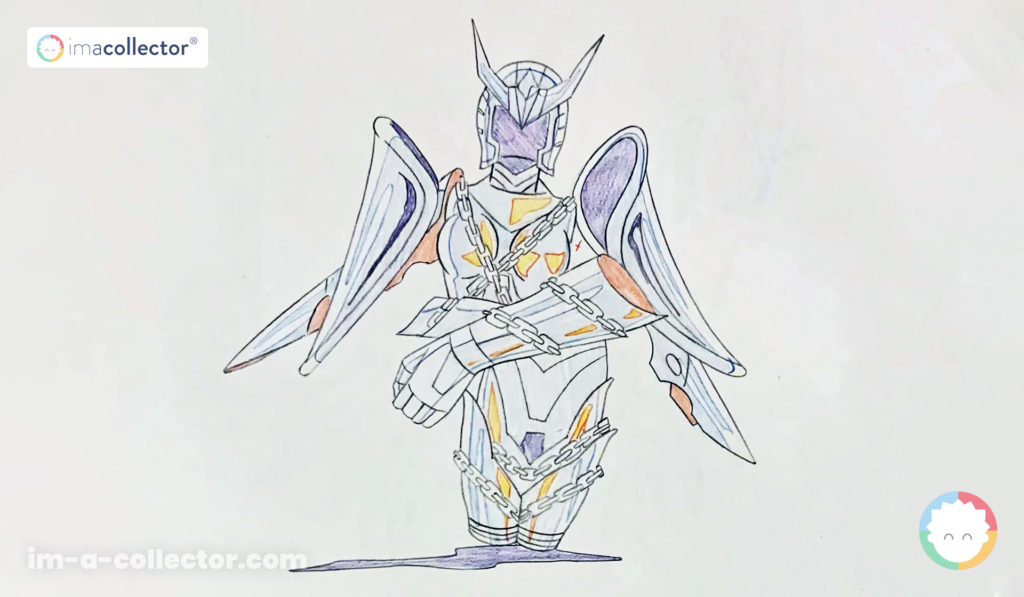
Another element clarified this blurred area: a public exchange involving Marco Albiero, an Italian illustrator known for his work around Saint Seiya. In this message, he explains that years earlier he produced illustrations at the request of a third party, without any intention to deceive or to pass them off as another artist’s work. He describes his surprise upon discovering that some of these pieces had circulated with incorrect attribution, and the steps he claims to have taken to correct the situation.
Reading this reminded me of something fundamental: in the world of collecting, images often travel faster than their context. And when context is not questioned, misunderstandings can harden into certainties.
A moral responsibility
Over time, one idea became unavoidable: collecting is not a neutral act.
There is a moral responsibility in owning, displaying, buying, and driving prices upward—a responsibility toward the works, the artists, and other enthusiasts.
Those who watch. Who dream. Who compare themselves.
If I were speaking today to a young collector, I would tell them three simple things:
- Stop comparing yourself
- Never buy at any price
- Let passion guide your choices, not profit
Not being able to buy is not always a failure. Sometimes, it is protection.

Ce que cette désillusion m’a appris
What disillusionment taught me
I do not regret those years of frustration. They shaped my perspective. They taught me patience, humility, and nuance.
They forced me to understand rather than accumulate.
Today, I collect differently: with more awareness, fewer fantasies, and far more meaning.
So, yes, the myth cracked.
But in its place stands something more solid: the maturity of a collector. And perhaps, in the end, that is the real success.
Sources and context
The information that triggered this reflection comes from public, documented sources:
La Dépêche — Suspected of corruption and money laundering, former mayor of Saint-Jory imprisoned
https://www.ladepeche.fr/2024/02/01/info-la-depeche-suspecte-de-corruption-et-de-blanchiment-lex-maire-de-saint-jory-est-emprisonne-11737410.php
Mediacités — Former mayor of Saint-Jory charged with corruption and placed in pre-trial detention
https://www.mediacites.fr/breve/toulouse/2024/02/02/mis-en-examen-pour-corruption-lex-maire-de-saint-jory-a-ete-place-en-detention-provisoire/
La Dépêche — Former mayor of Saint-Jory released under judicial supervision
https://www.ladepeche.fr/2024/05/24/info-la-depeche-suspecte-de-corruption-et-de-blanchiment-thierry-fourcassier-lancien-maire-de-saint-jory-va-etre-libere-11971480.php
Article produced by imacollector® — an editorial archive dedicated to the memory and heritage of Japanese pop culture.
Content published for informational and documentary purposes. All rights reserved to the respective rights holders.