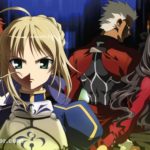


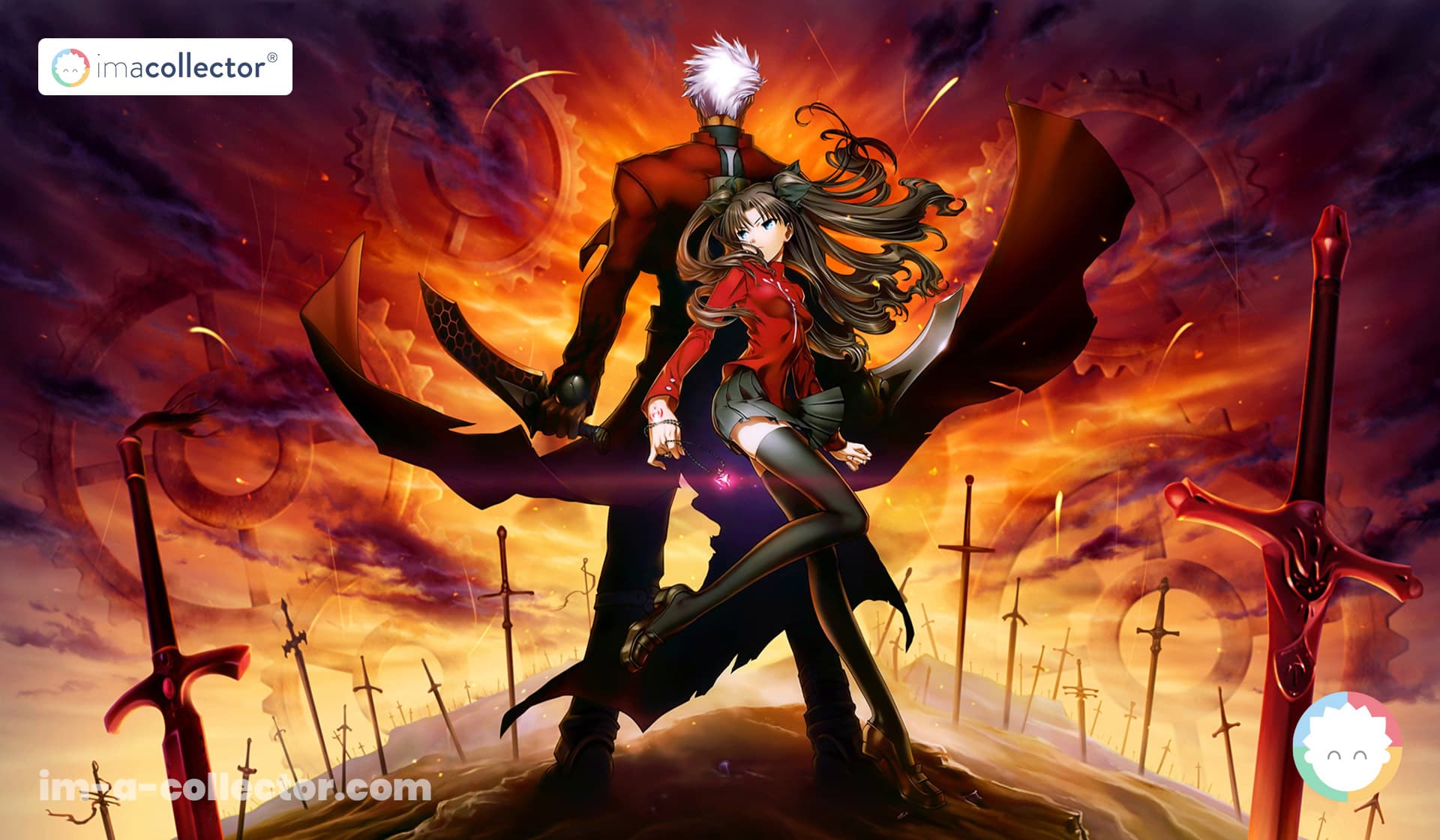
Fate/stay night: Unlimited Blade Works (2010) – What everyone missed in this film… even me

Or how to understand a work through what it deliberately leaves behind… More than ten years after its release, the Unlimited Blade Works adaptation by Studio Deen continues to divide fans. Yet its ellipses, its pacing, and its silences make it a singular work, perhaps even more faithful to the spirit of the visual novel than later versions.
A reappraisal is overdue.
Sommaire
I rewatched Unlimited Blade Works (Studio Deen, 2010) this week, more than ten years after first seeing it. And what struck me immediately was neither its animation nor its flaws. It was its speed.
A pace that does not try to reassure the viewer. Clear emotional choices, sometimes almost brutal in their directness. You can feel Archer’s muted sorrow, Rin’s simple and deeply endearing humanity, and Shirō’s almost painful determination to become a hero. That desire is not a form of pride. It feels more like a fate he cannot escape. He was saved by Kiritsugu, and since then, he has no idea how to live any other way.
Back then, I was looking for something else.
Now, I better understand what this film was saying. Perhaps unintentionally. Or perhaps exactly as intended.
What I learned revisiting UBW Deen echoes the way the Fate series gradually imposed itself on me. If you haven’t already, I invite you to read my article Fate/stay night: why this universe became mine.
What I saw then and what I see now
Ten years ago, I watched UBW Deen with the same expectations as many others: coherence, answers, strict fidelity to the original material.
In other words, I expected an adaptation to complete what I felt was missing.
Today, I see something else:
- what remains off-screen
- the silences
- the ellipses
- imperfect but fully embraced choices
And most importantly, I understand one essential truth: UBW Deen never tries to fix everything.
Archer: exhaustion rather than fall
It is often said that Archer is more spectacular (or better handled) in the later adaptation produced by ufotable. But at the time, our only reference point was the original visual novel.
In Studio Deen’s version, Archer feels more readable to me. Not because he is over-explained, but because he is not framed as a mystery to solve—or worse, a figure to admire.
He is shown to us for what he is: an exhausted man. A man who pursued a sincere ideal. An ideal that carried him, then drained him.
Archer did not become cynical out of convenience. Like many of us, he became bitter because he endured for too long.
And approaching forty, this reading resonates differently. It reflects something painfully concrete: the moment when we continue moving forward, no longer out of conviction, but out of moral inertia.
Archer does not hate Shirou because he is naive. He hates him because Shirō reminds him of who he once was, and what it cost him. And yet, in the end, he chooses to let go.
Not to abandon his regrets.
Not to abandon his lucidity.
But simply to abandon his hatred.
This is not redemption.
It is cessation.
The Sakura / Zōken off-Screen: an absence that speaks
In UBW Deen, Sakura, Zōken, and to a lesser extent Kirei, are nearly absent. For a long time, I saw this as a flaw.
Now I read it differently.
Sakura’s suffering and Zōken’s hatred do not disappear. They are displaced. Replaced.
Replaced by:
- Archer’s hatred toward Shirō
- the ideological conflict between two visions of heroism
- the gradual closeness between Rin and Shirō
The horrors of Heaven’s Feel require a different emotional framework. A different rhythm. A different intimacy.
This UBW film does not deny those shadows. It simply chooses not to dwell on them here. And that choice makes sense: UBW is not the route of intimate damnation. It is the route where an ideology is forced to confront its own limits. A bit like Fate/Zero, where Kiritsugu and Kirei do not oppose each other through emotion, but through their view of the world.
Rin and Shirō: a relationship without illusion
The ending of UBW Deen is often read as romantic closure.
I no longer see it that way.
Today, I see a healthy but risky relationship. Rin’s final look does not say, “Everything will be fine.” It says, “I know what awaits you.”
And that is precisely why it is powerful.
It marks the beginning of a relationship built not on romantic idealism, but on acceptance—of danger, of flaws, of each other.
Rin does not idealize Shirō. She understands him fully. And she chooses to move forward anyway.
This lucidity mirrors Archer’s treatment throughout the film: UBW Deen rejects illusions, heroic or romantic alike.
So the ending does not say that everything will turn out well. It says that the hardest part is still ahead, and that nothing is guaranteed. And that kind of emotional maturity, so early in a relationship, is rare both in fiction and in life.
Not everything can be repaired and that may be UBW’s core
With hindsight, UBW Deen speaks to something simple, and deeply uncomfortable: not everything can be repaired.
- a society close to bankruptcy
- a friendship that erodes
- a life choice that should never have been made
- a part of oneself fractured by too many falls
- and certainly not people
For my part, I have stopped waiting for others to change. I change myself. And to me, that is exactly what this arc is about. Shirō does not try to fix Archer. He does not try to save him. He keeps moving forward in spite of him.
Archer, in turn, understands he cannot prevent that path. He can only stop resisting its inevitability.
Peace comes not from fixing everything but from accepting what cannot be fixed.
Misunderstood work or late reinterpretation?
I do not know whether Unlimited Blade Works (2010) was conceived exactly this way from the start. Perhaps it was. Perhaps not.
But one thing is certain: my perspective has changed.
Some works only become readable in retrospect, once we stop expecting them to reassure us. Once we accept that they fix nothing, and may not offer as much as the original material. They do, however, have the merit of saying something true.
UBW Deen speaks to those who understand that not everything can be repaired, and that moving forward anyway is not heroism.
It is inner coherence.
If this reflection resonated with you, you may also appreciate my essay on Fate/stay night: the universe that chose me before I understood it.
Article produced by imacollector® — an editorial archive dedicated to the memory and heritage of Japanese pop culture.
Content published for informational and documentary purposes. All rights reserved to the respective rights holders.