




When Gabi Braun first appears in Attack on Titan / Shingeki no Kyojin, she has never met a single person from Paradis. She knows nothing about their villages, their families or what they actually think of Marley. And yet she already knows that they are dangerous, that they still bear responsibility for the crimes of their ancestors and that they deserve to be fought. She even knows what to call them: the “island devils.”
Table of contents
- Before we can hate someone, we first have to categorize them
- When a category starts to replace the individuals within it
- Marking, separating and making difference visible
- Dehumanization does not always mean saying that the other is no longer human
- How history turned neighbors into enemies
- This mechanism has not disappeared
- Our own societies are not immune either
- Gabi finally meets the people she hates
- Kaya asks the question the category cannot answer
- The Braus family shatters the idea of collective behavior
- When Gabi realizes there were no “devils”
- But Eldians really can become Titans
- Can a real threat make an entire people guilty?
- What Gabi actually leaves behind
- In the end, Gabi discovers nothing extraordinary
- Sources
- Social categorization, stereotypes and collective responsibility
- Dehumanization and moral exclusion
- Intergroup threat
- The Holocaust: categorization, marking and segregation
- Rwanda: propaganda and the transformation of a threat into a collective enemy
- Rohingya / Myanmar
- Ukraine
- Gaza / Palestinians
It is strange when you think about it. Gabi knows almost nothing about these people, yet she already has an extremely precise judgment of them. In Chapter 91, she even says that she wants to take part in their extermination to show the world that the Eldians living in Marley are different from those on Paradis. Becoming a Warrior is supposed to let her prove that some Eldians can still be trusted and, eventually, help free her people from the internment zone.
She does not see herself as separate from the Eldian people. Quite the opposite: she carries that identity almost like a debt. Eldians committed crimes, the world still judges them for those crimes, and her generation must now prove that it deserves something else.
That made me question the logic behind it: how do we come to hate people so deeply when we have never even met them? And how do we end up convinced that knowing which group someone belongs to already tells us what they think, what they want, or even what they might be capable of?
Before we can hate someone, we first have to categorize them
We constantly categorize the people around us, often without even noticing it: by nationality, religion, profession, generation, political views, or simply by whether they belong to our group or the one on the other side.
In social psychology, this way of organizing the world around us has a name: social categorization. There is nothing inherently abnormal about it. Our brains rely on categories to simplify a social world that would otherwise be far too complex to process.
Henri Tajfel’s work became especially influential on this question. In his so-called “minimal group” experiments, participants were assigned to groups using deliberately trivial criteria, with no shared history, no prior conflict and no real personal knowledge of the other members. Yet forms of favoritism toward their own group already appeared in the way resources were distributed. Tajfel did not, however, show that simply dividing people into two groups automatically makes them hate one another.
Psychologist Marilynn Brewer emphasized that distinction: favoring people we see as our own does not necessarily mean wishing harm on others. For a simple difference to become genuinely hostile, it usually needs something more: a story, a threat, social norms or a system that gives that difference much greater meaning.
Gabi grows up in Marley surrounded by all of these elements. For her, being Eldian is not just a matter of family background. It determines where she lives, the armband she must wear, the restrictions imposed on her people and the limited ways she can hope to improve her social status. The Warrior program introduces a very specific possibility: an Eldian can gain privileged status for their family by proving sufficiently useful and loyal to Marley.
Gabi learns very early that she belongs to a group considered inferior, but also that there is a way to escape part of that condition. This is where a second category becomes crucial to the way she sees the world: the Eldians of Paradis. In her mind, they descend from the same people, but unlike Eldians living in Marley, they reject the guilt her own community is expected to carry every day and still embody the historical threat associated with the Titans. Gabi can therefore set the Eldians she sees as righteous against the “island devils.”
The divide no longer runs only between Marley and the Eldians. It now cuts through the Eldian people themselves.
Category, stereotype, essentialism: what is the difference?
These three ideas are closely related, but they do not describe exactly the same thing.
– Categorizing means grouping several individuals under the same identity: Eldians, Marleyans, people of Paradis…
– Stereotyping means attaching certain traits to that category: dangerous, violent, loyal, treacherous…
– Essentializing goes one step further: those traits come to be seen as expressions of what the group supposedly is at a deep and lasting level.
This is how “some members did this” can gradually become “they do this,” and then “they are all like this.”

When a category starts to replace the individuals within it
We generally know very well that the members of groups we belong to can be radically different from one another. Two French people may disagree on almost everything, two people from the same religion may practice their faith in completely different ways, and two supporters of the same club may share a passion while having very different personalities, values and behavior.
That same diversity can become much harder to see when we look at a group we know little about.
Social psychology uses the term “outgroup homogeneity effect” for the tendency to perceive members of an outside group as more similar to one another than members of our own group. The effect is neither universal nor identical in every situation, but it helps explain how a category can gradually take precedence over the people who make it up.
Stereotypes can reinforce this process, along with what some researchers call essentialism. A behavior displayed by some members of a group begins to be interpreted as evidence of a deeper, more stable characteristic. “Some members of this group did this” can slowly become “they do this,” then “this is what they are like.”
Gabi follows exactly this kind of reasoning when she meets Kaya in Chapter 109. Confronted with one specific woman who committed none of the crimes Gabi attributes to her, she can only answer by returning to the broader history of the Eldians and the guilt of their ancestors.
That history cannot simply be dismissed as a lie invented by Marley. Attack on Titan / Shingeki no Kyojin never reveals that every atrocity attributed to the former Eldian Empire was fabricated. Willy Tybur himself acknowledges part of that violence, while the series also shows Eldian Restorationists constructing their own favorable version of the past.
Marley therefore does not need to invent the entire story in order to use it. It only needs crimes once committed by some Eldians to become information used to judge the people who are alive today.
Marking, separating and making difference visible
In Liberio, categorization does not remain a matter of rhetoric. It directly structures everyday life. Eldians live in internment zones, need authorization for certain movements and wear armbands that identify them immediately. The anime also makes clear that this sign distinguishes Eldians from other populations and that failing to wear it can be punished.
History offers many examples of systems that made certain categories visible or administratively identifiable. The most obvious parallel with Attack on Titan / Shingeki no Kyojin is the persecution of Jews under Nazi rule, but it must be used with great care. Eldians are not a representation of Jews, Marley is not an exact recreation of Nazi Germany, and the very real existence of Titan powers creates a fundamental difference that we will return to later.
Some historical mechanisms can nevertheless help us understand what this kind of marking does. With the Nuremberg Laws of 1935, the Nazi regime did not simply persecute people who practiced Judaism. The state gradually created a legal definition of Jewish identity based in particular on family ancestry. A person could therefore be placed in that category regardless of how they defined themselves.
The compulsory wearing of the yellow star later made that identity directly visible in public space. The United States Holocaust Memorial Museum notes that such markings were used, among other things, to stigmatize, separate, monitor and control the populations concerned.
This does not mean that a visible marker automatically creates hatred or mechanically leads to extermination. What it can do is allow a society to enforce, in concrete terms, the differences it has decided to make significant.
In Liberio, the armband serves that function. Before anyone knows what an Eldian thinks, what they have done or how they see themselves, their group membership is immediately identifiable.
In November 2021, the Attack on Titan production committee even canceled the sale of a replica of this armband. In its statement, the committee explicitly described it as a symbol of racial and ethnic discrimination depicted in the series.
Identifying a population does not only mean making it visible
In several historical systems of persecution, administrative identification also made it possible to apply different rules according to group membership: restrictions on movement, access to certain jobs, confiscation, checks or forced displacement.
The visible sign is therefore only one part of the system. Registers, identity documents and legal classifications can be just as important because they turn a social category into information that an administration can directly act upon.

Dehumanization does not always mean saying that the other is no longer human
The word “devil” used for the people of Paradis naturally raises the question of dehumanization. We often imagine it as comparing a population to animals, parasites, diseases or objects in order to make violence against them easier to accept. Research shows, however, that the process can be much more subtle.
Nick Haslam distinguishes several forms of dehumanization. Some strip people of qualities culturally associated with being human, such as rationality, self-control or morality. Others reduce the individuality, emotional warmth or psychological depth we attribute to them.
Jacques-Philippe Leyens’s work on infrahumanization points in the same direction. There is no need to explicitly claim that the other is no longer human. Emotions regarded as especially human can simply be attributed to members of an outside group less readily than to members of our own.
More recent research adds an important nuance: a person can be seen as intelligent, conscious and capable of love and suffering while still being judged guilty, dangerous or responsible for what happens to them. That is why Susan Opotow’s concept of “moral exclusion” may be even more useful for understanding some of the situations shown in Attack on Titan / Shingeki no Kyojin.
The idea is fairly simple: some people can gradually be placed outside the circle to which we normally apply standards of fairness, justice and protection. They remain human, but their suffering begins to count differently.
That is close to the way Gabi sees the people of Paradis at the beginning of her story. She does not say that they are incapable of thought or emotion. She mainly sees them as members of a historically guilty group that still represents a threat, making their destruction something that can be treated as legitimate.
In the end, we do not always need to believe that someone is no longer human in order to accept harm being done to them. It can be enough to believe that they deserve it.
Dehumanization does not explain every form of violence
Recent research cautions against an overly simple explanation in which people must first “stop seeing the other as human” before they can hurt them.
Violence can also be justified because the victim is seen as guilty, treacherous, dangerous or responsible for a threat. In some cases, attributing malicious intentions to someone actually requires continuing to see them as fully capable of thought and action.
Dehumanization, moral exclusion and collective guilt can therefore reinforce one another, but they do not describe exactly the same mechanism.
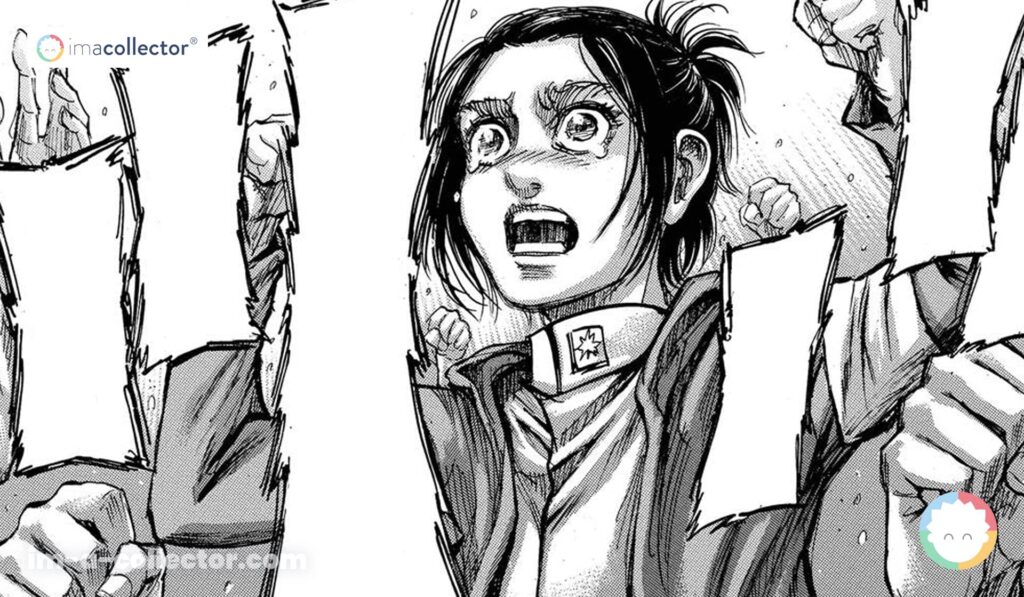
How history turned neighbors into enemies
The Holocaust helps us understand how a category of people can become legally defined, made visible and gradually assigned different rights. The genocide against the Tutsi in Rwanda adds another element that is especially useful for understanding Attack on Titan / Shingeki no Kyojin: what happens when a threat posed by certain actors begins to be extended to an entire population.
Hutu and Tutsi categories existed before colonization, but they were not necessarily as rigid, racialized or politically exclusive as they later became. German and, especially, Belgian colonial rule contributed to ranking and hardening those categories, eventually placing ethnic identity on official identity documents. During the 1994 genocide, those documents could be used at some roadblocks to identify people considered Tutsi.
But the Rwandan case matters here for another reason: there really was a war.
From 1990 onward, the Rwandan Patriotic Front fought the government. The military threat invoked by those in power was therefore not entirely invented. Extremist propaganda, however, made a much broader shift by increasingly linking RPF fighters with Tutsi civilians living in Rwanda, until a threat originating from an armed organization became a characteristic attributed to an entire population.
Media outlets such as Kangura and RTLM helped build this narrative. The word Inyenzi, often translated as “cockroaches,” became one of the best-known examples of dehumanizing language used at the time, but Tutsi were also portrayed as conspirators, infiltrators, traitors or accomplices of the enemy.
Constructing an enemy therefore does not rely only on portraying people as inferior or less human. It can also mean turning a specific threat into a collective danger, until the distinction between those who fight and those who merely share an identity with them begins to disappear.
This is where the comparison with Attack on Titan / Shingeki no Kyojin becomes especially meaningful.

This mechanism has not disappeared
Unfortunately, this mechanism does not belong only in history books. Contemporary situations show that a threat posed by individuals, a political movement or an armed organization can still be extended to a much broader population.
This does not mean that all these events are comparable or that they share the same legal classification. Gaza, Ukraine and the situation of the Rohingya have very different histories, forms of violence and international proceedings. The point here is much more specific: what happens when a threat attributable to certain actors begins to change the way an entire population is seen.
In Myanmar, this mechanism is especially visible in the case of the Rohingya. On August 25, 2017, the Arakan Rohingya Salvation Army (ARSA) carried out coordinated attacks on a military base and several security force posts. According to the UN Independent International Fact-Finding Mission, twelve members of the security forces were killed. Yet the military operations that followed reached far beyond members of that organization, and the UN mission described an extremely disproportionate response directed much more broadly at the Rohingya population. By mid-August 2018, nearly 725,000 people had fled to Bangladesh. The ARSA attacks were therefore real. But a Rohingya civilian did not become a member of that organization simply by sharing the same ethnic identity.
In a very different context, Russia has also used the language of “denazification” to justify its invasion of Ukraine. The existence of far-right and ultranationalist groups in Ukraine is not an invention, but that partial reality was folded into a much broader narrative used to characterize the Ukrainian state, its institutions and, at times, Ukrainian identity itself.
Gaza raises the same question of scale in a far more brutal way. The attacks carried out by Hamas on October 7, 2023, the killings and the taking of hostages are real. Yet living in Gaza does not make a Palestinian a member of Hamas, just as a child does not become responsible for the actions of an armed organization simply because they were born in territory it controls.
In September 2025, the UN Independent International Commission of Inquiry concluded that Israeli authorities and forces had committed and were continuing to commit genocide against Palestinians in Gaza. At the time of writing, the case South Africa v. Israel remains pending before the International Court of Justice, and no final judgment on the merits has yet been issued.
These situations must, of course, remain distinct. They nevertheless allow us to ask one shared question without pretending that they are equivalent: at what point do we stop responding to those who genuinely pose a threat and start treating the group associated with them as a threat in itself?

Our own societies are not immune either
We do not need to wait for war or genocide to see this way of thinking. It also appears in everyday political debate and today accompanies the rise of far-right movements in several democracies.
Again, it would be too easy to claim that everything rests on entirely invented threats. Islamist terrorist attacks have taken place in Europe, crimes are committed by foreigners as well as nationals, difficulties around integration exist, and extremist religious or political movements are real. Denying those facts would do nothing to help us understand the arguments that can later make use of them.
The mechanism begins when an event is no longer attributed only to those who committed it, but is used to draw conclusions about a much larger group associated with the perpetrators. An Islamist attack can feed a discourse about “Muslims,” a crime committed by a foreign national can be used to talk about “immigration,” and the actions of a radical movement can end up shaping how all the people we choose to associate with it are perceived.
This does not mean that every far-right voter reasons this way, still less that every migration or security policy amounts to dehumanization. Doing so would reproduce the very mechanism this article is trying to understand by locking very different individuals inside a category supposedly capable of explaining what they think.
When the behavior of some people begins to seem sufficient for judging everyone who shares their origin, religion or nationality, the reasoning changes fundamentally. The question “what did this person do?” gradually gives way to another: “which group do they belong to?” And that second answer can begin to feel sufficient on its own.

Gabi finally meets the people she hates
Long before arriving on Paradis, Gabi had already encountered a first contradiction in the ideal she believes in. Reiner returned from the island after living for years among people his family considers “devils.” In Chapter 94, when he has to describe what he found there, his memories take an odd turn. Instead of monsters, he mostly talks about the habits and behavior of his former comrades, details that are sometimes irritating, ridiculous or insignificant. They sound far more like the memories of a man who lived alongside other people than the expected testimony about a monstrous population.
Gabi notices that something does not quite fit and suspects that Reiner is not telling them everything, but it still does not change her own convictions.
Then comes the attack on Liberio, and this time experience seems to confirm everything she already believed. Eren attacks during Willy Tybur’s speech. Gabi watches Zofia die, sees Udo killed in the panic and witnesses several soldiers she knows fall in the fighting, while her neighborhood becomes a battlefield under an assault led by soldiers from Paradis.
From that point on, propaganda alone is no longer enough to explain her hatred. Before Liberio, Gabi mainly hated people she had never met on the basis of a historical and political narrative. After the attack, she now has losses of her own, memories of her own and a personal experience that seems to confirm that the people of Paradis really are dangerous.
That is also what makes her development much more interesting than the story of a child who simply discovers that she was lied to.
Falco already understands part of the situation. He knows that Marley attacked Paradis several years earlier and that the violence in Liberio belongs to an older chain of retaliation. Gabi, only hours after watching people close to her die, obviously does not have the same perspective. She is not going to abandon her beliefs because someone from Paradis suddenly shows her kindness. It will take much more than that.

Kaya asks the question the category cannot answer
When Gabi and Falco arrive on Paradis, the Braus family takes them in without knowing who they really are. Gabi still interprets what she sees through everything she has been taught about the island’s inhabitants. She looks for the devils she was taught to recognize and eventually meets Kaya, a girl whose mother died in the attack that led to the fall of Wall Maria.
Their conversation in Chapter 109 is probably the moment when Gabi’s reasoning truly begins to crack. Kaya never tries to defend the former Eldian Empire, nor does she claim that the people of Paradis are innocent of everything that has happened in history. She simply asks Gabi why her mother had to die.
The question forces Gabi to leave the broad sweep of history and return to one specific person. Yet every time she searches for an answer, she falls back on the group: the crimes of ancient Eldians, the guilt of their ancestors, then the recent attack on Liberio.
Falco eventually points out that Kaya’s mother died because Marley had launched its operation on Paradis four years earlier. Kaya answers with something that completes the logic perfectly: Falco himself does not need to apologize for that simply because he was born in Marley.
In other words, she applies exactly the same principle to both sides. Kaya’s mother is not responsible for crimes committed by earlier Eldians, just as Falco is not responsible for Marley’s attack simply because he was born on the same side of the sea.
Responsibility belongs to the people who committed the acts. The idea seems extremely simple, but it clashes directly with the way Gabi was taught to see the people of Paradis.

The Braus family shatters the idea of collective behavior
The scene at Niccolo’s restaurant in Chapter 111 pushes the contradiction even further. Gabi learns that Sasha, the soldier she killed after the attack on Liberio, was the very young woman who had once saved Kaya. Niccolo in turn learns that Gabi killed Sasha and seeks revenge, while Kaya herself tries to kill Gabi when she realizes what happened.
According to the logic Gabi still held only a few chapters earlier, these reactions could almost serve as another confirmation of what she thought she already knew: the people of Paradis really are violent.
But Sasha’s father refuses that conclusion. He has just lost his daughter and is standing in front of the person who killed her, with a personal reason far stronger than the inherited historical guilt Gabi used to condemn the island’s inhabitants. Even so, he refuses to turn his pain into permission to kill someone else.
All of these characters belong to the same group, yet that membership tells us nothing certain about what they will do. Niccolo wants revenge, Kaya gives in to anger, Sasha’s father refuses to kill Gabi, and the family ultimately protects her anyway. What Gabi had learned to see as a relatively homogeneous whole begins to break apart into individuals capable of profoundly different responses.

When Gabi realizes there were no “devils”
Pieck also helps Gabi understand that being Eldian, being a Warrior and believing in Marley are not necessarily the same thing. In Chapter 116, she states clearly that she does not trust the Marleyan state, even though she remains deeply attached to the comrades she fought beside.
For Gabi, who grew up learning that serving Marley was precisely how she could prove herself a good Eldian, that distinction matters a great deal. Pieck shows her that it is possible to remain loyal to the people she fought alongside without accepting the narrative of the state that sends them into battle.
Then comes Chapter 118, when Gabi finally puts into words what her time on Paradis has taught her: there were no devils on the island, only people. The rest of her reasoning is even more telling. She acknowledges that they had decided people they had never even met were devils.
At that point, we return directly to the question that opened this article. Gabi could hate people from Paradis she had never met because much of what she believed she knew about them existed before any encounter. Their history, their supposed guilt and the danger they were said to represent already gave meaning to their identity.
Living among them does not reveal that they are all innocent or kind after all. It forces her to discover something the collective narrative had made much harder to see: behind the category are people who do not all think alike, have not committed the same acts and do not carry the same responsibilities.
But Attack on Titan / Shingeki no Kyojin immediately adds a difficulty that has no equivalent in our own human history.

But Eldians really can become Titans
Comparing some of Marley’s mechanisms with historical systems of discrimination can be misleading if we forget one fundamental difference: in the world of Attack on Titan / Shingeki no Kyojin, Eldians really do possess a dangerous biological trait.
Subjects of Ymir can be transformed into Titans, and the Nine Titans can only be inherited among them. The Founding Titan can exercise powers over this population on an enormous scale, while Zeke, holder of the Beast Titan, can even trigger the transformation of people who have ingested his spinal fluid.
Marley directly uses this ability as a weapon of war. At Fort Slava, Eldians are transformed into Titans and then deployed against the enemy.
Fear of Titan power is therefore not based solely on propaganda. The threat is real within the world created by Hajime Isayama. It eventually reaches a global scale when Eren unleashes the Rumbling.
This is the main limit of any direct comparison between Eldians and populations subjected to racial or ethnic persecution in human history. In the real world, an ethnic group obviously has no supernatural biological ability that allows its members to transform into giant weapons.
Isayama therefore introduces something much more complex than a simple opposition between propaganda and truth. Marley lies, manipulates history and exploits Eldians, but the danger posed by Titans genuinely exists. It is not a myth or a legend.
The question then becomes much more interesting: what remains of Gabi’s reasoning when the threat she was taught to fear is not entirely imaginary?
Can a real threat make an entire people guilty?
A Subject of Ymir can be turned into a Titan, but an ordinary Eldian does not transform spontaneously. They do not necessarily possess one of the Nine Titans, do not control the Founding Titan and obviously did not choose the biological trait they were born with. Most importantly, they do not decide how Marley turns some Eldians into weapons.
The existence of Titan power therefore gives people something real to fear, but it does not resolve the question of responsibility.
Some Eldians committed atrocities in the past, Marley really does use Eldians as Titans, and Eren, together with soldiers from Paradis, really did attack Liberio. But Kaya’s mother took part in none of that. This is exactly where collective reasoning reaches its limit: acknowledging that a danger exists does not tell us who is responsible for it.
It is ultimately the same distinction Gabi could not make in Chapter 109. She had an answer to the question “what have the Eldians done?” but that answer still could not explain why this particular woman had to die.
Can a real threat be exploited politically?
Yes. A threat does not have to be invented to become a political tool.
A terrorist attack, a war, the existence of an armed group or an extremist movement can provide a real starting point. The shift happens when that reality is then used to attribute the same intentions, the same level of danger or the same guilt to everyone associated with the group in question.
The issue is therefore not only how to distinguish truth from falsehood, but also how to determine who can actually be held responsible.
What Gabi actually leaves behind
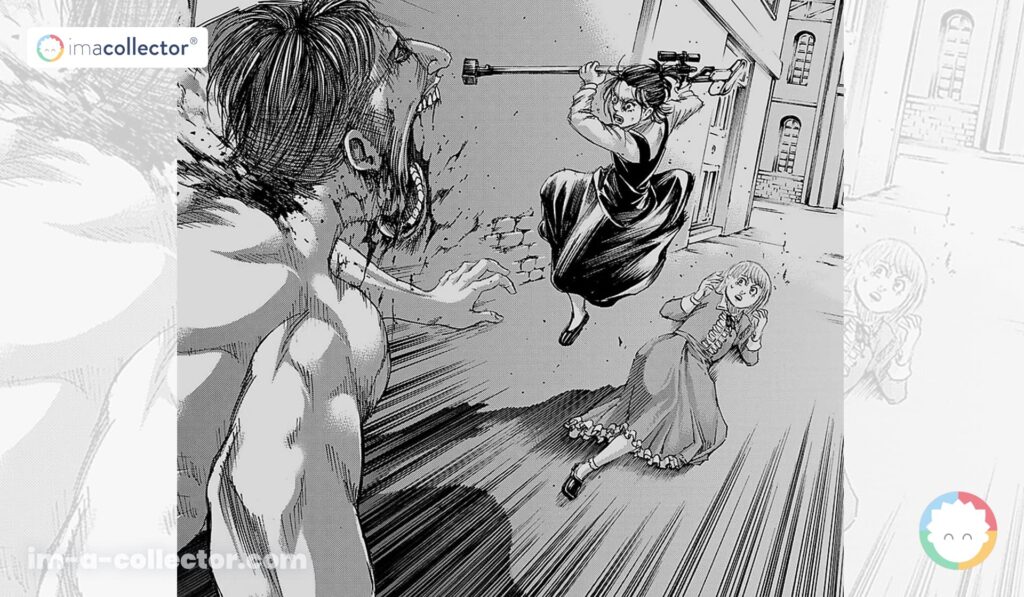
In Chapter 124, Gabi finds Kaya again as Titans once more threaten the people of Paradis. She risks her life to save her, and Kaya then protects Gabi by claiming that she is part of her family. When Kaya asks whether she is a devil, Gabi answers no.
When Gabi uses the word again a few moments later, its meaning has completely changed. She is now thinking about the people she herself killed in order to be praised, recognized and regarded as a good Eldian.
The distance traveled since Chapter 91 is enormous. At the beginning of the Marley arc, being a “devil” depended mainly on where someone was born and which group they belonged to. People from Paradis could be condemned before they had done anything because that identity alone was enough to make them suspect or guilty. By Chapter 124, Gabi instead begins to look at what people have actually done.
Nothing in the manga suggests that she abandons all anger, hatred or loyalty toward the people she grew up with. Nor does it show a Gabi who suddenly understands every political mechanism of Marley or becomes some kind of activist opposed to everything she once believed.
Her development is much more precise: she gradually stops treating the identity “person from Paradis” as sufficient evidence of guilt.
Attack on Titan / Shingeki no Kyojin does not simply replace one category with another by revealing that the “bad guys” were actually the “good guys.” The people Gabi meets on Paradis are capable of kindness, violence, revenge, compassion and sometimes cruelty, just like the people of Marley.
Sasha killed soldiers in Liberio, Kaya tries to attack Gabi when she learns that Gabi killed her, Niccolo also seeks revenge, and Eren eventually crushes a large part of the outside world. Yet none of these acts of violence is enough to make every person on Paradis guilty, just as Reiner, Falco and Pieck do not become responsible for every crime committed by Marley simply because they served in its military.
As Gabi discovers this world for herself, the explanations she was given become increasingly inadequate for understanding the people she meets. Being Eldian, living on Paradis or serving Marley can tell part of a person’s story, but none of those facts alone tells us what they think, what they have done or what they are responsible for.
In the end, Gabi discovers nothing extraordinary
Can we really hate someone we do not know? Clearly, yes. But not necessarily because we have been convinced that the other person is monstrous, inferior or completely unlike us. Sometimes all it takes is for certain information to reach us before the encounter: a history explaining what their people supposedly did, words used to name them, a system that makes their difference concrete and, sometimes, actions committed by some members of their group that seem to confirm everything we had already been taught.
Little by little, we can start to feel that we know enough about a person without ever having met them.
That is exactly what happens to Gabi. Before she ever sets foot on Paradis, she already has a history explaining the crimes of its inhabitants, a vocabulary for naming them and a personal identity built in opposition to them. Then Liberio gives that image a concrete reality when soldiers from the island attack her neighborhood and kill people she cared about.
This is probably one of Hajime Isayama’s most interesting choices in writing her character. It would have been much easier to reveal to Gabi that everything she had been taught was false, then have her meet a few sufficiently kind people from Paradis so that she immediately understood she had been manipulated.
But that is not the story the series tells. The former Eldian Empire probably committed real atrocities, Titans genuinely represent a threat, Marley really was attacked at Liberio, and Gabi really did lose people she cared about.
None of that makes Kaya’s mother guilty.
After dozens of chapters, wars, deaths, political speeches and several generations of hatred between Marley and Eldia, Gabi does not arrive at some especially complex philosophical revelation. She simply understands that a person should not be condemned for something they did not do.
The idea seems almost obvious when stated that way. Yet Attack on Titan / Shingeki no Kyojin shows how fragile it can become when several generations grow up surrounded by the same historical narrative, real trauma, collective threats and institutions that concretely organize separation between groups.
Gabi grew up seeing Paradis in exactly this way. Before she met any of its inhabitants, she already knew their history, their guilt and the danger they were supposed to represent. Only by living among them does she eventually understand that what she knew best was not the individuals themselves, but the story built around their group.
And this is probably where the rest of the series of articles becomes especially interesting. Gabi did not invent the “island devils” by herself. Someone taught her that story, gave her the words used to name them and showed her how to interpret what she saw.
What remains is to understand how such a powerful representation can be learned, repeated and reinforced until it becomes a collective certainty.
Sources
Hajime Isayama, Attack on Titan / Shingeki no Kyojin, Kodansha: primary source for Gabi, Marley, Liberio, the Warrior candidates, Reiner, Kaya, the Braus family, Pieck, Titan powers and Gabi’s character development. Chapters used especially heavily: 91, 94, 105, 109, 111, 116, 118 and 124.
Pika Édition,L’Attaque des Titans: official French editionused to verify chapters, titles and French terminology.
Official Japanese website for Attack on Titan: The Final Season: official information on Eldians, Warrior candidates, Titans and contextual material released with the anime.
Attack on Titan production committee, statement dated November 15, 2021, concerning the Marleyan armband: the armband is explicitly described there as a symbol of racial and ethnic discrimination depicted in the series.
Social categorization, stereotypes and collective responsibility
Henri Tajfel, Michael Billig, Robert Bundy & Claude Flament — “Social Categorization and Intergroup Behaviour”, European Journal of Social Psychology (1971) : expériences des « groupes minimaux » et apparition du favoritisme intragroupe.
Marilynn B. Brewer — “The Psychology of Prejudice: Ingroup Love or Outgroup Hate?”, Journal of Social Issues (1999) : distinction entre préférence pour son propre groupe et hostilité envers le groupe extérieur.
Thomas M. Ostrom & Constantine Sedikides — travaux sur l’effet d’homogénéité de l’exogroupe : analyse de la tendance à percevoir les membres d’un groupe extérieur comme davantage semblables entre eux.
Nick Haslam, Louis Rothschild & Donald Ernst — travaux sur l’essentialisme social (2000) : manière dont certaines caractéristiques peuvent finir par être perçues comme constitutives et durables d’un groupe.
Brian Lickel, Toni Schmader & David L. Hamilton — travaux sur l’entitativité et la responsabilité collective (2003) : manière dont les actes de certains membres peuvent être étendus à d’autres lorsque le groupe est perçu comme une entité cohérente.
Raymond S. Nickerson — “Confirmation Bias: A Ubiquitous Phenomenon in Many Guises” (1998) : rôle du biais de confirmation dans le maintien de croyances déjà installées.
Dehumanization and moral exclusion
Nick Haslam — “Dehumanization: An Integrative Review”, Personality and Social Psychology Review (2006) :présentation des différentes formes de déshumanisation.
Jacques-Philippe Leyens et al. — travaux sur l’infrahumanisation : étude des formes plus discrètes de diminution de l’humanité attribuée aux groupes extérieurs.
Nour Kteily et al. — travaux sur la déshumanisation explicite (2015)
Susan Opotow — travaux sur l’exclusion morale (1990) :définition du processus par lequel certaines personnes ou certains groupes sont placés en dehors du cercle auquel sont normalement appliquées les règles de justice et d’équité.
Albert Bandura — travaux sur le désengagement moral (1990) :justification morale, déplacement de responsabilité, attribution de la faute aux victimes ou déshumanisation comme différents moyens de rendre une violence compatible avec sa propre morale.
Tage Rai, Piercarlo Valdesolo & Jesse Graham — travaux sur violence et déshumanisation (2017) :montrent notamment qu’une violence moralement motivée n’exige pas nécessairement de nier l’humanité de la victime.
Harriet Over — travaux critiques sur le rôle attribué à la déshumanisation (2021)
Jeroen Vaes, Maria Paola Paladino & Nick Haslam — réponse au débat sur la déshumanisation (2021)
Johannes Lang — travaux sur déshumanisation et violence collective (2020)
Intergroup threat
Blake M. Riek, Eric W. Mania & Samuel L. Gaertner —méta-analyse sur la menace intergroupe (2006) : relation entre différentes formes de menace perçue et attitudes envers les groupes extérieurs.
Walter G. Stephan, Rolando Diaz-Loving & Anne Duran — travaux sur la menace intergroupe (2000)
The Holocaust: categorization, marking and segregation
United States Holocaust Memorial Museum — Nuremberg Laws :définition juridique et raciale imposée aux Juifs par le régime nazi.
United States Holocaust Memorial Museum — Jewish Badge :fonctions du marquage, notamment identification, stigmatisation, séparation, surveillance et contrôle.
United States Holocaust Memorial Museum — Ghettos : ségrégation, concentration, exploitation et évolution des fonctions des ghettos sous domination nazie.
Rwanda: propaganda and the transformation of a threat into a collective enemy
Alison Des Forges — Leave None to Tell the Story: Genocide in Rwanda, Human Rights Watch : référence majeure sur la préparation du génocide, la guerre, la propagande et la généralisation de la menace aux civils tutsi.
Scott Straus — travaux sur les effets des médias pendant le génocide des Tutsi (2007) : nuance l’idée d’une propagande médiatique agissant mécaniquement sur tous les auditeurs et insiste sur ses effets conditionnels.
Tribunal pénal international pour le Rwanda / Mécanisme international résiduel — “Media Case” :rôle de Kangura et de la RTLM et questions liées à l’incitation directe et publique au génocide.
Rohingya / Myanmar
Nations unies — Mission internationale indépendante d’établissement des faits sur le Myanmar : attaques de l’ARSA, réponse militaire, déplacement massif des Rohingyas et conclusions relatives aux actes génocidaires.
Conseil de sécurité des Nations unies — situation des Rohingyas / Myanmar
Cour internationale de Justice — Gambie c. Myanmar: procédure concernant les obligations du Myanmar au regard de la Convention sur le génocide.
Ukraine
Haut-Commissariat des Nations unies aux droits de l’homme / Human Rights Monitoring Mission in Ukraine : documentation des victimes civiles et des violations commises depuis l’invasion russe.
Cour pénale internationale — Situation in Ukraine : enquêtes et procédures relatives aux crimes internationaux commis en Ukraine.
Assemblée parlementaire du Conseil de l’Europe — Résolution 2556 (2024) : analyse notamment de la rhétorique russe autour de la « dénazification », de la négation de l’identité ukrainienne et des discours pouvant participer à une incitation génocidaire.
Gaza / Palestinians
Nations unies — Commission internationale indépendante d’enquête sur le territoire palestinien occupé, y compris Jérusalem-Est, et Israël — rapport A/HRC/60/CRP.3 : conclusion publiée en 2025 concernant le génocide des Palestiniens à Gaza.
Cour internationale de Justice — Afrique du Sud c. Israël : procédure engagée au titre de la Convention pour la prévention et la répression du crime de génocide.
OCHA — Occupied Palestinian Territory : données humanitaires sur Gaza, victimes, déplacements, destruction des infrastructures et conditions de vie.