

Today, Japanese football immediately brings to mind the World Cup, players competing in Europe’s leading leagues, and manga such as Captain Tsubasa, Whistle! and Blue Lock. Yet this picture of the sport is relatively recent.
Table of contents
For almost a century, football remained a secondary sport in Japan. The country already had a national federation, a long-standing domestic competition and even an Olympic medal. None of this, however, was enough to compete with baseball’s overwhelming popularity.
Why did football remain in the shadows for so long? Why did Japan have to wait until the 1980s, and later the creation of the J.League, before truly embracing the sport? Above all, how did a manga come to play such an important role in this transformation?
To answer these questions, we need to go back to a time long before Captain Tsubasa.
An imported sport that Japan never truly embraced
Football first appeared in Japan during the second half of the nineteenth century, as the opening of the country’s ports encouraged Western communities to settle there. Foreign residents were already playing the sport in Yokohama in the 1860s, but its introduction to Japanese players is traditionally associated with Archibald Lucius Douglas. In 1873, the Royal Navy officer arrived in Tsukiji to train cadets of the Imperial Japanese Navy and introduced them to several British sports, including football.
On 18 February 1888, Yokohama hosted a match between the Yokohama Country & Athletic Club and the Kobe Regatta & Athletic Club. This interport fixture is generally regarded as the first official football match played in Japan.
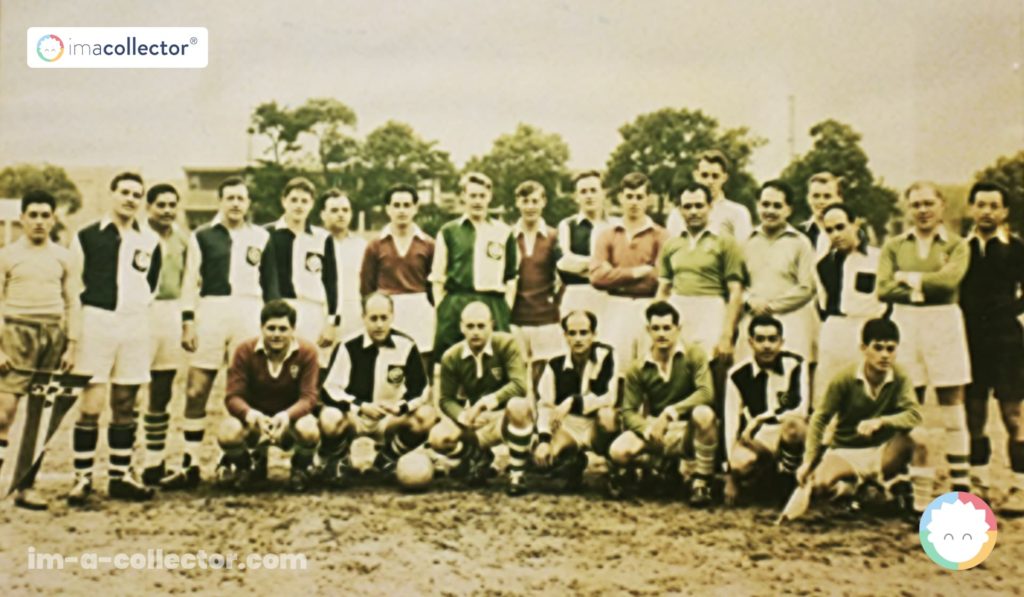
Football gradually established itself in several schools, universities and foreign communities. The creation of the Japan Football Association (JFA) in 1921 marked a major step in the organisation of the sport. That same year saw the first Emperor’s Cup, which remains Japan’s oldest national football competition.
For several decades, however, the JFA remained committed to a predominantly amateur model. Football developed mainly through schools, universities and company teams, far removed from the professional leagues already emerging across Europe.
Despite this progress, football remained a relatively marginal sport. Matches attracted few spectators and largely revolved around schools, universities and a handful of major companies.
Japan was familiar with football. It had not yet truly embraced it.
Japanese football before Captain Tsubasa: 6 key dates
1873 – Archibald L. Douglas introduces football to Japan.
1921 – Establishment of the Japan Football Association and the first Emperor’s Cup
1965 – Launch of the Japan Soccer League (JSL)
1968 – Japan wins the bronze medal at the Mexico City Olympics
1981 – Captain Tsubasa begins serialization in Weekly Shōnen Jump
1993 – Launch of Japan’s professional J.League
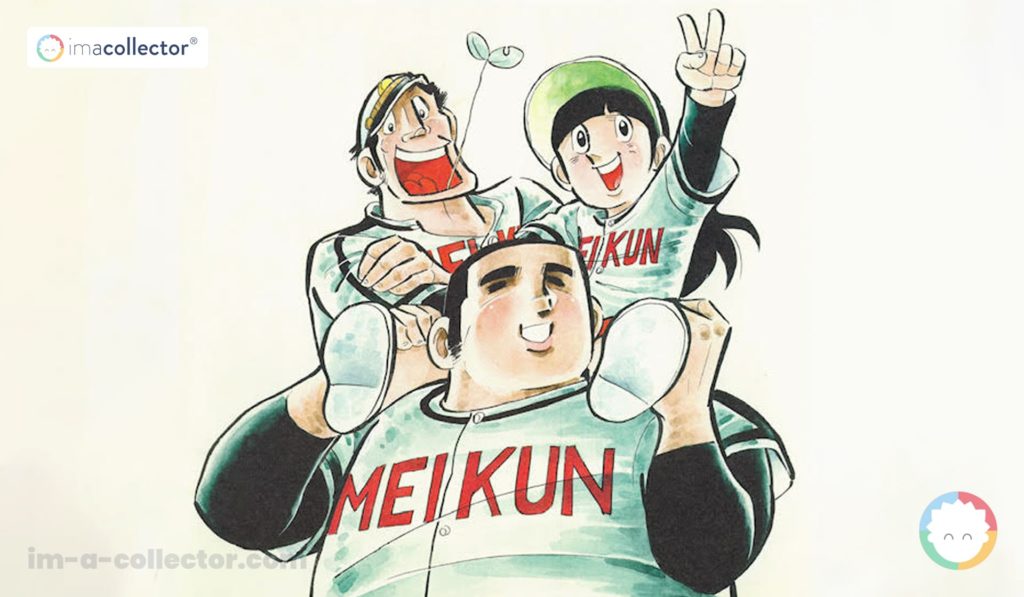
Meanwhile, baseball was winning over the nation
Introduced by American teachers in 1872, baseball quickly took hold in schools, universities and later company teams. High school tournaments, especially the famous Kōshien championship, became major national events. Babe Ruth’s visit with an American all-star team in 1934 drew almost 100,000 spectators in Tokyo, while the creation of Japan’s professional league firmly established baseball as the country’s leading team sport.
Its dominance was not built on the field alone. Television broadcasts, the press and school tournaments turned baseball into a genuine cultural phenomenon. Manga also played an important role. Series such as Star of the Giants, launched in 1966, and Dokaben, launched in 1972, became major popular successes and gave young Japanese readers heroes they could identify with.
Football, by contrast, remained largely absent from popular culture. A handful of football manga already existed, but their reach was limited, and they could not compete with the major baseball series published in the leading shōnen magazines.
This contrast also shaped Yoichi Takahashi. In several interviews, he has explained that he mainly read baseball manga as a child, simply because baseball was the sport everyone around him played. His turning point came later, while watching the 1978 World Cup in Argentina. Struck by the standard of play and the atmosphere surrounding the tournament, he discovered a form of football unlike anything he had known in Japan. He began imagining a story that could pass this passion on to a new generation.
The contrast is revealing. Baseball did not dominate simply because it was better organised. It already had a complete ecosystem in which competitions, media coverage, manga and popular figures reinforced one another. Football had structures of its own, but it still lacked the shared cultural imagination capable of turning a sport into a social phenomenon.
An organised sport with little popular support
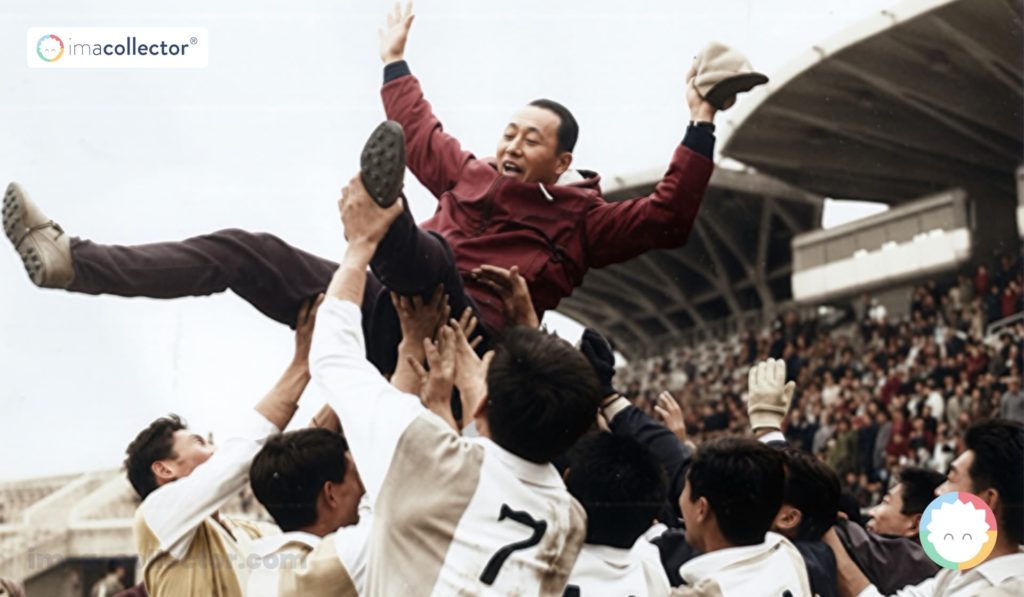
Contrary to a common assumption, Japanese football did not suddenly appear in the 1980s. After the Second World War, the Japan Football Association continued to organise the sport and gradually worked to provide it with a more solid framework.
These efforts led to the creation of the Japan Soccer League (JSL) in 1965, the country’s first national league. For the JFA, the competition represented an essential step in the development of Japanese football. It brought together eight clubs backed by major companies such as Mitsubishi, Yanmar, Hitachi and Furukawa, which invested in their teams as a source of corporate prestige and employee development.
Its structure, however, remained far removed from Europe’s major professional leagues. The players were employees first. They worked for their companies during the day, trained in the evening and represented their employer at weekends.
Several Japanese researchers specialising in the sociology of sport argue that this model helped improve the technical standard of football without creating a genuine popular culture around its clubs. The teams represented companies far more than towns or regions, which naturally limited the sense of identification among supporters.
This situation is also highlighted in several NHK documentaries on the history of Japanese football. Looking back at the 1960s and 1970s, they depict a sport that was already well organised but still widely regarded as a school, university or company activity, far removed from the popular spectacle it would become several decades later.
Japanese football already had solid foundations. What it still lacked was a story capable of moving beyond the pitch and becoming part of everyday life in Japan.
Football manga remained a niche genre
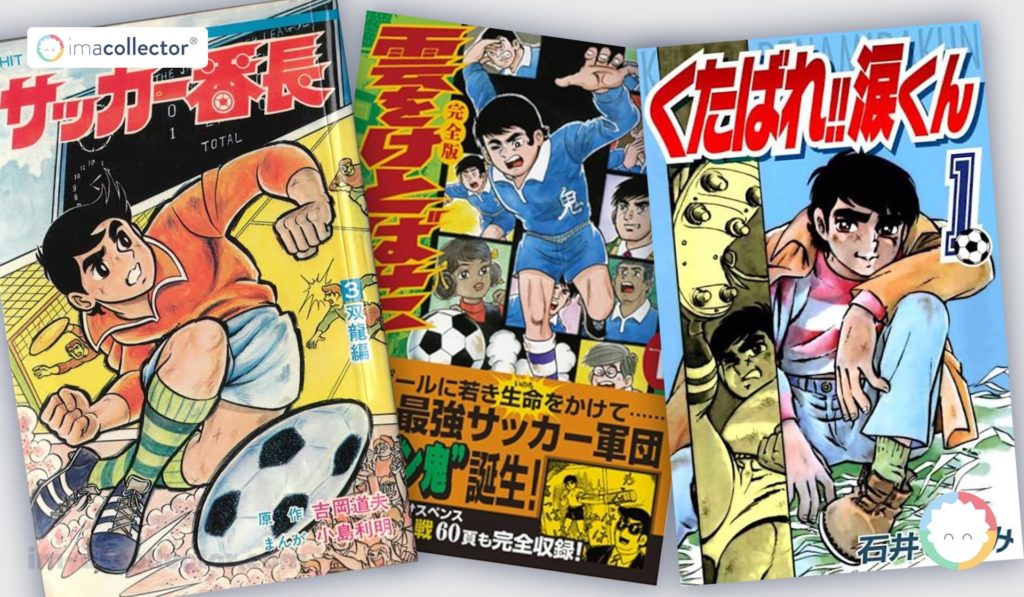
Long before Captain Tsubasa, football had already appeared several times in Japanese manga. Around the turn of the 1970s, titles such as Kutabare!! Namida-kun, Soccer Banchō and Kumo o Ketobase! were published.
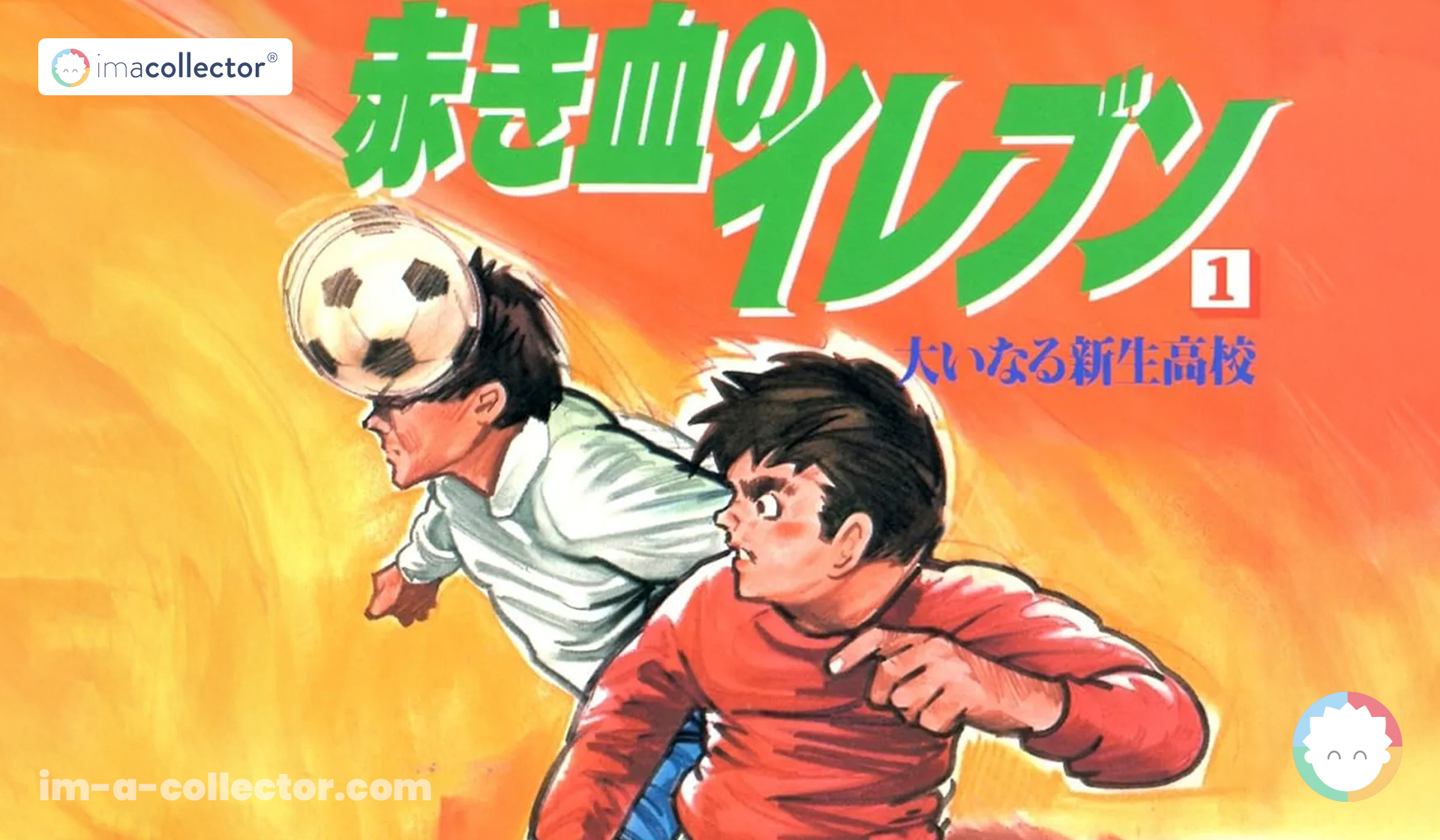
In 1970, Akakichi no Eleven, written by Ikki Kajiwara and drawn mainly by Mitsuyoshi Sonoda, became one of the first major Japanese series devoted entirely to football. Adapted for television that same year, it found a degree of success among young football fans and helped give the sport greater visibility.
Other football manga followed during the 1970s, but none achieved the nationwide influence that Captain Tsubasa would gain after its debut in 1981.
Their limited impact cannot be explained solely by their storytelling or distribution. These works appeared in a country where football was still a secondary sport. Most children played baseball, football competitions received little media coverage, and Japanese players had very little public visibility.
In other words, these manga appeared without a wider ecosystem to support them. They portrayed a sport that already existed but was still struggling to find a place in the public imagination.
The situation changed dramatically with the arrival of Captain Tsubasa in 1981. The series was published in Weekly Shōnen Jump, then Japan’s most widely read manga magazine. For the first time, millions of young readers followed the weekly story of a boy who dreamed of becoming the best footballer in the world.
Football gradually ceased to be merely a sport played in certain schools or companies. It also became an adventure that could be imagined, told and shared.
Football manga before Captain Tsubasa
The first wave of football manga emerged in the late 1960s, around the time Japan won the bronze medal at the Mexico City Olympics. Among them was Kutabare!! Namida-kun and Soccer Banchō, both launched in 1969, followed by Kumo o Ketobase! and Akakichi no Eleven in 1970. Akakichi no Eleven became the most prominent football manga of the period. Adapté à la télévision pendant 52 épisodes, il rencontre un certain succès auprès des jeunes pratiquants et participe à la popularisation de la discipline.
These manga were not entirely obscure. Their influence was nevertheless more limited and less enduring than that of Captain Tsubasa. Japan already had a national competition, the Japan Soccer League, and recognised players such as Kunishige Kamamoto, but football remained less visible than baseball in popular culture and still lacked a professional championship.
From 1981 onwards, Captain Tsubasa operated on an entirely different scale. Its publication in Weekly Shōnen Jump, followed by a television adaptation in 1983, allowed it to reach a far wider audience. Its success, however, was not simply a matter of exposure. Yoichi Takahashi placed young players at the centre of the story and gave them an ambition that was still largely unfamiliar in Japan: becoming professionals and one day competing against the best teams in the world.
An Olympic medal that did not change everything
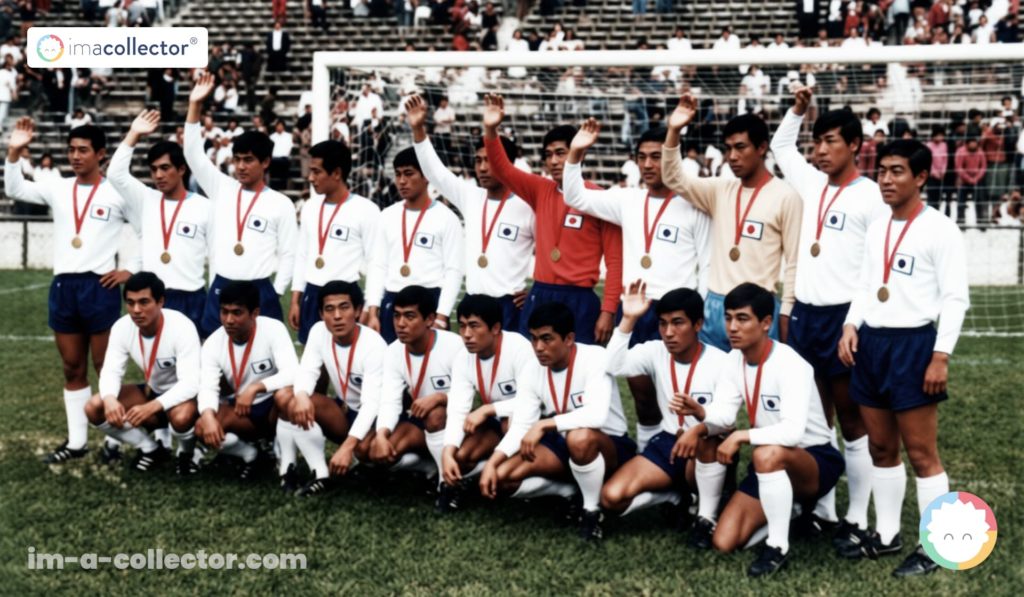
Japanese football achieved its first major international success at the 1968 Mexico City Olympic Games. Led in particular by Kunishige Kamamoto, who would finish as the tournament’s top scorer, Japan won the bronze medal after eliminating France in the quarter-finals. It was the first Olympic football medal won by an Asian country.
For the Japan Football Association, this result remains a defining moment in the sport’s history. It showed that Japan could compete with more experienced nations and generated renewed interest in football. A second division was gradually introduced, while several clubs raised their ambitions by recruiting foreign players, particularly from Brazil.
The momentum was nevertheless limited. Players remained dependent on their employers, matches continued to attract relatively few spectators, and the media still devoted most of its coverage to baseball and sumo.
This period is sometimes described as the “long winter” of Japanese football. The foundations for future development were already in place, but they were not yet enough to create a genuine popular culture around the sport.
The contrast was striking. Japan had just proved that it could compete internationally, yet few young people dreamed of becoming professional footballers. The sport’s structures were developing faster than its popular appeal, leaving a gap that neither sporting success nor the JFA’s reforms could yet fill.
What Japanese football was still missing
By the early 1980s, Japanese football already had many strengths. The country had an established national federation, a historic domestic cup, an organised league, an Olympic medal and almost 69,000 registered players. On paper, the foundations were firmly in place.
Yet these foundations were not enough to make football a popular sport. It remained closely associated with schools, universities and major companies, while baseball continued to occupy a central place in the media and popular culture.
Several Japanese researchers specialising in sports history have stressed that the development of a sport depends on more than infrastructure and competitive results. It also relies on a society’s ability to identify with its athletes, its clubs and the stories built around them. This was precisely where Japanese football still lagged behind in the early 1980s.
It was in this context that a young manga artist, deeply affected by the 1978 World Cup in Argentina, imagined the story of a boy who dreamed of becoming the best footballer in the world.
His name is Yōichi Takahashi.
His protagonist is Tsubasa Ozora.
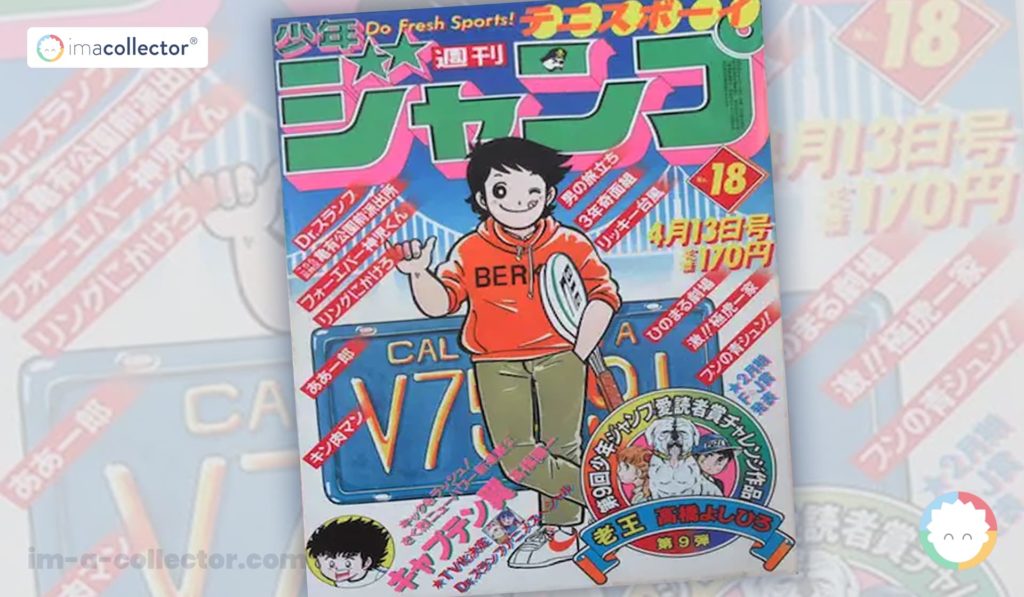
When Captain Tsubasa began publication on 13 April 1981, football suddenly gained unprecedented exposure among an entire generation of young readers. Schools, universities, the JFA and the Japan Soccer League had already laid the groundwork. The manga supplied what was still missing: characters, dreams and a story in which millions of children could finally see themselves.
By telling the story of a child rather than celebrating the achievements of established athletes, Captain Tsubasa gradually changed the way football was perceived. It was no longer simply a sport to play. It became something to aspire to.
In 1981, Japanese football finally gained what it had lacked for decades: a story capable of inspiring dreams. Whether that dream could permanently transform reality remained to be seen. This would be decided over the following years, through the influence of Captain Tsubasa, the professionalisation of Japanese football and the creation of the J.League.
The popularity of Japanese football did not emerge from a single event. It was the result of a long process in which institutions, competitions, the media and popular culture gradually reinforced one another.
Captain Tsubasa may not have been the starting point, but it was probably the link that brought everything together.