

[feature] When the dream becomes a profession: how manga portrayed the professionalization of Japanese football

In 1981, Captain Tsubasa imagined a Japan where a child could dream of playing football on the international stage, even though the country did not yet have a professional league. Seventeen years later, when Whistle! began publication, the landscape had changed completely: the J.League was established, Japan had just qualified for its first World Cup, and becoming a professional footballer was finally a real possibility. But making a dream possible does not make it accessible to everyone. Once thousands of young players can pursue the same goal, a new question emerges: is talent still enough to earn a place?
Table of contents
- Whistle!: when talent is no longer enough
- When the best players also become rivals
- Progress also means discovering new gaps
- Hungry Heart: when the dream can also become a burden
- Giant Killing: when manga starts thinking about football before the match begins
- Everything that happens before the shot
- A professional player is more than technical ability
- When the camera pulls back to show the pitch differently
- From the player to the club
- When the dream becomes an institution
- Sources
Once a sport becomes a profession, the logic changes: players have to be selected, trained, compared… and sometimes left out. Some improve faster than others, some stall, and all of them are competing for the same places. The contest is no longer played out only on the pitch, but also in the minds of coaches.
This is the Japan in which Shō Kazamatsuri appears. He does not leave his school because he hates football. Quite the opposite: he leaves because he loves it too much to accept being kept on the sidelines.
With Whistle!, the question begins to shift. It is no longer only about how far football might take a young Japanese player, but about what he will have to go through to earn his place.
From dream to profession
1981 – Captain Tsubasa begins. Japan still has no professional football league
1993 – The J.League plays its first season
1997 – Japan qualifies for the World Cup for the first time
1998 – Whistle! begins serialization in Weekly Shōnen Jump
2002 – Hungry Heart begins. A few months later, Japan co-hosts the World Cup and reaches the round of 16
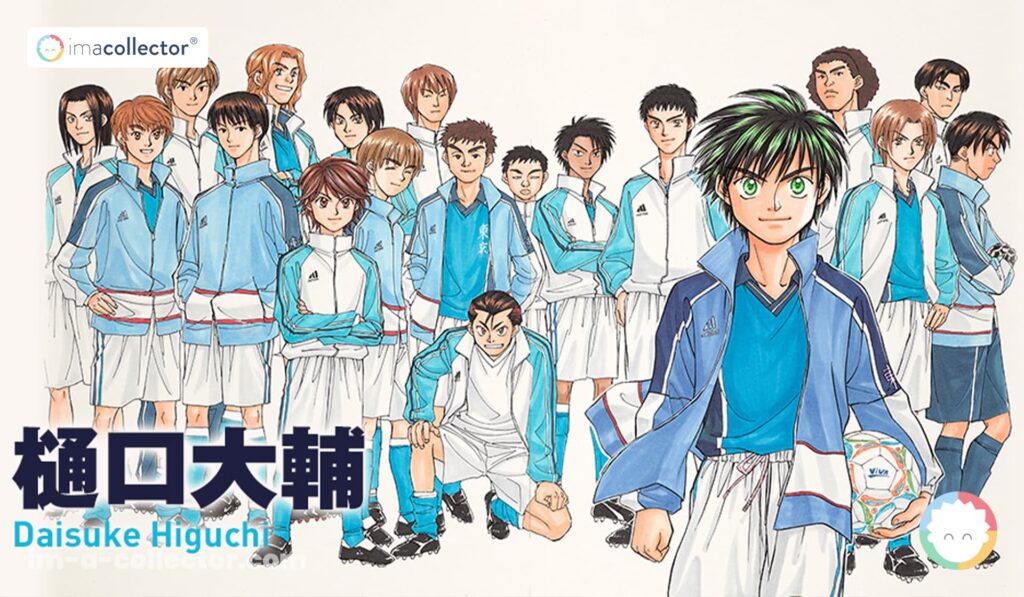
Whistle!: when talent is no longer enough
This is exactly where Shō Kazamatsuri finds himself at the beginning of Whistle!. At Musashinomori, a school renowned for its football program, his small build leaves him among the substitutes for the third team. Yet Shō deeply loves the game. Rather than accept watching others play, he decides to leave this prestigious setup for Sakurajosui, a less celebrated school where he hopes, at last, to get the chance to show what he can do.
His priority is simple: find a place where someone will give him a chance. That immediately sets his path apart from Tsubasa’s.
Takahashi’s hero possessed an exceptional talent that seemed to open new possibilities almost naturally as he moved forward. For Higuchi’s protagonist, nothing is ever so straightforward. Shō has ability, certainly, but he has to prove it again and again in an environment where the players around him have strengths of their own.
Football has become structured enough to create a new difficulty: wanting to play is no longer enough. Above all, you have to be chosen.
When the best players also become rivals
That logic becomes especially important when Shō joins the Tokyo representative squad.
There he meets players from different schools, many of them better than him in specific areas. He is forced to confront his own limitations. In volume 8, technical tests, small-sided games and competition for a forward position take on a central role. To keep improving, Shō has to understand what he lacks while also identifying what might allow him to stand out.
Competition changes form. Until then, the opponent was mainly the team he had to beat in the next match. Now, some of the players training alongside Shō are pursuing exactly the same goal as he is. They may become his teammates minutes later, while still remaining the players he must outperform when selection decisions are made.
This tension becomes even clearer in volume 9, when Shō has to identify his own “weapon”: the quality that could justify his place in the final squad
From that point on, Whistle! begins to move beyond a simple story of individual progression. In an environment where being “good” means very little because everyone around you has already reached a certain level, what matters is each player’s ability to find a role within the group, meet its needs and bring something the others do not.
Talent does not disappear from the sports manga. It simply stops being a guarantee.
What Whistle! changes
For Tsubasa, talent gradually expands the horizon.
For Shō, talent first has to be recognized within a system where other players are pursuing exactly the same goal.
Football is no longer only a journey toward the top: it also becomes a succession of selections, levels and places to be earned.
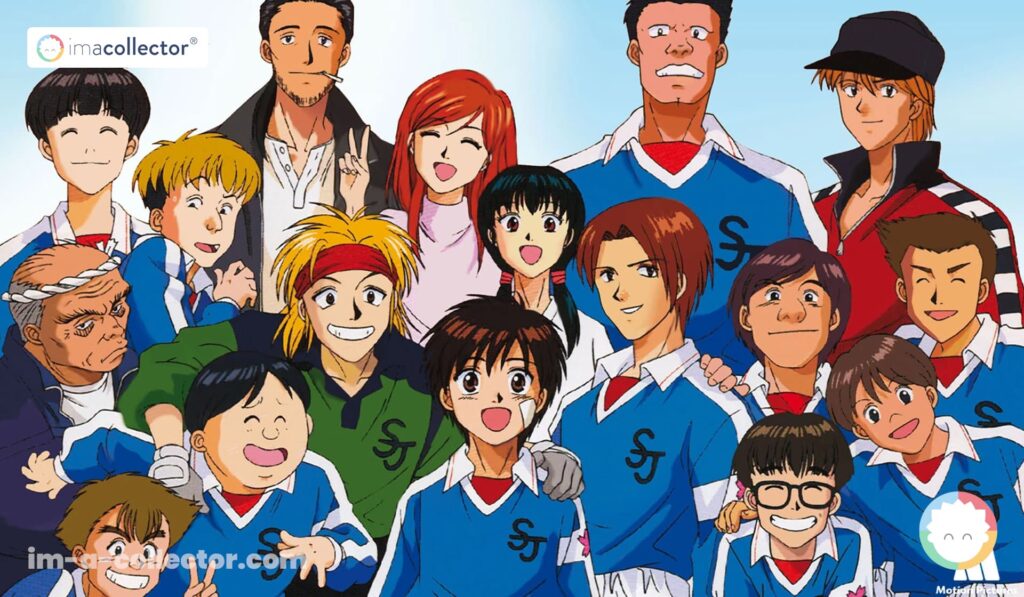
Progress also means discovering new gaps
Whistle! goes further by showing that progress does not automatically solve every problem. Far from it.
After his time with the Tokyo representative squad, Shō returns to Sakurajosui with more experience and at a different level. Around the middle of the manga, particularly in volume 10, he begins to feel a gap opening between his own development and that of some of his teammates.
This development matters because it prevents training from becoming a simple narrative mechanism in which everyone improves at the same pace until the next victory.
By spending time with players who are better than him, Shō changes his own frame of reference. What once looked like a high level no longer seems quite as impressive. This is perhaps one of Whistle!’s most accurate observations about sporting development: the closer a player gets to the top, the more he discovers how narrow the road becomes.
A teenager can be outstanding at school, much more ordinary in a regional selection, and then discover another gap when approaching the professional game. At every level, there are fewer places available, and the differences can become harder to close.
In Japan in 1998, this dynamic carries an added resonance. The country has just qualified for its first World Cup, and the J.League has already been running for several seasons. There is no basis for claiming that Daisuke Higuchi created Whistle! as a direct commentary on this transformation of Japanese football. The manga nevertheless appears in a country where becoming a professional player is now a concrete possibility.
Shō no longer needs to be taught to dream about football. He has to learn what it means to pursue that dream in a world where many others have now decided to do exactly the same thing.
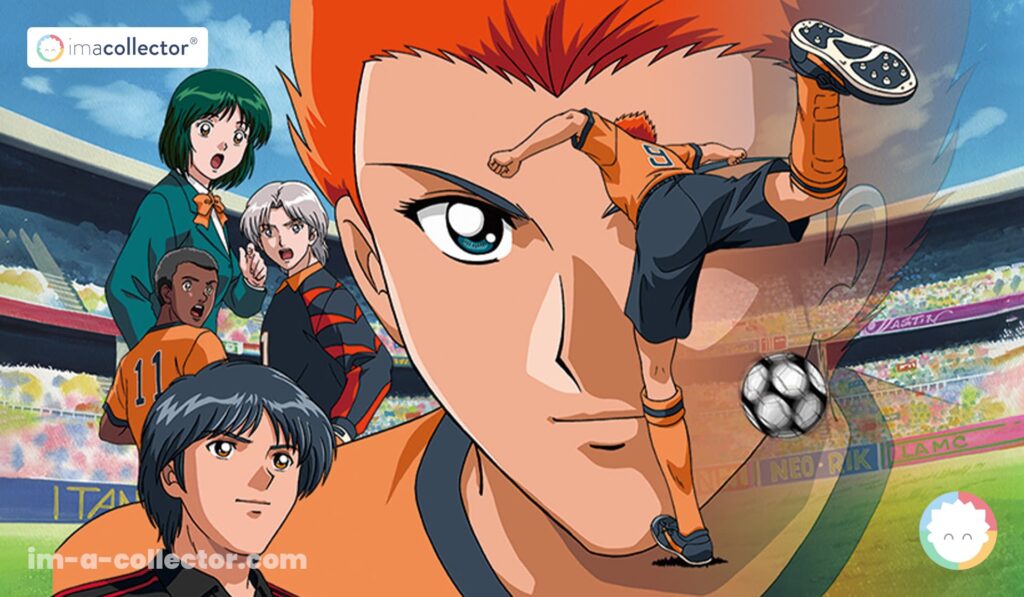
Hungry Heart: when the dream can also become a burden
In 2002, Yōichi Takahashi returned to football himself with Hungry Heart: Wild Striker, without simply creating another Tsubasa.
Kyōsuke Kanō genuinely loves football. He has obvious ability and, on the surface, could follow the familiar path of the gifted sports hero. But he has always lived in the shadow of his brother Seisuke, portrayed as a prodigy who has already achieved what many young players can only dream of. When the story begins, Kyōsuke has stepped away from the pitch.
Unlike stories in which football represents a promise, here it becomes a constant point of comparison.
Where Shō Kazamatsuri has to convince others that he deserves a place, Kyōsuke first has to decide whether he still wants to look for one. That distinction is crucial to what makes Hungry Heart interesting within the evolution of Japanese football manga.
In 1981, Takahashi told Japanese children that they could aspire to the world of football. In 2002, as that world literally comes to Japan with the World Cup co-hosted with South Korea, he tells the story of a boy who can no longer tell what the sport means to him.
The timing is striking. Hungry Heart begins publication in January 2002. A few months later, Japan hosts the World Cup, wins its first matches in the tournament and reaches the round of 16 for the first time.
Japanese football had probably never been so visible. Yet the hero Takahashi chooses begins his story having stopped playing.
The contrast with the transformation of Japanese football is hard to ignore, even if there is no evidence that Takahashi consciously set out to create it. Kyōsuke’s journey is about reclaiming football for himself, no longer measuring his own desire against his brother’s and, above all, discovering what he truly wants to pursue on his own terms.
In that sense, Hungry Heart adds another dimension to what football manga can now explore.
With Whistle!, the dream had become concrete enough to create selection and competition. With Hungry Heart, it has become present enough to weigh on someone who should, in theory, naturally want to pursue it.
In 2002, Yōichi Takahashi therefore returns to football with a hero who is not initially looking for a path to the top. He is looking for a reason to start running again.
Japanese football had changed; perhaps it was now also time to tell the stories of those who could be crushed by the dream.
Meanwhile, Captain Tsubasa is also evolving alongside Japanese football.
In Road to 2002, which began publication in 2001, Tsubasa is no longer just the gifted child dreaming of conquering the world: he joins FC Barcelona and, in turn, faces the competition of professional football, while Hyūga continues his career in Italy.
Even the hero who once embodied the dream must now learn to live in the world that dream helped make imaginable.
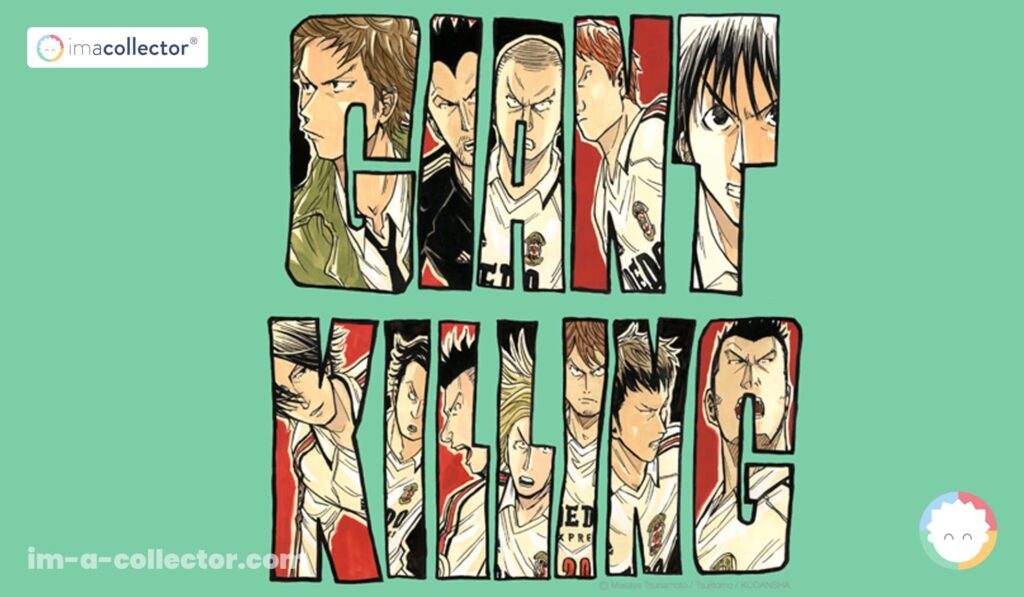
Giant Killing: when manga starts thinking about football before the match begins
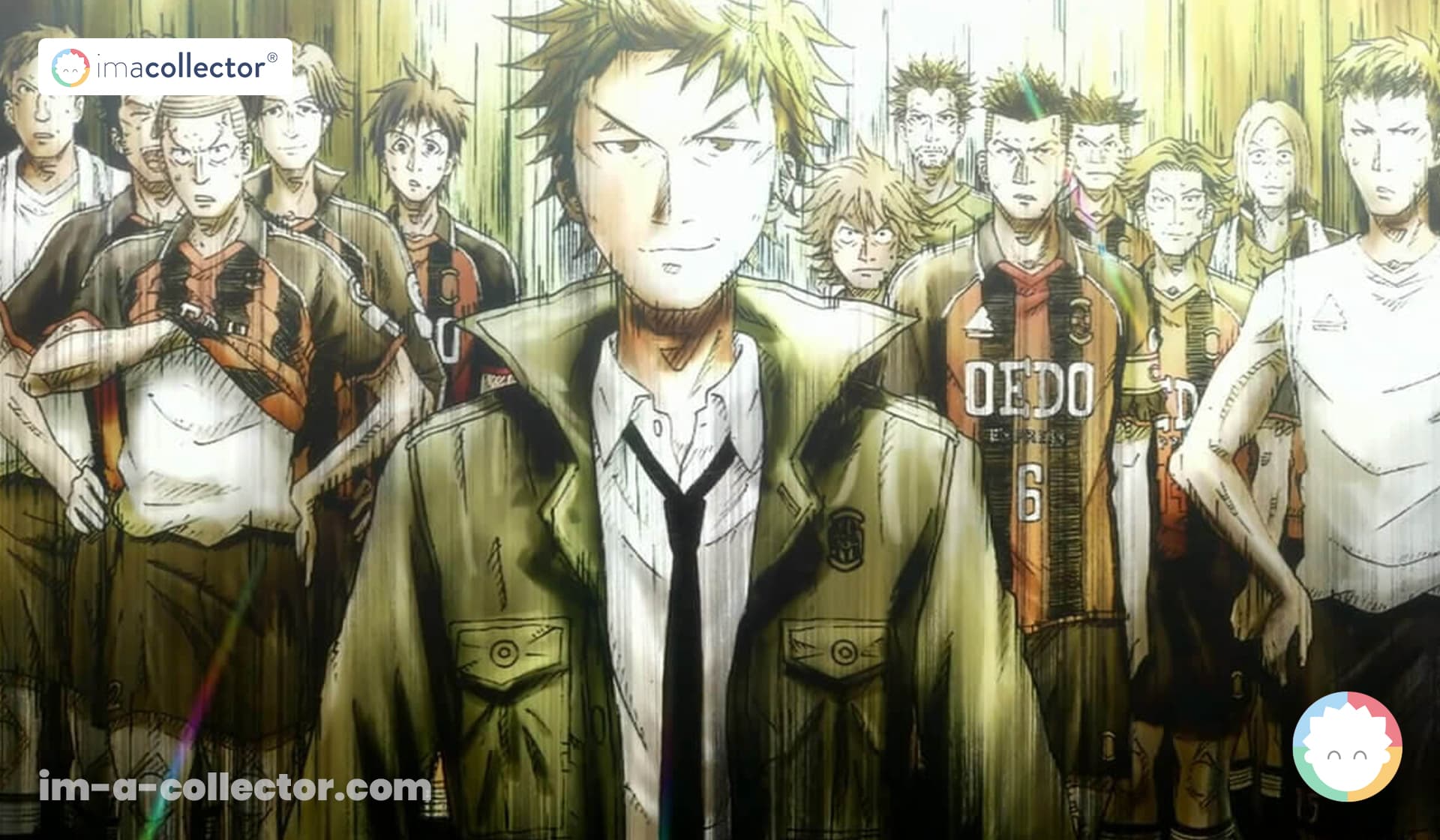
A few years later, Giant Killing arrives and unsettles some of the conventions of football manga by making Takeshi Tatsumi, a 35-year-old coach of a struggling professional club, the central character of its story.
That choice says something much deeper than a simple change of protagonist: football is now established enough in Japanese culture for a manga to treat someone who hardly ever touches the ball as a compelling central figure.
The origins of Giant Killing itself help explain this shift. Masaya Tsunamoto, who conceived the project, is a supporter of JEF United Ichihara Chiba. When Ivica Osim becomes the club’s manager in 2003, Tsunamoto witnesses a transformation that leaves a deep impression on him. The same squad suddenly seems capable of playing a different kind of football, simply because a new man has arrived on the bench.
Years later, Tsunamoto summed up his surprise in a single line:
“監督が代わるだけでこんなにもクラブのサッカーが変わるんだ!”
“Just changing the manager could transform a club’s football this much!”
(Source: Masaya Tsunamoto, interview with Kōsho Kōjitsu / Asahi Shimbun, 2019)
This time, the connection with the evolution of professional football in Japan is not an interpretation. Tsunamoto himself explains that watching Osim’s JEF showed him just how much a coach could transform a team, and that the experience made him want to build a manga around that role. The JFA has also highlighted Osim’s immediate impact on the club: from his first season, JEF produced results strong enough to draw attention to his work and his way of thinking about the game.
What Tsunamoto discovered in the stands then became the narrative principle of Giant Killing: a match does not begin when the referee blows the whistle. It has already begun long before.
Everything that happens before the shot
With Giant Killing, the way football is told changes profoundly.
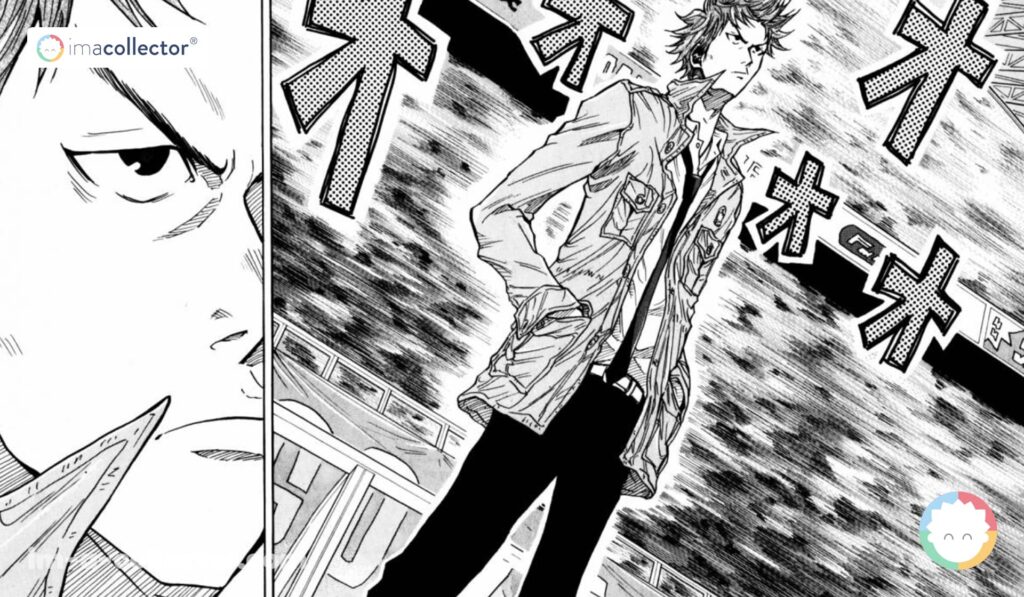
In Captain Tsubasa, the spectacle naturally revolves around players capable of producing extraordinary actions. In Giant Killing, the action we see is often only the final outcome of decisions made much earlier.
Why is this player standing there? Why does Tatsumi start one player rather than another? Behind those decisions may be spaces deliberately conceded to the opponent, altered roles or plans built around a specific weakness.
The shot is no longer necessarily the beginning of what deserves attention. It may be the consequence of something imagined several days earlier.
This idea comes through very clearly in conversations between Tsujitomo and Yasuhito Endō. They discuss players whose influence is not always visible in the final pass or the goal, but a few actions earlier. To understand why an attack worked, you sometimes have to go back two or three passes and look at the player who shifted the balance of play before the danger became obvious.
(Source: Yasuhito Endō × Tsujitomo interview, Gekisaka)
Giant Killing teaches us to see football differently: not only through the player who finishes the move, but through everything that made it possible.
And sometimes that work begins before the players even step onto the pitch.
A professional player is more than technical ability
But Giant Killing is not interested in tactics alone. Tsujitomo also draws on interviews with players and coaches, studying their reactions to infer what may lie behind their public statements. That approach is visible throughout Giant Killing, where the internal dynamics of the club become a central part of the story.
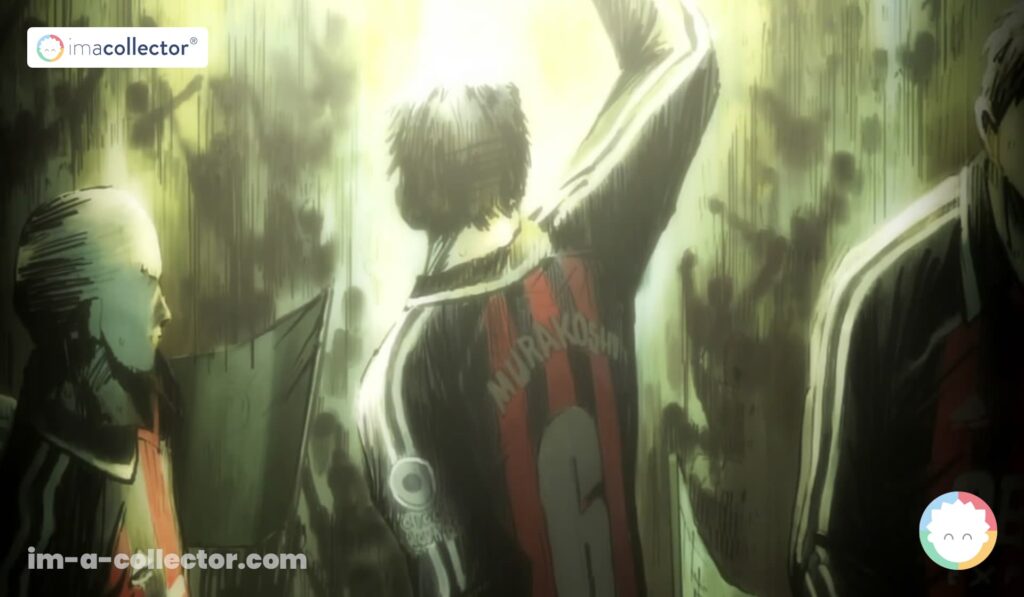
The realities of a professional dressing room can be harsh: a starter can lose his place, a younger player can push a more experienced one onto the bench, a captain carries responsibilities different from those of his teammates, and a coach may have to preserve the confidence of a player he already knows will not start the next match.
Professional football becomes a human environment, shaped by status, frustration and power relationships. That is precisely what Kengo Nakamura recognizes in Giant Killing.
In a conversation held to mark Giant Killing’s 500th chapter, the former Japan international explains that he has been reading the series since it began.
When he himself has to hand the captain’s armband to Yū Kobayashi at Kawasaki Frontale, he returns in particular to Murakoshi’s journey in the manga, because the situation echoes what he is going through at the time.
More importantly, Nakamura says something far more revealing than a simple compliment about the series’ realism:
“僕ら本当のサッカー選手に近い”
The characters are close to “us, real football players.”
(Source: Kengo Nakamura × Tsujitomo, GIANT KILLING extra / Comic Days)
Giant Killing’s realism does not rest only on the precision of a tactical system or the way a match is depicted. A professional player recognizes situations he knows himself in these characters: responsibility, doubt, competition, ageing, and the moment when you have to accept that someone else is gradually taking the place you built for yourself.
A player is no longer simply a body capable of running, dribbling or shooting: he also has a career.
When the camera pulls back to show the pitch differently
This evolution also comes through in the staging itself.
In a conversation with Tsujitomo, Yūgo Kobayashi, the author of Ao Ashi, explains that he was struck by the way Giant Killing positions its “camera” around the pitch. Where many sports manga create the impression of running alongside the hero, Giant Killing reminds him more of a television broadcast that can shift its focus from one part of the match to another (source: Tsujitomo × Yūgo Kobayashi, Big Comic Bros / Shōgakukan).
The comparison is revealing: the change concerns not only the protagonist, but also the reader’s position.
The reader can follow one player, then watch an entire line shift, understand a coach’s reaction on the bench, assess the consequences of a tactical change or notice space opening elsewhere on the pitch.
The manga therefore asks the reader less often to identify solely with the player running with the ball, and more often to understand what several people are building together at the same time.
This staging makes it possible to show the player, the team’s movement and the decisions shaping the match all at once.
From the player to the club
This is the logical culmination of that evolution.
Tatsumi remains the character around whom much of the story is organized, but Giant Killing is never simply about a brilliant coach arriving to rescue a “weaker” team. It gradually tells the story of the club as a whole: its players, staff, supporters and the tensions that determine what it can become.
Tsunamoto’s personal experience is once again important. Before imagining Giant Killing, he was first and foremost a JEF United supporter, to the point of saying that the club had become part of his everyday life. His interest therefore comes not only from the match itself, but from everything that exists around it.
This is where Giant Killing marks a clearer break from the football of Captain Tsubasa.
The pitch has obviously not lost its importance, but it is no longer enough to explain what has just happened. Behind a shot may lie an instruction given days earlier, a weakness spotted in the opposition, a player moved into a new position, confidence rebuilt or a decision whose importance the spectator had not yet understood.
For a long time, Japanese football manga asked how to become a better player. With Giant Killing, it can now ask another question: how do you make everyone who affects the result work together, including those who will never touch the ball?
When the dream becomes an institution
Between Whistle!, Hungry Heart and Giant Killing, Japanese football manga does not simply become more realistic.
Captain Tsubasa taught a generation that a Japanese player could look toward the summit of world football. The works that followed began to explore everything that ambition entails once it becomes concrete: earning a place, living with comparison, understanding one’s own relationship with the game, accepting a hierarchy and learning to function within a collective.
The dream has become a profession. And with it came an entire world that manga could now tell stories about.
But another stage still awaits Japanese football.
Once professional clubs are established, selections are structured and tactical culture has developed, another question becomes essential: how do you actually train a player capable of reaching the highest level?
Ao Ashi makes that question the heart of its story. With Ashito Aoi, the focus will no longer be only on dreaming, earning a place or understanding how a club works. The manga moves inside a structure designed to identify potential, refine it, develop it and gradually turn a teenager into a professional footballer.
Talent will no longer be only something a player possesses. It will become something he learns to build.
Sources
Japan Football Association (JFA) — history and timeline of Japanese football: the creation and development of the J.League, Japan’s first qualification for the FIFA World Cup, and the evolution of professional football in Japan.
Japan Football Association (JFA) — France 1998: Japan’s first World Cup appearance and Japan–Korea 2002: the sporting context in which Whistle! and later Hungry Heart were published.
Shūeisha — Daisuke Higuchi’s Whistle! — Volume 8, Volume 9 and Volume 10: the Tokyo selection team, technical tests, competition between players, the search for the quality that can set Shō Kazamatsuri apart, and the consequences of his progression.
Akita Shoten — Weekly Shōnen Champion No. 9, 2002 — 24 January 2002 issue: the beginning of Yōichi Takahashi’s Hungry Heart, a few months before the World Cup hosted by Japan and South Korea.
Nippon Animation — Hungry Heart: Wild Striker — official series page: Kyōsuke Kanō’s journey, his relationship with football, and the burden of being compared with his brother Seisuke.
Captain Tsubasa Official — overview of the manga’s different series: Road to 2002, Tsubasa’s arrival at FC Barcelona, and the characters’ transition into European professional football.
Asahi Shimbun / Kōsho Kōjitsu — interview with Masaya Tsunamoto: the author explains how JEF United’s transformation under Ivica Osim made him realise the extent to which a manager can shape a club’s football, helping inspire the creation of Giant Killing.
Japan Football Association — Ivica Osim — Japan Football Hall of Fame profile: Osim’s arrival at JEF United in 2003 and the rapid transformation of a struggling club into a team capable of challenging near the top of the table.
Gekisaka — Yasuhito Endō × Tsujitomo interview: a discussion about reading the game, the actions immediately preceding a goal, and the often less visible elements needed to understand how an attack is constructed.
GIANT KILLING extra / Comic Days — Kengo Nakamura × Tsujitomo interview: a conversation marking the 500th chapter of Giant Killing. Nakamura notably discusses the realism of its characters and how closely they resemble real professional players.
Big Comic Bros / Shōgakukan — Tsujitomo × Yūgo Kobayashi interview: a discussion between the creators of Giant Killing and Ao Ashi about how they depict football, stage matches, and position the “camera” around the pitch.