

Collectible Eternity Labs (CEL): what are the risks of grading anime art?

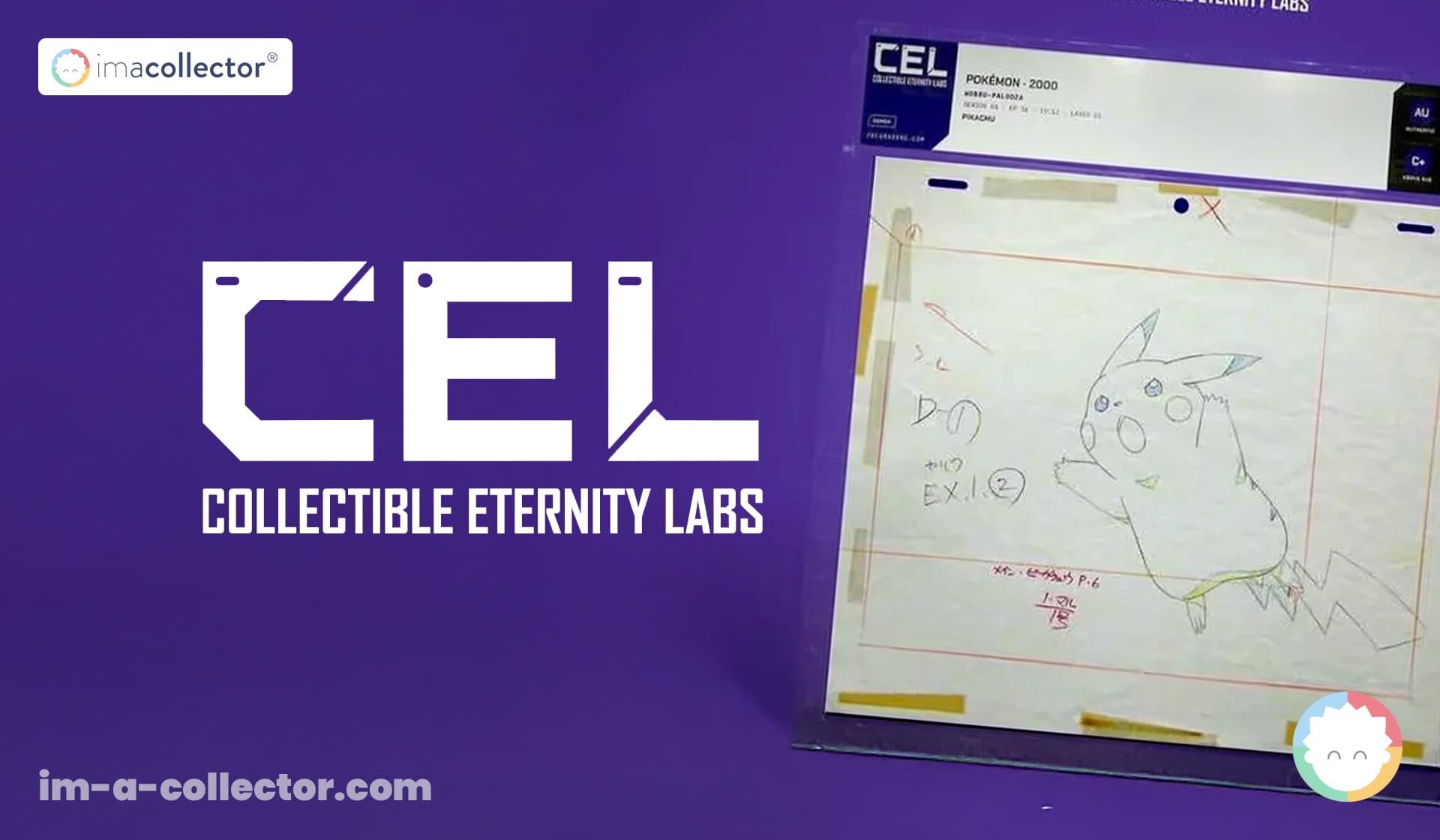
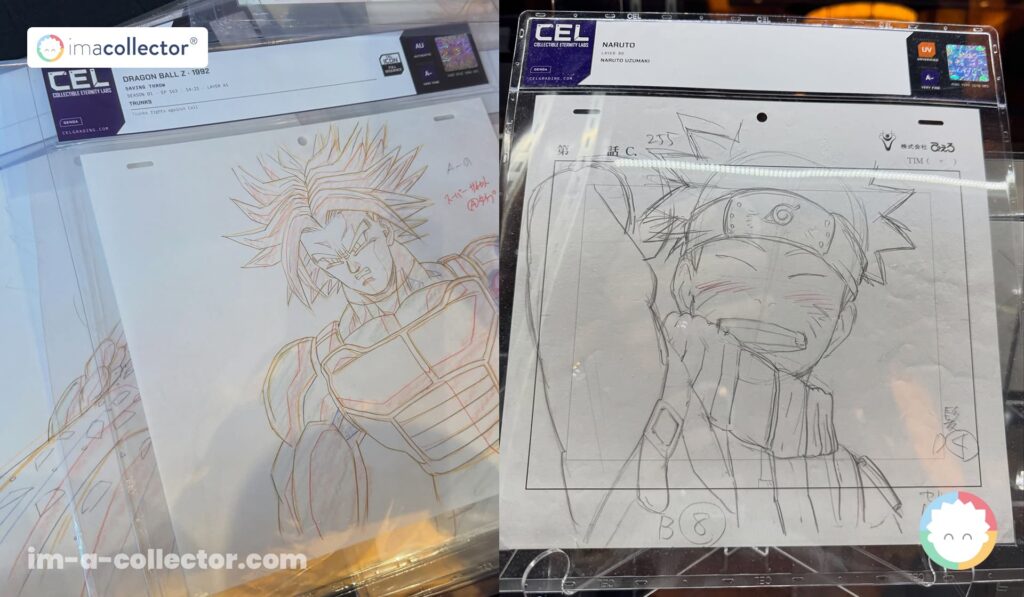
A Naruto genga has just been graded A-, while a Pokémon douga received a B. Collectible Eternity Labs (CEL), a new service dedicated to authenticating and grading anime art, now wants to apply its system to cels, genga, douga and other production drawings. The sheet may carry peg holes, annotations and the normal traces of a drawing that was actually used during production, yet that letter ultimately tells me very little about the drawing or the piece itself. What it does say a great deal about is how Collectible Eternity Labs (CEL) now wants us to look at these objects: as pieces that can be authenticated, ranked and sealed inside a holder, with a grade prominent enough to be understood before we have even looked at the drawing itself.
Table of contents
- Why grade a sheet that CEL itself describes as unique?
- Production traces risk becoming negative points
- However high the grade, it does not tell you what you own
- Where Mandarake documents, Collectible Eternity Labs simplifies
- Who are the experts at Collectible Eternity Labs (CEL)?
- CEL’s Contract is far more cautious than its label
- Technology cannot determine who drew the sheet
- The transparent sleeve raises very concrete questions
- With cels, conservation cannot stop after grading
- Grading breaks into individual pieces what animation produced as an ensemble
- CEL’s best idea already exists and it does not beed a grade
- CEL is already making resale part of a piece’s story
- Jeremy Padawer and the collectibles logic behind Collectible Eternity Labs
- You do not build authority by blocking criticism
- Anime Art needs expertise far more than it needs another ranking system
- Sources
I have been collecting animation drawings for years, and the condition of the sheet is almost never the first thing I look at. I look for the linework, a scene, a character, corrections, sometimes simply an instinctive connection. I have bought sheets simply because they had something stronger than others. Something that spoke to me.
CEL offers authentication and grading for cels, genga, douga, layouts, backgrounds, storyboards, correction sheets and production scripts. Condition is graded from S to C-, after which the piece is encapsulated and entered into a public database. The site itself describes these production materials as unique, “1-of-1” objects.
I had already written about graded manga, and about the rather strange idea of increasing a book’s status by making it impossible to read. With anime art, the issue bothers me even more. A manga is still a mass-produced object. A genga, douga or storyboard is a one-off trace of the production process whose significance often depends on the other documents that once surrounded it.
Grading offers a simple, instantly visible answer for objects that, by their very nature, take time to understand. I am not convinced that this simplification does them any favors.
Why grade a sheet that CEL itself describes as unique?
CEL’s grading scale starts at S Supreme, defined as perfect condition with no visible flaws. It then moves down through A+, A, A-, followed by B and C. From C+ onward, CEL even compares a piece with other surviving examples from its era. C- corresponds to significant damage and a “lower collectible value.”
Seriously? At what point does a condition scale start speaking directly about collectible value?
With a Pokémon card, I can understand the principle, even if I do not agree with it. Thousands of identical copies exist. Some are perfectly centered; others have a damaged corner or a scratch. A grade makes it possible to compare multiple examples of the same object.
Animation drawings work very differently.
An A1 is not a better example of an A2. They are two different drawings. Full stop. A rough and the genga produced from it are not two condition states of the same piece. They represent two different stages of the work. An animation director’s correction cannot be placed, intellectually or qualitatively, on the same scale as a clean douga simply because both happen to be drawn on paper.
CEL itself acknowledges this uniqueness on its homepage: every piece of production material is presented as a “1-of-1” object.
There is also a very concrete problem with the definition of C+. CEL states that a C+ piece is “better preserved than most surviving examples of its era.” But what exactly is the reference population? Every known genga from the same period? Every piece submitted to CEL? Every drawing from the same studio? The site provides no comparison corpus and no figures by material type or period. We are therefore told that a sheet is better preserved than “most” others without being told what those other pieces are.
So the question remains: what do we actually learn from a grade?
Production traces risk becoming negative points
CEL is perfectly clear on this point: what matters is the physical condition of the sheet. A grade can be useful for flagging a tear, lifting paint, discoloration or heavy wear. But the prominence given to that grade around a unique object seems completely disproportionate to what it actually tells us.
A heavily damaged, annotated or torn sheet can be historically fascinating, especially when its history is known.
Another point bothers me as well: at the top of CEL’s grading scale, “perfect condition with no visible flaws” strikes me as a rather curious concept when we are talking about materials that were used to make an animated production.
To be clear, a production sheet has been handled. It may have been corrected, taped or annotated. The peg holes were used. Some marks were created during the work itself and are part of the material history of the piece.
Moisture damage, a tear or flaking paint are conservation issues. Those are genuine forms of deterioration. But I refuse to place actual degradation and a trace of production in the same category.
While researching this article, I identified several fairly logical risks once the market begins rewarding the highest grades:
- · cleaning
- · flattening
- · separating certain elements to improve presentation
I would find it deeply regrettable if future collectors were taught to see a trace of the production process as a defect that might cost a piece a higher grade.
However high the grade, it does not tell you what you own
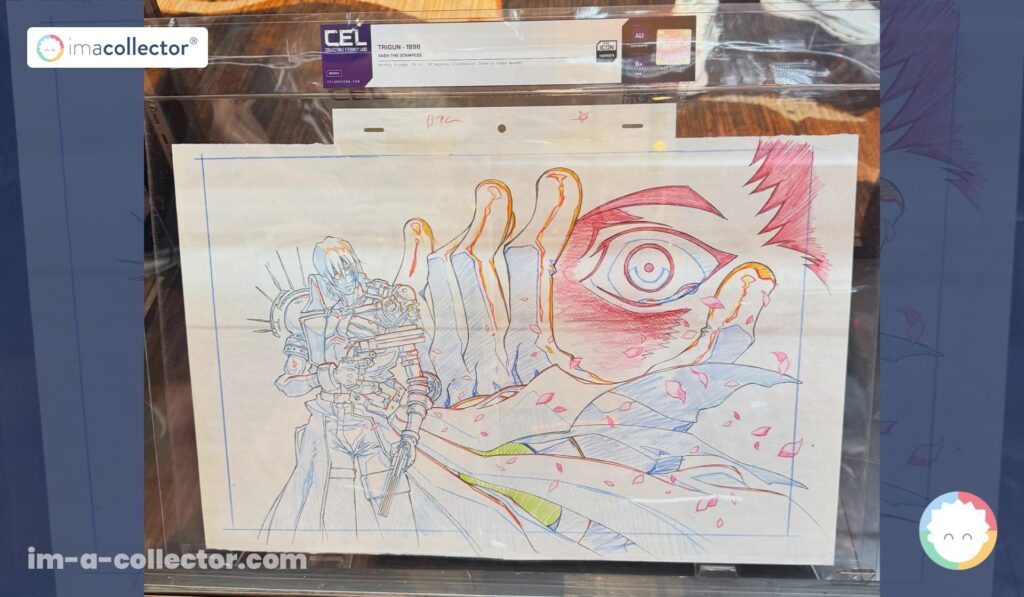
Fortunately, CEL separates grading from authentication. Pieces considered authentic receive the AU designation. When the company believes an object is probably authentic but cannot link it closely enough to its production context, it uses UV (Unverified).
This part interests me far more. It still runs into a problem that anime art has faced for a long time: the word “authentic” needs to be extremely precise.
JAMAC, the Japan Anime & Manga Appraisal Committee, for example distinguishes between cels actually used for filming, licensed or promotional pieces, reproductions, rilezu, pieces made for sale and fakes.
An official reproduction can therefore be authentic. But it remains an official reproduction. In the same way, a photocopied settei distributed to animators can be a genuine production document without being the character designer’s original drawing.
Then there is attribution to a specific person, which raises another set of difficulties. An authentic Castle in the Sky sheet does not automatically become a Hayao Miyazaki drawing simply because Miyazaki directed the film. That may seem obvious to some. Less so on the market.
Je vais t’expliquer le problème avec un cut de Castle in the Sky.
Where Mandarake documents, Collectible Eternity Labs simplifies
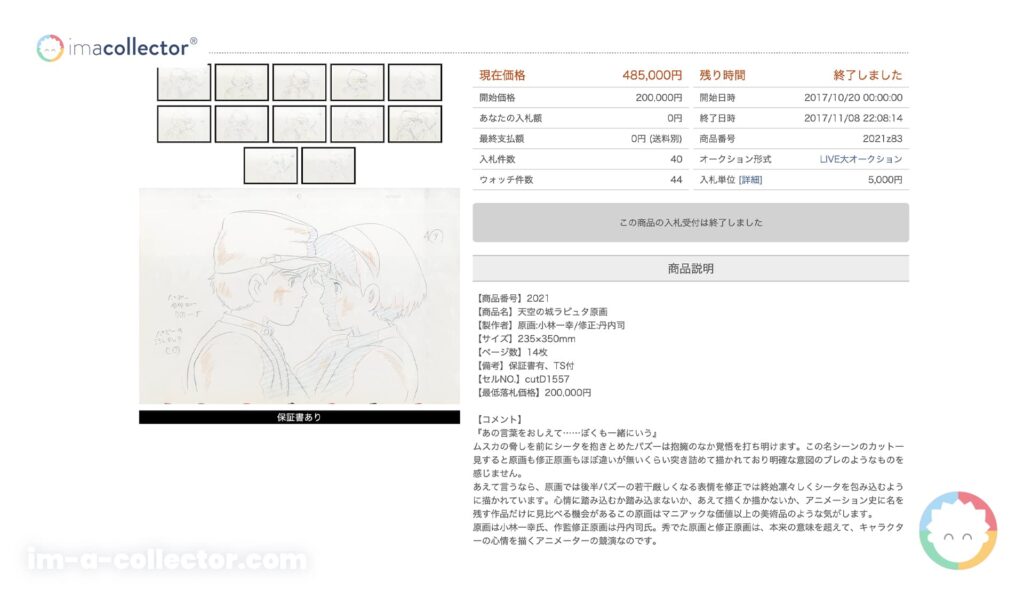
Mandarake documents cut D1563 from Castle in the Sky extremely well. Its Japanese description attributes the genga to Kazuyuki Kobayashi, a correction rough to Hayao Miyazaki, and the animation director corrections to Tsukasa Tannai. Three people worked around the same cut, with their roles identified separately. Mandarake even comments on the differences in how Kobayashi, Miyazaki and Tannai interpret the characters’ expressions and poses.
That is what I love about animation art: a single sheet can lead you back to the work itself.
Now imagine that one of those pieces is separated from the others for twenty years. Its provenance suddenly becomes much less clear. The entire context disappears, and the seller eventually writes nothing more than “Miyazaki — Castle in the Sky.”
We are left with the correct title of the work, but that is nowhere near enough to attribute every drawing to Miyazaki.
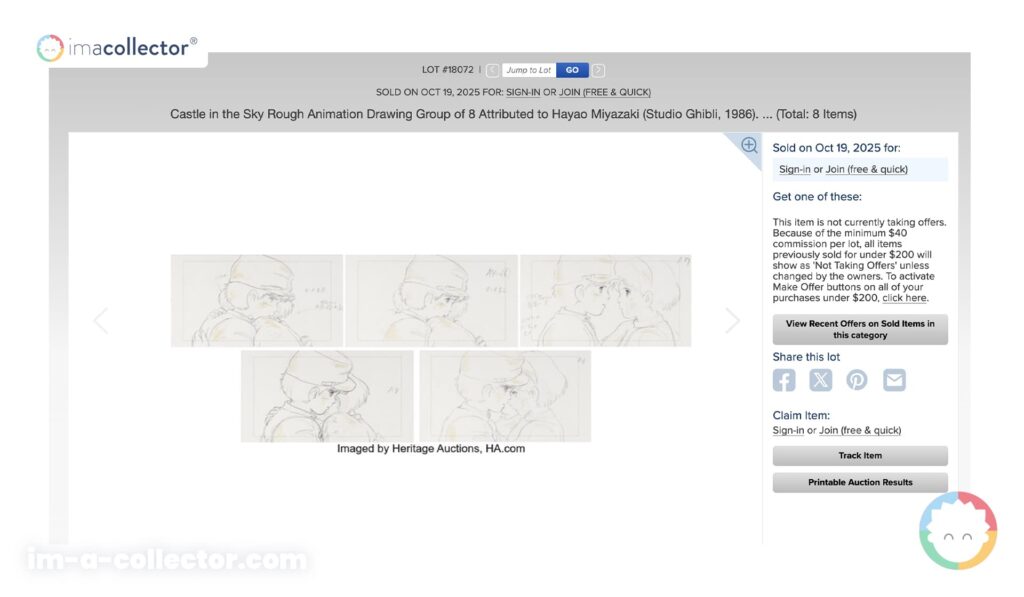
A lot sold by Heritage Auctions in October 2025 shows just how complicated the attribution of an animation drawing can become. Eight Castle in the Sky roughs sold for $24,000 under the title “Attributed to Hayao Miyazaki.” The listing still carries the note “EDIT: Attributed to Hayao Miyazaki,” explicitly indicating that the attribution was changed.
An earlier version of the description, still accessible on Lot-Art, instead attributed the scene to Kazuyuki “Ikko” Kobayashi. Mandarake, meanwhile, sold a set of fourteen drawings with its timesheet for cut D1557 in 2017. The quoted line corresponds to the same moment: Pazu embraces Sheeta and asks her to teach him the spell so they can say it together. Mandarake attributes the genga for this cut to Kazuyuki Kobayashi and the animation director corrections to Tsukasa Tannai.
The images from the Mandarake lot let us follow the different stages of the embrace, as Pazu and Sheeta move closer and their expressions change from sheet to sheet. The description even compares the work of the two animators: in Kobayashi’s genga, Pazu’s expression becomes slightly harsher toward the end of the cut, while Tannai’s corrections keep him in a more dignified, protective posture toward Sheeta.
The Heritage listing gives no cut number, so I cannot state with certainty that its eight roughs correspond to the D1557 documented by Mandarake. Nor can I determine from the publicly available information whether Heritage later obtained evidence that justified reattributing them to Miyazaki. What is documented, however, is the change itself: an earlier description linked the scene to Kobayashi, while the current listing attributes it to Miyazaki without explaining what prompted the change.
For a lot that sold for $24,000, I would like to know what justified moving from one name to the other. That is exactly the kind of information an authentication system should preserve. Printing “Hayao Miyazaki — Authentic” on a holder tomorrow without retaining the attribution history, the sources used and the level of certainty would remove information rather than add it. With this kind of object, I expect exactly the same thing from an authentication service.
With this kind of object, I expect exactly the same thing from an authentication service. I want to know who examined the sheet, which references the attribution is based on, and how far that person is prepared to stand behind the opinion.
Who are the experts at Collectible Eternity Labs (CEL)?
The grading page states that authentication is carried out by Collectible Eternity Labs (CEL) staff with expertise in the history of anime production. Yet on the public pages currently available, no names, profiles, professional backgrounds or specific qualifications identify the people making those decisions.
For a company claiming to authenticate and grade pieces that can be worth several thousand euros, this complete lack of transparency looks less like a minor omission than a serious credibility problem.
Asking collectors to trust an “expertise” while giving them no way to know who provides it, what verifiable skills it rests on, or who assumes responsibility for the authentication raises a genuine question of credibility.
The launch of the site also brought a rather surprising element to light. CEL has created a “Bounty Board” for documents it cannot identify using its own resources. Members of the community can locate an episode, film or timestamp and receive credits in return, including credits that can be used toward grading fees. I have no objection in principle to involving collectors: some know a particular series or studio with remarkable precision. But I then want to know which information came from a CEL expert, which came from a community member, and how it was verified before being added to a piece’s record.
JAMAC, for its part, explains that it brings in different specialists depending on the work or genre being examined. Rinkya Authentic issues a verdict signed by an identified expert, separates the condition grade from authentication, and can leave a result as “Inconclusive” when the evidence does not support a firmer conclusion. Rinkya summarizes the distinction rather well: a grade answers the question of condition, while authentication answers the question of what the object actually is.
With CEL, I can know the grade, the certificate number and that the object received AU. What I cannot know is who is putting their expertise behind that attribution.
For a Pokémon card, that lack of a name may already be uncomfortable. For a correction rough potentially attributed to Miyazaki, it bothers me even more.
CEL’s Contract is far more cautious than its label
In its terms, CEL makes it clear that authentication remains an expert opinion. It can therefore be challenged if new information emerges.
The wording is very specific: CEL describes its authentication and grading decisions as “subjective expert opinions” and states that they are neither a guarantee nor a certification of future consensus. That is quite different from the way the result appears on the holder, where the collector primarily sees AUTHENTIC and a certificate number.
On the label, that caution disappears completely. The word AUTHENTIC gives the impression of final certainty: the piece is authentic, full stop. In the contract, CEL is essentially saying, “we can be wrong.” On the holder, the message becomes, “this is authentic.”
For me, serious expertise should display its limits as clearly as its conclusions.
Technology cannot determine who drew the sheet
CEL says it uses image recognition, metadata, reference databases and AI-assisted tools. These technologies can be very useful for locating an episode or cut, or for comparing a sheet with the final image.
But they cannot answer the most important question: who actually drew this sheet?
A screen match proves that a drawing corresponds to an image in the anime. It does not prove who was holding the pencil during production. A single sheet may have been started by one animator, corrected by another, then retouched again later.
That is the limit of the system. Technology can find the image. On its own, it cannot reconstruct the exact history of the drawing.
CEL itself acknowledges the limits of these tools. Its documentation states that image recognition or AI-assisted systems can produce errors, incomplete matches or false matches. The company also notes that the historical databases used as references may contain information that is inaccurate, disputed or later corrected. I think it is healthy to state that openly. The question is how those uncertainties are preserved once the piece has been authenticated and its label printed.
My example with Castle in the Sky cut D1563 illustrates that very well.
The transparent sleeve raises very concrete questions
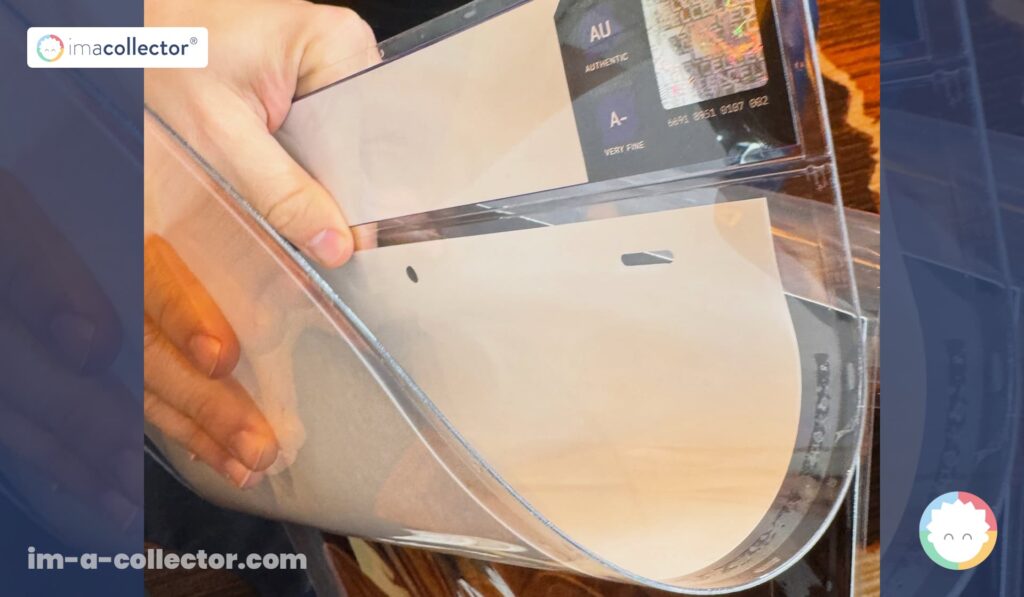
The published photos also give us a clearer idea of the packaging: the drawing appears to be placed inside a flexible transparent sleeve.
The problem is that we still do not know what plastic is in contact with the drawing, or how the sheet is held in place.
That is not a trivial detail: graphite, pastel and some pencils can be sensitive to contact and static electricity. Suitable conservation materials exist, but not all plastics are equal when it comes to preserving an original drawing.
I am not saying that CEL’s system damages artworks. But without technical information, it is impossible to verify that it protects them as claimed.
The wording on CEL’s homepage is nevertheless very clear: once graded, a piece is “safely encapsulated.” In the Submission Agreement, however, the submitter also acknowledges that handling, transport, encapsulation, environmental exposure and age-related fragility carry inherent risks. Those are precisely the risks I would like to be able to assess. For now, CEL says its encapsulation is safe without publishing the specifications of the material placed directly around the sheet.
For a company that uses conservation as a commercial argument, failing to publish the composition and precise specifications of its packaging is a lack of transparency that is difficult to understand.
With cels, conservation cannot stop after grading
A cel can change over time: the plastic may yellow, warp or shrink, while the paint may crack or lift. That is why cels need to be stored under carefully controlled conditions.
Grading does not stop that aging process. A grade awarded in 2026 therefore describes only the cel’s condition in 2026. Five or ten years later, its condition may have changed even if it never left its holder.
This is where I expect precise answers from CEL: can the holder be opened? Can the cel be removed for treatment? Can internal materials be replaced? Can the piece be reinspected a few years later?
For a cel, the real question is not simply what grade it deserves today. It is whether the system still allows it to be conserved properly tomorrow.
Grading breaks into individual pieces what animation produced as an ensemble
An animation drawing almost never exists in isolation. A single cut can include layouts, roughs, genga, corrections, douga, timesheets and multiple layers. Some groups can contain dozens, or even more than a hundred, sheets.
The market has been breaking these sets apart for years already. Grading may simply accelerate that process by placing even more value on the biggest and most visually impressive pieces when they are taken individually.
This raises a real heritage issue: we may end up preserving the most beautiful images while losing the process that produced them.
To me, that is a far more serious loss than any question of condition or presentation.
CEL’s best idea already exists and it does not beed a grade
There is, however, one part of the Collectible Eternity Labs project that I find genuinely interesting: its database.
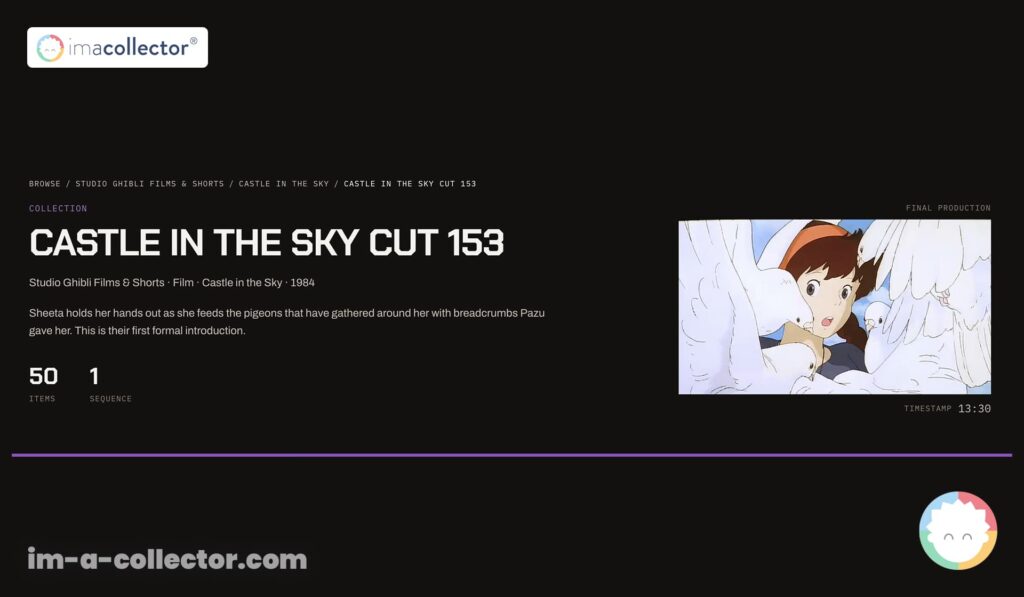
The example of Castle in the Sky cut 153 brings together 50 elements, including 49 genga and one timesheet. Even when dispersed among several collectors, these pieces can remain connected to one another.
To me, that is far more useful than knowing whether a sheet deserves an A or an A-.
With 724 entries across 200 series, CEL has already laid the groundwork for something that could become a genuine documentary resource. And that may be where the project’s strongest idea lies: not simply grading pieces, but rebuilding the information that has been lost around them. It is also a project I have been trying to develop for several years.
The quality of that database will nevertheless need to be scrutinized with the same level of care as the pieces it claims to document. The collection dedicated to Castle in the Sky cut 153 already contains an error that is hard to miss: CEL currently lists “Castle in the Sky · 1984.” The film was released in Japan on August 2, 1986, a date provided directly by Studio Ghibli. Data-entry mistakes can obviously happen. But this one appears in one of the examples CEL uses to demonstrate how precisely it can reconstruct a cut, its layers and its timesheet. Before attributing a sheet to an artist or reconstructing its history, the basic information has to be correct.
At the time of writing, the grading page states that submissions are not yet open to the public. CEL already displays 35 pieces marked “Verified authentic,” but the service has therefore not yet been tested against an open flow of material submitted independently by outside collectors. We will have to wait and see how its method performs when faced with much more varied provenance, difficult attributions, or documents for which no obvious match can be found.
CEL is already making resale part of a piece’s story
CEL’s homepage shows a telling example involving a Digimon Adventure production document: purchased on Yahoo Japan for ¥386,000 in April 2025, it was graded A- and authenticated on September 10, 2026, then resold for $6,700 three days later.
This example was chosen to explain how the service works: between the purchase and the resale sits the certification itself.
We already know from other markets, such as comics, that grading can increase buyer confidence and make it easier to sell an item at a higher price.
The same mechanism can operate with anime art: the certificate simplifies a complex object, reassures the buyer and makes the piece easier to resell.
Once a system makes resale easier, it no longer serves only to document or conserve. It also becomes a tool for financial appreciation.
Jeremy Padawer and the collectibles logic behind Collectible Eternity Labs
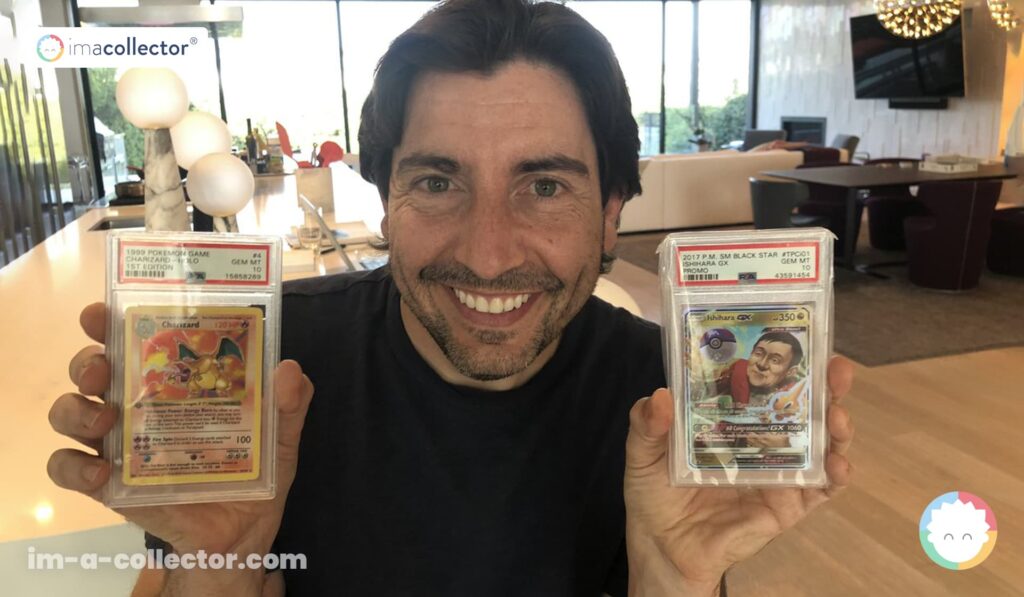
Jeremy Padawer is one of the visible figures around the launch of Collectible Eternity Labs. His background in toys, licensing and collectibles will be familiar to some. Personally, I had only seen his face in two or three stories. What I have not found is any stated experience in the conservation of animation materials.
Several collectors have also resurfaced an older video in which he still appeared to be having the difference between a genga and a douga explained to him just a few months before CEL launched.
CEL still does not clearly say who carries out its appraisals. If Jeremy Padawer is one of the experts, I personally question his credibility in that role.
As a Collector, I Want to Know Who Decides Whether a Rough Is Attributed to Miyazaki or Shingo Araki. For a Company Charging for Authentication, That Lack of Transparency Is Hard to Accept.
You do not build authority by blocking criticism
Since its launch, CEL has already prompted considerable concern among anime art collectors: grading unique objects, cel conservation, the team’s actual experience, and the arrival of TCG-style codes in this market.
Some reactions are aggressive. Others raise entirely legitimate questions. Yet several collectors say they were blocked on Instagram after criticizing the project or posting negative comments. If that is indeed the case, it is a very poor way to build trust.
CEL is entering a field where some people have been collecting, studying and preserving these pieces for twenty or thirty years. Conservators have spent years working on cel degradation. Auction houses, studios and Japanese specialists have their own archives and knowledge.
If the company wants to become a reference point, it will need to respond to serious criticism, publish its methods and accept disagreement.
Blocking people who ask questions does not strengthen its authority. It weakens its credibility.
Anime Art needs expertise far more than it needs another ranking system
I completely understand the value of a service capable of authenticating a piece. I even see the need for one. I worked on a similar project myself in 2020.
A good service could document an entire production process or explain precisely why a particular piece matters.
Collectible Eternity Labs has already begun building part of that tool through its database. It is probably the most interesting part of the project — but also the most complex.
At the same time, we have reached a point where we seem increasingly unable to accept that an experience, an object or a person might escape being rated. Restaurants, hotels, the cleanliness of toilets, drivers, sellers, even romantic relationships: everything has to be ranked, compared and reduced to a score. But an animation drawing does not need an A- to have value. More importantly, that letter tells me almost nothing about what actually interests me in the piece.
I have never looked at a Saint Seiya, Shaman King or Naruto drawing and wondered whether it deserved an A-, B+ or some other letter. I look at what it tells me: who drew it, how it was corrected, where it sits in the production process, and what it helps us understand about the final image.
That is the knowledge I refuse to see replaced by a letter designed to be understood in a second on Instagram, in an auction listing or on a product page.
If CEL manages to recover lost pieces, reconnect dispersed sheets and build a genuine archive of animation, I will consult that database with great interest and I will not have to build my own.
But if the main ambition is to turn unique drawings into standardized, encapsulated objects that are easier to sell, then CEL will not document animation history any better.
It will simply have succeeded in putting a grade on it and that will probably remain the least interesting piece of information about any work of anime art.
Sources
Collectible Eternity Labs, site officiel, consulté le 12 septembre 2026
Justia Trademarks, dépôt CEL — Collectible Eternity Labs LLC, 28 mai 2026 :
Association of Japanese Animations, avertissement concernant les ventes de cels et dessins d’animation par des tiers, 23 août 2021
JAMAC — Japan Anime and Manga Authentication Committee, site officiel
JAMAC, services et catégories d’expertise
JAMAC, règlement du comité
Sōmeidō Misakian, expertise de cellulos et recherche d’authenticité
Mandarake, Castle in the Sky, cut D1563 — genga Kazuyuki Kobayashi, rough de correction Hayao Miyazaki, correction Tsukasa Tannai
Mandarake, Castle in the Sky, cut D1557 — ensemble de dessins et timesheet
Heritage Auctions, Castle in the Sky Rough Animation Drawing Group of 8 Attributed to Hayao Miyazaki, vente à 24 000 dollars en octobre 2025.
M. T. Giachet et al., Assessment of the composition and condition of animation cels made from cellulose acetate, Polymer Degradation and Stability, 2014
Getty Conservation Institute / Disney Animation Research Library, travaux consacrés à la composition, au vieillissement et à la conservation des cellulos d’animation
Kristen McCormick et al., Animation Cels: Conservation and Storage Issues, Objects Specialty Group Postprints.
Katharina Hoeyng et al., travaux sur le rattachement des peintures de cellulos et leur conservation.
Canadian Conservation Institute, Encapsulation, CCI Notes 11/10
U.S. National Archives and Records Administration, principes de provenance et d’ordre original appliqués aux archives
CGC, CCG and CGC Comics Statement on Holder Tampering Incident, 2024
PSA, Cert Verification — Security: A Buyer’s Guide : https://www.psacard.com/cert
Michaël Dewally & Louis Ederington, Reputation, Certification, Warranties, and Information as Remedies for Seller-Buyer Information Asymmetries, Journal of Business, 2006
Animate Times, entretien avec Mitsutoshi Kubota de Shaft concernant notamment le nombre de dessins pouvant composer certains cuts