

From literature to animation, stories travel across cultures and take on new forms. Behind characters we’ve known for years, we sometimes find novels written more than a century ago, even older legends, or works that have been reinvented time and again. For the Art Animation VIII auction, a selection of original production materials (animation cels, douga, genga and more) offers a chance to trace these transformations and see the works we collect from a different perspective.
Table of contents
- When literary classics meet Japanese animation
- Adapting a story also means changing it
- From Maurice Leblanc to Lupin III: how an inspiration becomes a new world
- Moby-Dick: from a seafaring novel to science fiction
- Myths and Legends: stories that never stop changing
- From manga to screen: a new interpretation of the artwork
- When animation creates its own imaginary worlds
- Original Animation Art: a record of the journey between imaginary worlds
- Why collect images from these stories?
- A few lots worth exploring
Some classic series have a way of bringing back childhood memories. A familiar character can take us straight back to an opening theme or a scene we grew up with: Rémi travelling the roads of France with Vitalis, Tom Sawyer and Huckleberry Finn on the banks of the Mississippi, Sara Crewe at her London boarding school, or Willy Fog on his extraordinary journey around the world.
Long before they appeared on television, however, these characters had already lived on the pages of novels by Hector Malot, Mark Twain, Frances Hodgson Burnett and Jules Verne.
Their stories travelled across decades, and sometimes continents, before reaching the artists who gave them faces and voices. Some took on forms no one might have expected. That journey from one medium to another lies at the heart of the eighth Art Animation Auction, titled From One Imaginary World to Another: From Literature to Animation.
Beyond literary adaptations, the auction also invites us to look at myths, manga, comics and works conceived from the outset for television or cinema.
For collectors of original animation art, it also raises a particularly compelling question: what are we really preserving when we collect images from a story that existed long before those images were made?
When literary classics meet Japanese animation
During the 1970s and 1980s, Japanese studios frequently turned to Western literature for television series. World Masterpiece Theater (Sekai Meisaku Gekijō), developed in particular by Nippon Animation, remains one of the clearest examples of this approach.
Each year, viewers could discover a new adaptation of a major literary work, often written for younger readers. Anne of Green Gables, The Adventures of Tom Sawyer, The Swiss Family Robinson: Flone of the Mysterious Island and A Little Princess Sara all acquired a new visual identity through the work of Japanese studios and animators.
Turning a novel into a series of dozens of episodes means designing recognisable characters who can be animated consistently. Above all, it means inventing their gestures, expressions and the settings through which they move.
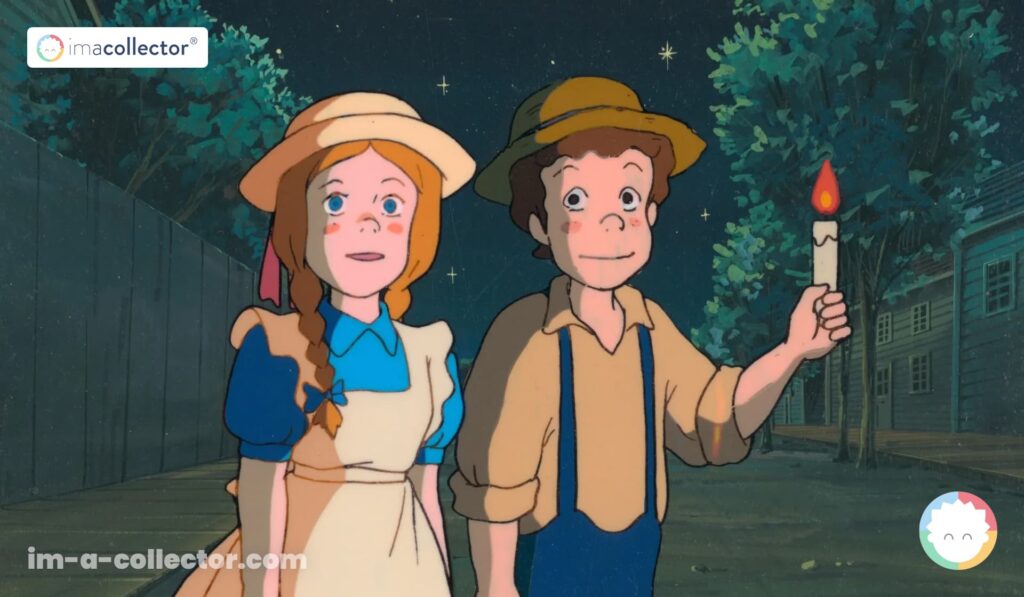
It is an enormous challenge: giving visible form to what readers were once free to imagine for themselves. Lots 16 to 21 from The Adventures of Tom Sawyer illustrate this transformation particularly well. They bring together genga (key animation drawings), correction sheets and cels used in Nippon Animation’s 1980 series. These pieces document a tangible stage in the journey from Mark Twain’s fictional world to animated images.
These documents therefore tell us more than the story of Tom Sawyer. They also show how Japanese artists interpreted a character who had first appeared in American literature more than a century earlier.
Adapting a story also means changing it
An adaptation does not necessarily remain faithful to its source. Studios have choices to make. They may alter a character’s personality, develop certain relationships or rearrange events to accommodate production constraints—or simply the screenwriters’ imagination.
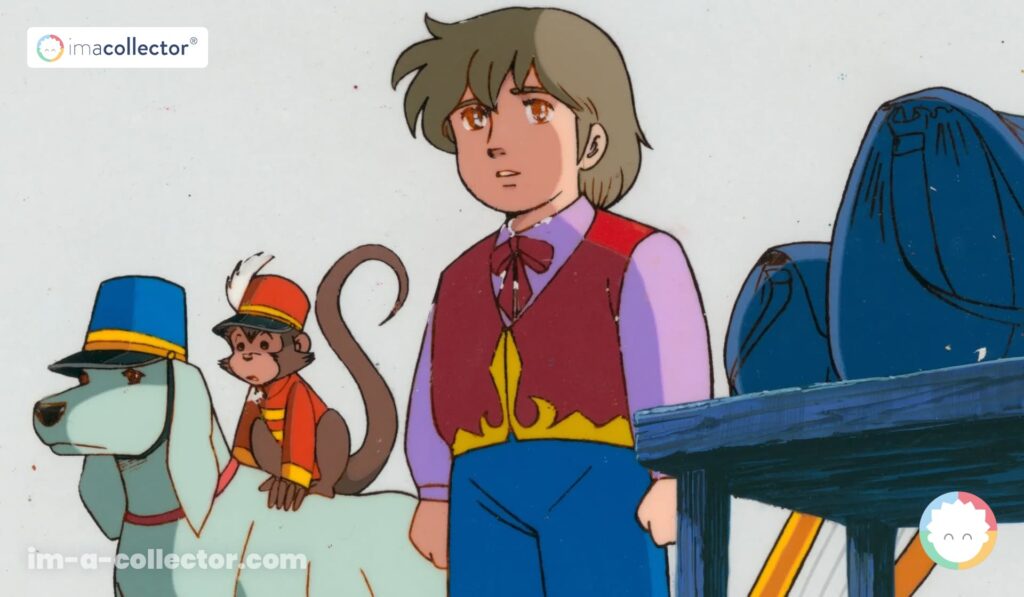
Hector Malot’s 1878 novel Sans famille is a striking example. In 1977, Tokyo Movie Shinsha produced Nobody’s Boy: Remi, directed by Osamu Dezaki. Accompanied by Vitalis and his animals, Rémi became one of the familiar faces of Japanese animation broadcast across Europe.
The auction includes several pieces from this production, among them a two-layer cel featuring Rémi, Capi and Joli-Cœur (lot 1), along with a group of dōga (in-between drawings) and layouts from episode 42 (lot 2).
Together, they let us see the same world from two different perspectives: the finished image painted on cel and the drawings involved in creating it.
Nearly twenty years later, Nippon Animation offered a new interpretation with Ie Naki Ko Remi (1996). This time, the protagonist was a girl, and several major elements of the story were substantially reworked. Lots 7 to 9 come from this later version.
A single auction therefore brings together two interpretations of the same literary work, produced in different periods by different studios.
A single work of literature can give rise to several visual worlds, each with its own history and style.
From Maurice Leblanc to Lupin III: how an inspiration becomes a new world
The relationship between literature and animation is not always one of faithful adaptation. Some works borrow a character, an idea or an archetype to create something entirely different.
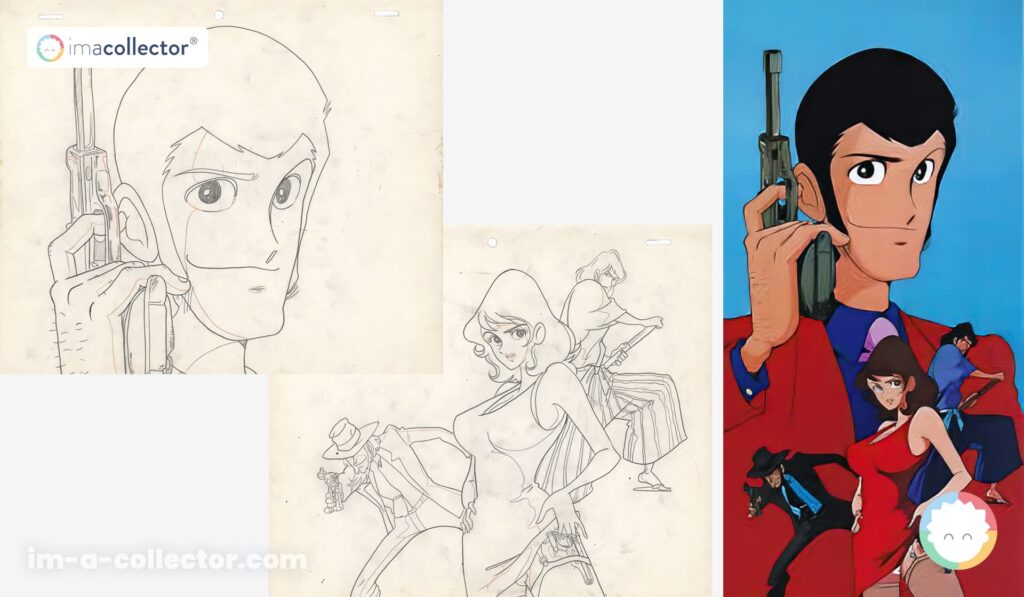
Lupin III is one such case. In 1905, Maurice Leblanc created Arsène Lupin, the gentleman thief who became one of the best-known figures in French detective fiction. In 1967, manga artist Monkey Punch introduced Lupin III as the famous thief’s grandson. Rather than retelling Leblanc’s adventures, the manga carried that character’s legacy into a new world, with its own humour, visual language and cast.
The manga went on to become a major Japanese animation franchise. Lots 55 and 56, featuring Fujiko and Lupin respectively, document another stage in that evolution. These are hanken genga: original drawings created for promotional purposes rather than to animate a scene. Initially associated with “Lupin the Third: Collect the Color Films”, a series of 24 designs distributed through dagashiya, Japan’s small traditional sweet shops, my research revealed that the drawings were ultimately used in the development of a promotional poster for the series.
Moby-Dick: from a seafaring novel to science fiction
In 1851, Herman Melville published Moby-Dick, the story of Captain Ahab and his obsessive pursuit of the white whale.
Almost 150 years later, director Osamu Dezaki reimagined the story in an unexpected and visually magnificent form with Hakugei: Legend of the Moby Dick (1997).
The story now unfolds in space rather than at sea. The whales have become enormous spacecraft, while Ahab remains consumed by his pursuit.
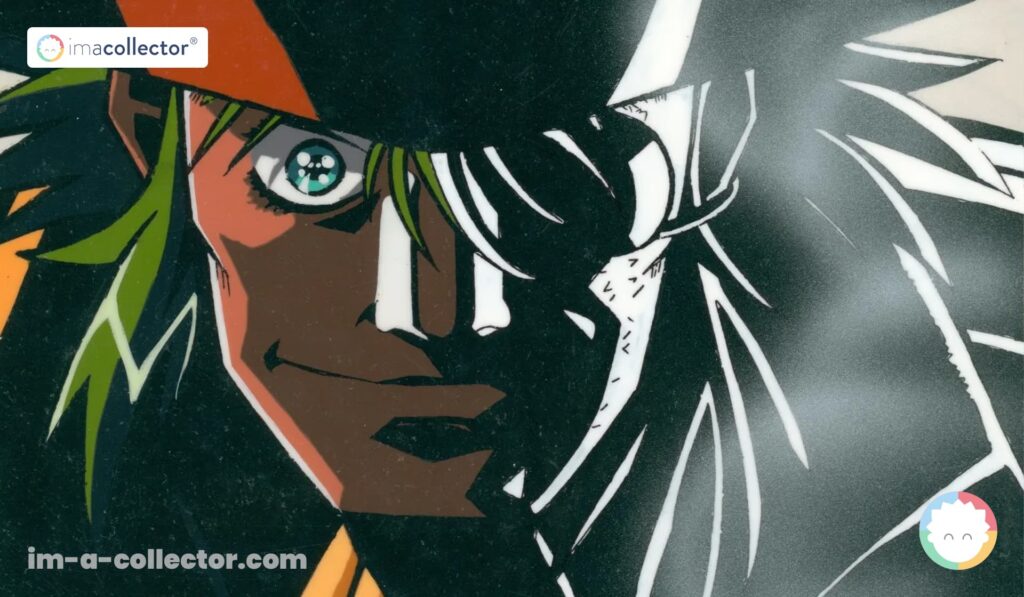
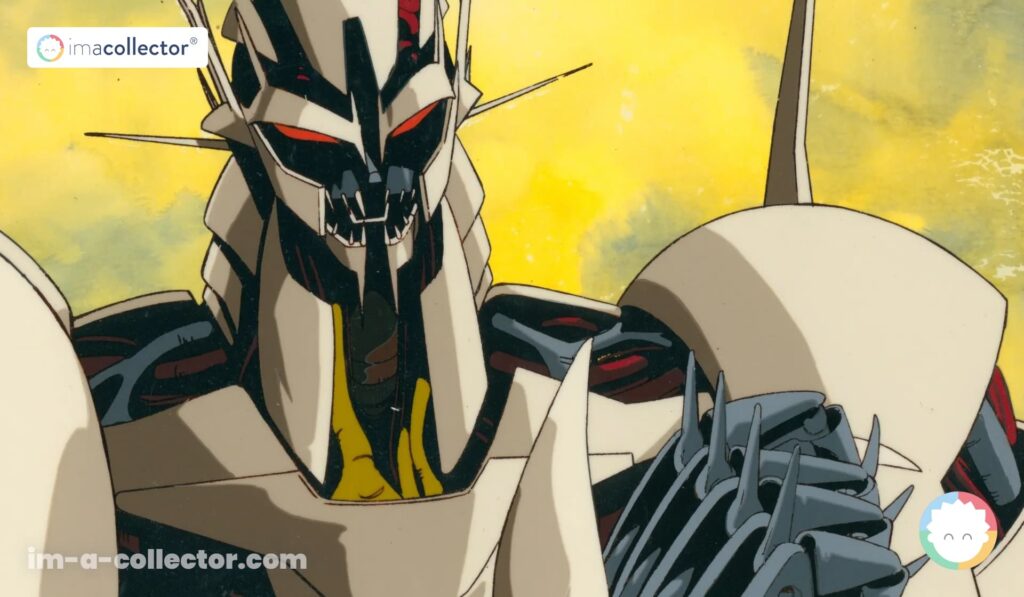
Lot 39 features a striking portrait of the captain, half his face swallowed by shadow. It is a panoramic cel made up of four hand-painted layers, accompanied by its original dōga drawings and an original background.
The almost theatrical composition reveals the full visual power of this adaptation. Looking at this white-haired figure with his piercing gaze, it is hard to imagine that his origins lie in a nineteenth-century American novel.
Yet that is precisely what makes this piece so interesting: it shows how a story almost 150 years old could become a radically different visual world while retaining the qualities that make its central character so compelling.
Myths and Legends: stories that never stop changing
Written literature is not the only source of inspiration for manga creators and animators. Mythology and legend offer a vast repertoire of characters, symbols and stories as well.
Saint Seiya is surely one of the best-known examples. Masami Kurumada drew on Greek mythology for the names of deities, the constellations and some of their symbolism, building a world of his own. Toei Animation’s adaptation, which began in 1986, gave those references another dimension through its visual identity, armour designs and fight sequences.
Lot 69, showing Capricorn Shura in his confrontation with Shiryu, captures this meeting of different traditions. Shura belongs to a universe inspired by Greek constellations and mythology, yet his technique, Excalibur, takes its name from Arthurian legend.
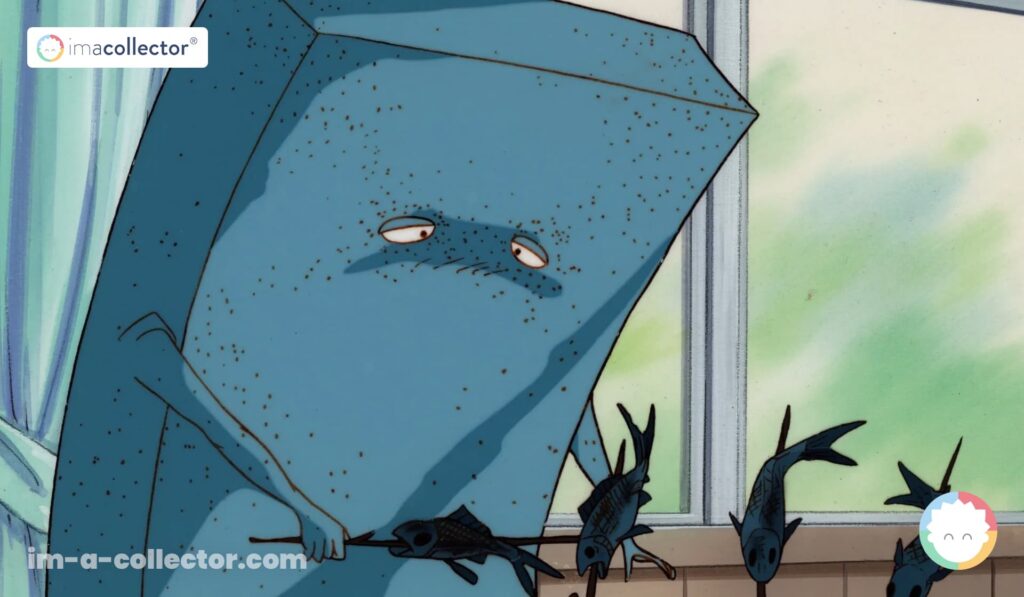
Japan also has its own storytelling traditions. Through GeGeGe no Kitarō, Shigeru Mizuki helped bring yōkai, the supernatural beings of Japanese folklore, to a wider audience by placing them in a manga world and, later, animation. Lot 66, a cel from the Toei Animation series produced between 1996 and 1998, is part of this long history of reinterpretation. Yōkai existed long before Mizuki, of course, but he gave them a new place in contemporary popular culture.
Collecting an original drawing of Kitarō therefore means more than owning an image from a manga or anime. It also means engaging with the ways a traditional imaginary world continues to be passed down and transformed.
From manga to screen: a new interpretation of the artwork
Adapting a comic or manga may seem more straightforward than adapting a novel. After all, the characters already have a distinct appearance and inhabit a visually established world.
Yet simply reproducing manga panels is never enough to make an animated film or series. Adaptation brings a new set of decisions: how should an action be broken down, a movement constructed, a change of camera angle handled, or an emotion expressed visually?
This auction offers several examples of that transformation, from Dragon Ball and Hunter × Hunter to Naruto, Bleach and City Hunter.
For characters such as Son Goku or Naruto, whose designs have changed across manga, television series and films, a dōga, a genga and an animation cel each tell a different story even when they depict the same character.
That is exactly what makes original production materials so rewarding to collect.
When animation creates its own imaginary worlds
Not every animated story begins as a novel, a legend or a comic. Some are created specifically for television or cinema.
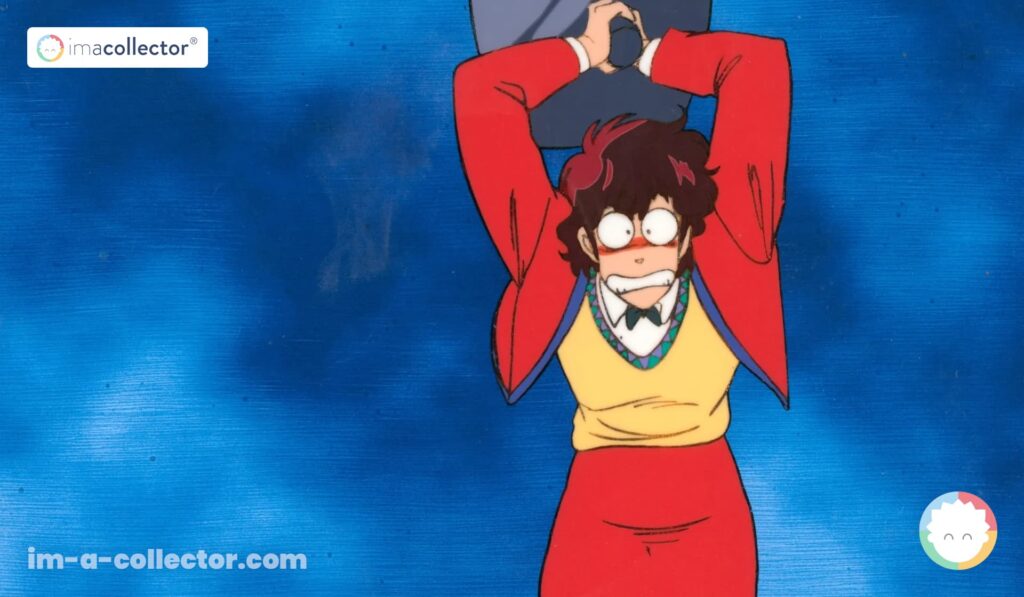
Cowboy Bebop, created at Sunrise, is one example. Lot 125 features a dōga drawing of Spike Spiegel from the first episode. The character, his mannerisms and the way he moves were all conceived for an audiovisual work. Another interesting example is Robot Carnival (1987), an anthology film made up of several animated shorts. Lots 202 and 203 come from Starlight Angel, the segment directed by Hiroyuki Kitazume.
These cels document a creative process different from that of a literary adaptation. Here, the making of the images is inseparable from the birth of the world and the story themselves.
Animation is no longer interpreting an existing work. It is the story’s first language.
Whether a story comes from a nineteenth-century novel or an original concept, it passes through stages of visual development before reaching the screen. In those stages, collectors can now recover part of its history.
Original Animation Art: a record of the journey between imaginary worlds
When we watch an animated episode or film, we see the result of a collaborative process, much of which remains invisible.
Layouts establish the composition of a shot; genga drawings define its key poses; dōga drawings help build the movement; and, in traditional cel animation, painted cels are the elements photographed to create the final images.
And, of course, each of these documents serves a very different purpose.
Lot 31 from A Little Princess Sara, for example, combines a five-layer animation cel with an original layout from episode 21. Viewed together, they help us understand how a shot was assembled through different stages of production.
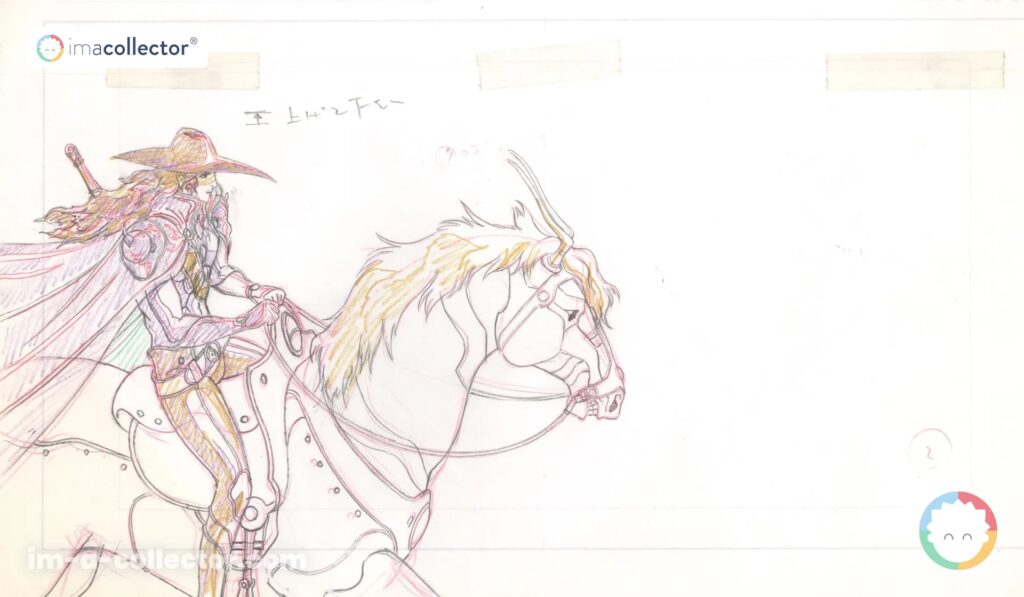
Conversely, a piece can be compelling for the sheer strength of its drawing. Lot 50 from Vampire Hunter D: Bloodlust, a genga depicting D on horseback, is a case in point. It preserves the energy of the linework, the construction marks and the distinctive look of a character born in Hideyuki Kikuchi’s novels, whose visual identity is closely associated with Yoshitaka Amano’s illustrations.
The piece becomes interesting on several levels: for the film it comes from, for the literary world to which it belongs, and for the quality of the drawing itself.
It also matters what accompanies the artwork: an original or printed background, whether it matches the scene, correction sheets, timesheets, annotations, condition and provenance. All of these details help us understand a piece and can also influence its value to a collection.
Why collect images from these stories?
You can love Nobody’s Boy: Remi without having read Hector Malot, know Lupin III without ever discovering Maurice Leblanc, or be devoted to Saint Seiya without having explored the foundational texts of Greek mythology. There is no contradiction in that. Stories change form, and each generation encounters them through the media it knows best. For some, Tom Sawyer will always be a character from a novel. For others, he will forever have the face he was given in Nippon Animation’s series. Both memories belong to the same cultural history. That is also what I value about collecting original animation art. We often begin by looking for a character, a scene or a series that left a lasting impression on us. But as we take a closer interest in production materials, we discover the artists, studios, influences and sometimes the original works behind those images. The drawing then becomes more than a souvenir. It connects different eras, different cultures and the people who helped bring these stories to life. A story can travel across centuries. An animation drawing lets us preserve one particular moment in that journey. And perhaps that is one of the most rewarding aspects of collecting anime art: keeping not only the images that stayed with us, but also the traces of the artistic work that brought them into being.
A few lots worth exploring
Lot 1 — Nobody’s Boy: Remi (家なき子)
Lot 21 — Tom Sawyer (トム・ソーヤーの冒険)
Lot 39 — Hakugei: Legend of the Moby Dick (白鯨伝説)
Lot 50 — Vampire Hunter D: Bloodlust (バンパイアハンターD)
Lot 55 — Lupin III – Monkey Punch
Lot 56 — Lupin III – Monkey Punch
Lot 66 — GeGeGe no Kitaro (ゲゲゲの鬼太郎)
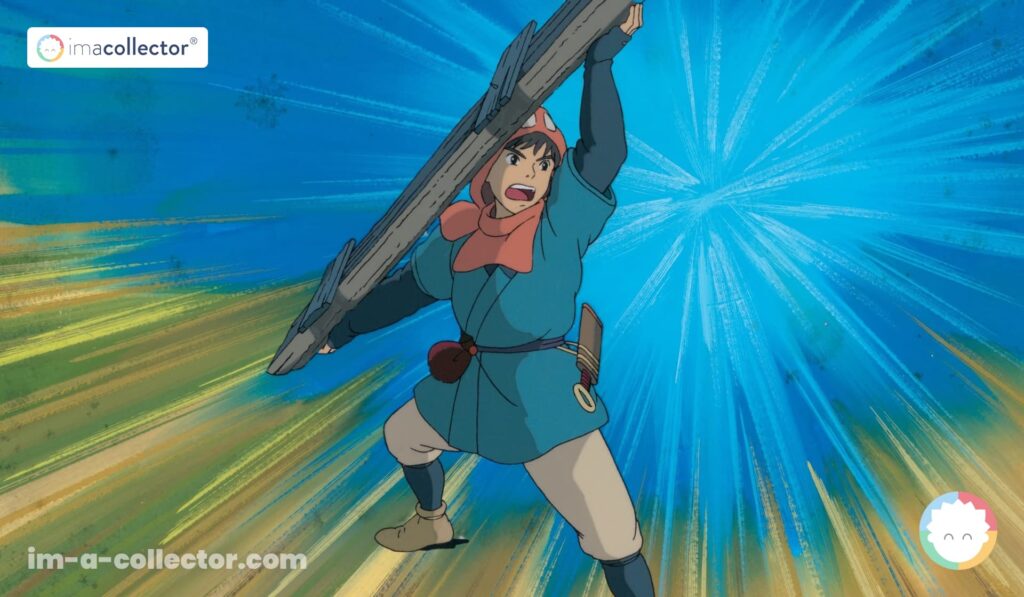
Lot 84 — Princesse Mononoke (もののけ姫)
Lot 172 — City Hunter (シティーハンター)
Lot 202 — Robot Carnival (ロボットカーニバル)
This article was produced as part of a paid partnership with Art Animation Auction for its Art Animation VIII sale, From One Imaginary World to Another: From Literature to Animation, held on November 29, 2026.
The selection of works and editorial analysis remain entirely those of imacollector®.